We research everything we recommend. When you buy through our links, we may earn a commission. As an Amazon Associate we earn from qualifying purchases.
Best Electrician Tool Belts for Pros and Apprentices
Looking for the best electrician tool belts? We compare five rigs for wiring, panels, and rough-in work, with fit, pocket layout, and comfort notes.
As an Amazon Associate I earn from qualifying purchases. This post may contain affiliate links at no extra cost to you.
⭐ Key Takeaways
Quick answer: Our top pick is Gatorback B240 Electrician's Combo, Medium — The Most Complete Pick, with CLC 1608 Electrician's Comfort Lift Combo — The Best Suspender Rig as a strong alternative.
An electrician’s tool belt is not a framer’s rig with a different label. The work is different: wire strippers, lineman’s pliers, a non-contact tester, a handful of wire nuts, a tape measure, and a drill that spends half the day in a holster and the other half on a joist. The belt has to hold slim tools upright so they can be drawn one-handed, keep fasteners from spilling when the wearer bends into a panel, and stay comfortable through a full day of standing, kneeling, and climbing. A rig built for nails and a hammer will carry an electrician’s tools, but the pockets will be the wrong shape, the hammer loop will sit in the wrong place, and the belt will fight the wearer by noon. This guide compares five electrician tool belts currently sold on Amazon on pocket layout, belt width and waist range, material and stitching, weight, suspenders and back support, and the holders that matter for electrical work, using each maker’s published specifications and the Amazon listing for each product.
The short answer is that the Gatorback B240 is the most complete pick here, a 27-pocket electrician’s combo on a ventilated back-support belt with memory foam, for buyers who want one rig that handles rough-in, trim, and service calls. The CLC 1608 answers with the best suspender rig at the budget tier, a 28-pocket Comfort Lift combo with padded suspenders and a built-in drill pocket, for buyers who want the load off their hips without spending more. The DEWALT DG5641 is the adjustable apron, a 20-pocket combo apron with padded suspenders, for buyers who want a full rig that adjusts to fit. The Klein 5225 is the base belt, a 2 inch wide polypropylene web belt that fits waists from 32 to 48 inches, for buyers who already own pouches and need a light belt to hang them from. The DEWALT leather belt is the leather pick, an 11-pocket nubuck top-grain leather belt with two steel hammer loops, for buyers who want leather that holds its shape. Every figure below comes from the maker’s published specifications and the Amazon listing for each product, and disagreements are flagged rather than smoothed over.
As an Amazon Associate, we earn from qualifying purchases.
Tier key: the Gatorback B240 sits in the premium tier of this group, the CLC 1608 and the DEWALT DG5641 sit in the mid-range, and the Klein 5225 and the DEWALT leather belt are the budget picks. Tier here describes where each rig sits in this lineup on material, pocket count, and included hardware, not a promise about what any seller charges on a given day.
An electrician carries more slim tools than any other trade, and the pocket layout has to match them. Screwdrivers, strippers, pliers, a tester, and a knife all need slots that hold them upright and handle-up, so the hand can draw one without looking and without pulling two more out with it. Wide nail pockets are the wrong shape for this work: a screwdriver laid flat in a wide pocket slides to the bottom and hides under the pliers, and a tester in a wide pocket rattles around and cracks its case. The Gatorback B240 carries 27 pockets across two pouches, with an 18-pocket tool pouch and a 9-pocket fastener pouch, which gives slim tools their own slots and fasteners their own home. The CLC 1608 carries 28 pockets across two side bags, with a zippered top flap pouch for small parts. The DEWALT DG5641 carries 20 pockets with sleeves for small tools and parts. The DEWALT leather belt carries 11 pockets, which is the smallest count here but enough for a service call. The Klein 5225 carries no pockets at all, because it is a base belt, and the buyer hangs pouches from it. Count the slots before the pockets, because a rig with 28 wide pockets and no slim slots is worse than a rig with 11 pockets shaped for the tools it holds.
Belt width, waist range, and measuring over clothes
The belt carries the load, and its width and fit range decide whether the rig rides comfortably or digs into the hips by noon. The Gatorback B240 in Medium fits waists from 31 to 35 inches, and the line runs from small to 3X-large, so a buyer outside the medium range should order the matching size rather than forcing the medium to fit. The CLC 1608 fits waists from 29 to 46 inches, the widest fixed range in this guide. The Klein 5225 fits waists from 32 to 48 inches on a 2 inch wide web belt. The DEWALT leather belt is adjustable, and the DEWALT DG5641 adjusts with padded suspenders. The rule every maker repeats is to measure the waist over clothes, because a belt sized to a bare waist will ride tight over a work shirt and a jacket, and a belt that is too tight will not hold its pouches in place. A buyer between sizes should size up for winter layers, because a belt at its last hole has no room to grow. Check the stated range for the exact size being ordered, because a rig sold in six sizes has six different ranges, and the medium range is not the rig’s range.
Material: ballistic nylon, polyester, leather, and webbing
Electrician tool belts come in four materials that matter for this guide, and the material decides how the rig ages and how it handles weather. Ballistic nylon is the toughest fabric here, woven tight enough to resist tears and scuffs, and the Gatorback B240 uses DuraTek nylon at 1250 denier, the heaviest fabric in this guide. Polyester is lighter and dries faster, and the CLC 1608 uses heavy-duty polyester with ballistic binding at the edges. Leather holds its shape under load, so a leather pouch stays open when the hand goes in for a wire nut, and the DEWALT leather belt uses nubuck top-grain leather with double stitching and reinforced rivets. Polypropylene webbing is the lightest material here and the simplest, and the Klein 5225 uses heavy-duty 2 inch wide polypropylene webbing with a rugged metal buckle. None of the four is a wrong choice: ballistic nylon is the toughest fabric, polyester is the lightest full rig, leather holds its shape the longest, and webbing is the lightest base belt. The practical rule is to check the material line for the pouches and for the belt separately, because a rig can pair leather pouches with a web belt or fabric pouches with a leather belt, and the listing should say so.
Suspenders and back support, and when they stop being optional
A loaded electrician’s belt is heavy before the drill goes in, and suspenders turn a hip load into a shoulder load. The CLC 1608 includes padded suspenders in the box, built on the maker’s Comfort Lift support system, which spreads the weight across the hips and shoulders. The DEWALT DG5641 includes adjustable padded suspenders, so the belt and the suspenders arrive as one rig. The Gatorback B240 takes a different approach, with a ventilated Pro-Comfort back-support belt filled with memory foam and air channels, which supports the lower back and lets air move behind the belt. The Klein 5225 and the DEWALT leather belt include no suspenders, because they are base belts, and the buyer adds suspenders when the load grows. Klein states plainly that its tool belts are not occupational protective belts and are not for fall arrest or back support, and the same warning applies to every rig in this guide: a tool belt holds tools, it does not protect the back, and a buyer with a bad back should treat suspenders as part of the setup rather than an accessory. A rig that loads one side only will pull the belt crooked and tire the lower back, which is why a buyer should spread the load across both pouches before tightening the belt.
Holders that matter for electrical work
Four holders separate an electrician’s rig from a general rig, and a buyer should check for each one before ordering. A tape measure holder or tape chain keeps the tape on the hip where the hand expects it, and the Gatorback B240, the CLC 1608, and the Klein 5225 family all provide one in some form. A hammer loop holds the hammer clear of the leg, and the DEWALT leather belt carries two steel hammer loops, one on each side, which is the most forgiving layout here. A drill pocket or drill holster holds a compact drill upright, and the CLC 1608 includes a built-in drill pocket, which is rare in this group. A lanyard clip and a tape chain keep small tools tethered, and the CLC 1608 provides both. A knife pocket keeps a blade sheathed and out of the way, and a cell phone holder keeps a phone off the ladder rung. Count the holders first, then the pockets, and check that the hammer loop sits on the side the hand expects.
Weight, and why the empty weight misleads
A tool belt’s empty weight matters less than its loaded weight, because the tools decide the day, but the empty weight still sets the floor. The Gatorback B240 weighs about 5 pounds empty, the heaviest rig in this guide, because the back-support belt and the two pouches are built heavy. The Klein 5225 weighs 0.6 pounds, the lightest pick here, because it is a bare web belt with no pouches. The DEWALT leather belt weighs 2.6 pounds. The CLC 1608 and the DEWALT DG5641 do not state a weight in the listing record, and the guide says so rather than guessing. The loaded weight matters more than the empty weight, because an electrician’s pouch holds pliers, strippers, screwdrivers, a tester, wire nuts, and a tape. A buyer who walks a rough-in all day will feel every extra pound of belt, and a buyer who works a service call with six tools will not. Suspenders are the honest answer when the load grows past what a belt can carry comfortably.
The 5 Best Electrician Tool Belts
1. Gatorback B240 Electrician’s Combo, Medium — The Most Complete Pick
Top Pick
1. Gatorback B240 Electrician’s Combo, Medium — The Most Complete Pick
Material: DuraTek nylon, 1250 denier
Configuration: 2-pouch combo on a ventilated back-support belt
Pockets: 27, including an 18-pocket tool pouch and a 9-pocket fastener pouch
Belt: Pro-Comfort ventilated back-support belt with memory foam and air channels
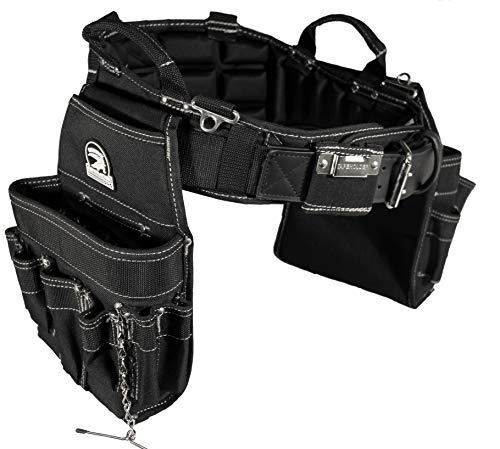
The Gatorback B240 is the most complete electrician’s rig in this guide, and the completeness comes from the combination, not from any single feature. It is a two-pouch combo on a ventilated Pro-Comfort back-support belt, with 27 pockets in all: an 18-pocket tool pouch and a 9-pocket fastener pouch. The tool pouch holds the slim tools upright, and the fastener pouch holds wire nuts, connectors, and screws where they can be reached without digging. A custom hammer holster and a tape clip sit on the rig, so the hammer and the tape each have a dedicated home. The belt is built from DuraTek nylon at 1250 denier, the heaviest fabric in this guide, with rivets and bar tacks at every stress point, which is the construction that keeps a loaded pouch from tearing at the seams. The back-support belt uses memory foam with air channels, which lets air move behind the belt on a hot day and spreads the load across the lower back.
The Medium size in this guide fits waists from 31 to 35 inches, and the line runs from small to 3X-large, so a buyer outside that range should order the matching size. The rig weighs about 5 pounds empty, which is the heaviest in this guide, and the weight is the honest trade for the back support and the pocket count. A buyer who wears it all day should plan on the suspenders the line offers as an add-on, because a 5 pound rig loaded with tools is a shoulder job, not a hip job. The pouches are removable, so the buyer can carry only the tools a job needs, and can leave the fastener pouch in the truck on a service call.
The B240 earns its place as the most complete pick because it does everything an electrician’s rig must do without demanding a second rig. The pocket count covers a full daily load, the fabric is the toughest in this guide, the back-support belt is the most supportive, and the pouches come off when the job is light. It is the heaviest rig here, it sits in the premium tier, and a buyer who wants the lightest rig or the lowest tier should look at the Klein 5225 or the CLC 1608. A buyer who wants one electrician’s rig that handles rough-in, trim, and service calls should start here.
2. CLC 1608 Electrician’s Comfort Lift Combo — The Best Suspender Rig
Runner-Up
2. CLC 1608 Electrician’s Comfort Lift Combo — The Best Suspender Rig
Material: Heavy-duty polyester with ballistic binding
Configuration: 2 side bags with padded suspenders included
The CLC 1608 is the suspender rig in this guide, and the suspenders are the reason to buy it. It is a 28-pocket combo built on the maker’s Comfort Lift support system, with padded suspenders included in the box that spread the load across the hips and shoulders. The rig carries two side bags with a zippered top flap pouch for small parts, a built-in drill pocket for a compact drill, a carry handle for off-the-belt carry, and a tape chain with a lanyard clip. The belt is 3 inches wide and padded, which spreads the load across the hips before the suspenders take over. The material is heavy-duty polyester with ballistic binding at the edges, and the bottoms are double layered, which is where a pouch wears first when it is set down on concrete all day. The waist range is 29 to 46 inches, the widest fixed range in this guide, which covers more buyers than any other full rig here.
The pocket count deserves a careful read. The listing counts 28 pockets, and some guides count 29 when sleeves are included, so the guide uses the listing figure of 28. The layout leans toward electricians, with slots for pliers, testers, and fasteners, but general DIYers use it too, which says the layout is forgiving rather than narrow. The weight is not stated in the listing record, and the guide says so rather than guessing. The suspenders are the honest answer for a heavy rig, and they arrive in the box rather than as an add-on, which is the difference between this rig and the Gatorback above.
The 1608 earns its place as the best suspender rig because it gives a buyer padded suspenders, a drill pocket, and 28 pockets at the budget tier, with the widest waist range of any full rig here. It is not ballistic nylon, it is not leather, and its weight is not stated, so a buyer who wants the toughest fabric or the lightest rig should look at the Gatorback or the Klein 5225. A buyer who wants the load off the hips, who carries a compact drill, or who wants a full rig without spending more should start here.
3. DEWALT DG5641 Combo Apron with Suspenders — The Best Adjustable Apron
3. DEWALT DG5641 Combo Apron with Suspenders — The Best Adjustable Apron
Material: Not stated in the listing record
Configuration: Combo apron with adjustable padded suspenders
Pockets: 20, with sleeves for small tools and parts
The DEWALT DG5641 is the adjustable apron in this guide, and the adjustability is the point. It is a 20-pocket combo apron with adjustable padded suspenders, so the belt and the suspenders arrive as one rig and adjust together. The pocket layout carries 20 pockets with sleeves for small tools, nails, pencils, and parts, which is enough for a day of wiring and trim without the bulk of the 27 and 28 pocket rigs above. The suspenders are padded and adjustable, which lifts the load off the hips and onto the shoulders, and the belt adjusts to fit the wearer over work clothes. The apron format puts the tools in front where the hands expect them, which suits panel work and rough-in, where the wearer faces the work and reaches down rather than around.
One small caution belongs in the open. The hammer loop on this apron runs small, which makes it slow to slide a hammer in and out, so a buyer who draws a hammer all day should check the loop before the first day on the job. The guide notes the point rather than hiding it, because a hammer loop that fights the hand is a daily annoyance. The material and weight are not stated in the listing record, and the guide says so rather than guessing. The DG5641 is a different rig from the DEWALT framer’s combo apron that shares the maker’s naming, so a buyer should match the model on the listing, not the brand alone.
The DG5641 earns its place as the best adjustable apron because it gives a buyer a full 20-pocket rig with suspenders that adjust as one unit, at the mid-range tier. It is not the most pockets here, its hammer loop runs small, and its material and weight are not stated, so a buyer who wants the most pockets or a leather rig should look at the Gatorback or the DEWALT leather belt. A buyer who wants a full apron that adjusts to fit, with suspenders in the box, should start here.
4. Klein 5225 Adjustable Electrician Tool Belt — The Best Base Belt
4. Klein 5225 Adjustable Electrician Tool Belt — The Best Base Belt
Material: Heavy-duty polypropylene webbing, brown
Configuration: Base belt only, no pouches included
Pockets: None, pouches hang from the belt
Belt: 2 in wide web belt, rugged metal buckle, quick release
The Klein 5225 is the only pick in this guide that is a belt and nothing else, and that is exactly why it is here. It is a 2 inch wide belt in heavy-duty polypropylene webbing, with a rugged metal buckle for quick release and easy adjustment, and it fits waists from 32 to 48 inches. It carries no pockets of its own. The buyer hangs pouches from it, and the belt is built for that job: it accommodates tunnel-loop and slotted tool pouches and holders, and the hardware resists corrosion. Klein is a pro electrician brand, and the belt is built to the same standard as the pouches it is meant to carry, which means the webbing is heavy, the buckle holds, and the belt does not stretch under a loaded pouch. A buyer who already owns Klein pouches, or any pouches that hang from a belt, can set the layout exactly as the work demands, and can swap pouches between jobs without buying a new rig.
The waist range is the reason to pick this belt: 32 to 48 inches on a single belt, which covers more waists than any other base belt here, and the adjustment is a slide rather than a set of holes, so the fit is continuous. The belt weighs 0.6 pounds, the lightest pick in this guide by a wide margin, which is the whole point of a web belt: it adds almost nothing to the load. The 2 inch width is narrower than the 3 inch padded belts on the full rigs, so a heavy pouch will dig in sooner, and a buyer who loads this belt with two full pouches should plan on suspenders. Check that the pouches hang from tunnel loops or slots that match the belt width, because a pouch built for a wider belt will not sit right on a 2 inch belt. The belt is brown, and it is made in the USA of global components.
The 5225 earns its place as the best base belt because it does one job well: it holds pouches on a wide range of waists without stretching, sagging, or slipping, and it weighs almost nothing. It is not a complete rig, it is not the widest belt here, and it carries no pockets of its own, so a buyer who wants a ready-to-wear rig should look at the aprons and combos above. A buyer who owns pouches, who wants the lightest possible belt, or who wants to build a rig pouch by pouch should start here.
5. DEWALT 11-Pocket Leather Tool Belt — The Best Leather Belt
5. DEWALT 11-Pocket Leather Tool Belt — The Best Leather Belt
Material: Nubuck top-grain leather, brown
Configuration: Leather tool belt with fixed pockets
Pockets: 11 by the listing title, one specification field lists 18
Belt: Leather belt with double stitching and reinforced rivets
The DEWALT leather belt is the leather pick in this guide, and the leather is the reason to buy it. It is an 11-pocket belt in nubuck top-grain leather, with double stitching and reinforced rivets, built for jobsite wear. Leather holds its shape under load, so a leather pouch stays open when the hand goes in for a wire nut and keeps its shape after years of use, and this belt is the only pick here that gives an electrician that rigidity across the whole rig. Two steel hammer loops sit on the belt, one on each side, so the hammer can ride on either hip, which is the most forgiving layout in this guide for a left-handed buyer. The belt weighs 2.6 pounds, which is heavier than the web belts and lighter than the full suspender rigs, and the weight is the honest trade for leather that holds its shape.
One disagreement in the sources deserves a note. The listing title counts 11 pockets, while one specification field counts 18, and the guide uses the title figure of 11, because the title is the listing’s own headline and the field is an outlier. A buyer should count the pockets on the listing photos before ordering, because a rig with 11 pockets and a rig with 18 pockets are different rigs. The waist range is not stated in the listing record, and the guide says so rather than guessing. The belt is brown, the leather is nubuck top grain, and the stitching is double with rivet reinforcement at the seams.
The DEWALT leather belt earns its place as the best leather belt because it gives a buyer a real leather rig, with pockets that hold their shape and hammer loops on both sides, at the budget tier. It is not a two-pouch combo, it is not built for wet work, and its pocket count is disputed in the listing, so a buyer who wants the most pockets or a suspender rig should look at the Gatorback or the CLC 1608. A buyer who wants leather, who is left-handed, or who wants the hammer to ride on either hip should start here.
Mistakes to Avoid With an Electrician Tool Belt
The first mistake is buying by the waist size on a pair of trousers. A tool belt rides over a work shirt and often over a jacket, and a belt sized to a bare waist will ride tight, slip down, and pull the pouches out of reach. Measure the waist over clothes at the hip where the belt will ride, and match the measurement to the stated range for the exact size being ordered, not to a trouser size. A buyer between sizes should size up when the work means winter layers, and a buyer at the top of a range should check the next size before ordering. The Gatorback B240 is sold in sizes from small to 3X-large, and the medium range is not the rig’s range.
The second mistake is buying a rig by pocket count alone. A rig with 28 wide pockets and no slim slots is worse than a rig with 11 pockets shaped for screwdrivers, strippers, and a tester. Count the slots first, then the pockets, and check that the hammer loop sits on the side the hand expects and that the tape holder is where the hand reaches without looking. A tester in a wide pocket rattles around and cracks its case, and a screwdriver laid flat in a wide pocket slides to the bottom and hides under the pliers.
The third mistake is assuming that every rig with the word leather in its name is all leather. Some rigs are ballistic fabric with leather trim, and some aprons pair a fabric body with a web belt, and both are fair designs when the listing says so. The Gatorback B240 uses nylon with leather ends on the belt, and the guide says so in the Specs block, because a buyer who expects an all-leather rig and gets a nylon rig has a fair complaint. Read the material line for the belt as well as for the pouches.
The fourth mistake is loading one side only. A single-side apron with a full set of tools pulls the belt crooked and tires the lower back, and a two-pouch combo loaded on one side does the same. Spread the load across both pouches before tightening the belt, keep the heaviest tools near the center, and use suspenders when the load grows. A drill in a holster on one hip and nothing on the other is the fastest way to end a day with a sore back.
The fifth mistake is hanging a full-size drill from a nail pocket or a hammer loop. None of the five picks in this guide is sold as a drill holster except the CLC 1608, which includes a built-in drill pocket, and even that pocket is built for a compact drill. A full-size drill belongs in a tool bag or on a hook until it is needed. A hammer loop holds a hammer, a tape holder holds a tape, and a drill pocket holds a compact drill, and asking any of them to hold more than they were built for is asking for a dropped tool.
The sixth mistake is skipping the first inspection. A new rig feels stiff, and the stitching, rivets, and buckle should be checked before the first day on the job, not after the first failure. Flex the pouches, work the buckle, pull the hammer loop, and look at every seam, because a buckle that slips is easier to catch at the bench than on a ladder.
Care, Setup, and Safety Checks
Set the rig up before the first day on the job. Arrange the pouches until the load sits level, set the hammer loop on the dominant side, and tighten the belt over the clothes that will be worn on the job. Load the slim slots with screwdrivers and strippers, the wide pockets with pliers and a tester, and the holders with the tape and the hammer, then walk, bend, and reach before deciding the layout is right, because a rig that feels fine standing still can pull badly when the wearer bends into a panel. Keep blades sheathed and knives in a pocket built for them, keep the belt snug so it does not ride down and catch on a ladder rung, and do not overload one side, because a lopsided load strains the lower back and throws the wearer off balance.
Fabric rigs need little care and reward it. Brush dust off the pouches at the end of the day, keep the rig dry, and let it dry at room temperature if it gets wet. Leather needs a little more: wipe dust off at the end of the day, keep it dry, and condition the leather a few times a year with a leather conditioner, worked in lightly and wiped off, which keeps the hide supple and slows scuffing. Store the rig flat or hung, not folded, because a folded pouch creases and a creased pouch stays creased. Replace the rig when the stitching fails at a load-bearing seam, when a rivet pulls through, or when the buckle slips under load, because a rig that fails on a ladder is a hazard, not an inconvenience.
Safety on an electrician tool belt starts with what the belt is not. Klein states plainly that its tool belts are not occupational protective belts and are not for fall arrest or back support, and the same warning applies to every rig in this guide. A tool belt holds tools. It does not protect the back, it does not arrest a fall, and it does not replace a harness. A buyer working at height should use rated fall protection, not a tool belt, and a buyer with a bad back should treat suspenders as part of the setup rather than an accessory. Check the rivets and stitching every few months, and check the buckle every time the belt goes on, because hardware wears slowly and then fails all at once.
On recalls, no CPSC recall covers electrician tool belts as a class, and no recall covers any of the five picks in this guide. One recent action deserves a precise note, because it names a maker that appears in this guide. The CPSC action numbered 27-090, dated November 19, 2026, covers about 229,430 units from the Hultafors Group, and it names the CLC Lighted Portfolio model L217 and certain Johnson Level tools that use button cells. That action covers lighted portfolios and measuring tools only, so the CLC 1608 combo rig is not covered. Two other records are worth scoping out: a March 2020 action on Grizzly children’s toy tool kits covers lead in toy goggles and a toy hard hat, which are children’s toys, and a 2024 action on Leatherman Charge Plus and TTi multi-tools covers a blade defect in multi-tools, not belts. A 2013 UK action on ASOS fashion belts covers fashion belts, not work tool belts. None of those records touches the five picks here.
Frequently Asked Questions
What makes a tool belt an electrician’s tool belt?
An electrician’s tool belt is built around slim tools: screwdrivers, strippers, pliers, a tester, and a knife, with slots that hold them upright and handle-up so the hand can draw one without looking. It also carries holders that matter for electrical work, such as a tape measure holder, a hammer loop, a drill pocket, and a lanyard clip. A framer’s rig carries wide nail pockets and a hammer loop, while an electrician’s rig carries slim slots and a tester pocket, and the layout is the difference.
How do I measure my waist for an electrician tool belt?
Measure the waist over the clothes that will be worn on the job, at the hip where the belt will ride, with a tape held snug but not tight. Match the measurement to the stated range for the exact size being ordered, not to a trouser size. The ranges in this guide are 31 to 35 inches for the Gatorback B240 in Medium, 29 to 46 inches for the CLC 1608, and 32 to 48 inches for the Klein 5225. A buyer between sizes should size up when the work means winter layers, and a buyer at the top of a range should check the next size before ordering.
Can an electrician tool belt hold a drill?
A nail pocket is not a drill holster, and only one pick in this guide, the CLC 1608, includes a built-in drill pocket, which is built for a compact drill. A full-size drill belongs in a tool bag or on a hook until it is needed. The hammer loop holds a hammer, the tape holder holds a tape, and the nail pockets hold fasteners, and asking any of them to hold a drill is asking for a dropped tool. A buyer who carries a drill all day should add a dedicated drill holster pouch to a base belt like the Klein 5225, or carry the drill in a tool bag.
Do I need suspenders with an electrician tool belt?
Suspenders turn a hip load into a shoulder load, and they stop being optional when the rig is heavy or the day is long. The CLC 1608 and the DEWALT DG5641 include padded suspenders in the box, the Gatorback B240 offers them as an add-on, and the Klein 5225 and the DEWALT leather belt take suspenders when the buyer adds them. A rig that loads one side only will pull the belt crooked and tire the lower back, so spread the load across both pouches first, then add suspenders when the load grows past what a belt can carry comfortably.
Conclusion
The right electrician tool belt is the one whose pocket layout holds the slim tools the buyer reaches for all day, whose belt fits the waist measured over clothes, whose material matches the work, and whose suspenders or back support carry the load when the day gets long. The Gatorback B240 is the most complete pick, a 27-pocket combo on a ventilated back-support belt, for buyers who want one rig that handles rough-in, trim, and service calls. The CLC 1608 is the suspender rig, a 28-pocket Comfort Lift combo with padded suspenders and a drill pocket, for buyers who want the load off their hips at the budget tier. The DEWALT DG5641 is the adjustable apron, a 20-pocket combo apron with padded suspenders, for buyers who want a full rig that adjusts to fit. The Klein 5225 is the base belt, a light 2 inch web belt that fits waists from 32 to 48 inches, for buyers who own pouches and need a belt to hang them from. The DEWALT leather belt is the leather pick, an 11-pocket nubuck top-grain belt with hammer loops on both sides, for buyers who want leather that holds its shape. Whichever rig you choose, measure over clothes, check the live offer and the exact size before ordering, set the layout before the first day on the job, and keep the load balanced across both hips. An electrician’s tool belt rewards setup more reliably than any other piece of gear on the hip.
M
Miller the Driller Editorial Team
We compare specs, warranty terms, long-term owner feedback and street pricing before anything earns a spot. Rankings are never paid.
Affiliate disclosure. As an Amazon Associate we earn from qualifying purchases at no extra cost to you. Prices accurate as of the date shown.
Three wireless routers for small offices compared on device capacity, network separation, wired speed, and coverage, with specs taken from their Amazon listings.
Compare 5 mechanic tool sets for car repairs: a 247-piece DEWALT kit, a 450-piece CRAFTSMAN set, a drawer-box GEARWRENCH set, a 170-piece Crescent set and a 450-piece WORKPRO set.
Four splitting axes and mauls that actually split firewood: a long 36-inch axe for tall users, a shorter 28-inch option, and two 8 lb mauls for knotty rounds.
Learn whether a 20V rechargeable drill battery can be repaired, which faults you can check safely at home, and when replacing the pack is the safer choice.
A specs-based review of the officially licensed Retro-Bit Sega Saturn 2.4 GHz wireless controller: dual receivers, Genesis Mini and Switch support, battery, layout, limits, and FAQs.
Find the best drill battery for Power Wheels ride-on toys for families, with DeWalt, Milwaukee and Ryobi adapters, voltage and safety guidance in this guide.
Find the best hole saw for noching dom pipe: bi-metal saws, deep cups, and the right sizes for clean, tight notches in DOM tube for fabrication shops today.
Find the best diy tile saws for home tiling projects. Compare wet tile saws by blade size, cutting capacity, and features for ceramic and porcelain tile.



 4. Klein 5225 Adjustable Electrician Tool Belt — The Best Base Belt
 5. DEWALT 11-Pocket Leather Tool Belt — The Best Leather Belt









