What's inside
- Quick picks by fishing situation
- How rod length changes performance
- Power is the rod’s lifting range
- Action controls sensitivity and hook-setting speed
- Construction: graphite, fiberglass, and composites
- Line and lure ratings prevent mismatches
- Choose by your actual fishing pattern
- Maintenance that extends rod life
- Bottom line
- Quick picks by fishing situation
- How rod length changes performance
- Power is the rod’s lifting range
- Action controls sensitivity and hook-setting speed
- Construction: graphite, fiberglass, and composites
- Line and lure ratings prevent mismatches
- Choose by your actual fishing pattern
- Maintenance that extends rod life
- Bottom line
As an Amazon Associate I earn from qualifying purchases. This post may contain affiliate links at no extra cost to you.
The best fishing rods are matched to the species, lure or bait, line strength, and water you fish most often—not simply the most expensive or strongest model.
What we cover
- Quick picks by fishing situation
- How rod length changes performance
- Power is the rod’s lifting range
- Action controls sensitivity and hook-setting speed
- Construction: graphite, fiberglass, and composites
- Line and lure ratings prevent mismatches
- Choose by your actual fishing pattern
- Maintenance that extends rod life
- Bottom line
Our Top Picks
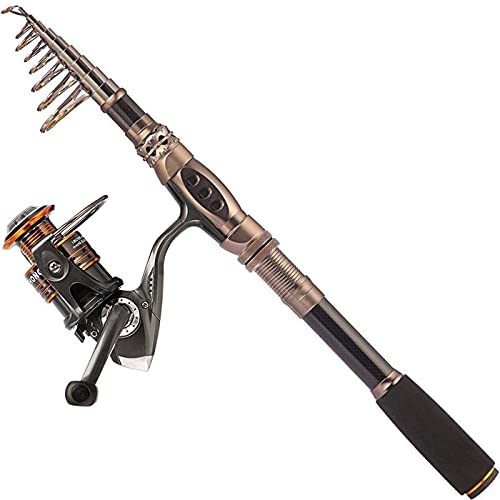
 Ugly Stik 7’ Complete Saltwater Kit Fishing Rod7' - Medium Heavy - 3pc34.5 x 6.5 x 4.5 inches2.1 PoundsCheck on Amazon


Quick picks by fishing situation
| Fishing situation | Recommended rod | Useful specifications | Why it works |
|---|---|---|---|
| Small streams and panfish | Ultralight spinning rod | 5’6″–6’6″, ultralight power, fast action, 1/32–1/8 oz lure rating | Accurate with tiny lures and makes small fish feel lively |
| General freshwater bass | Medium-heavy spinning or casting rod | 6’10″–7’3″, medium-heavy power, fast action, 10–17 lb line | Balances casting distance, hook-setting power, and cover control |
| Walleye, trout, and finesse presentations | Medium-light spinning rod | 6’6″–7’2″, medium-light power, fast action, 4–10 lb line | Loads well with light jigs and protects thin line |
| Catfish and heavy freshwater rigs | Medium-heavy or heavy spinning/casting rod | 7’–8’6″, moderate-fast action, 20–40 lb line, 1–6 oz sinker rating | Handles large baits, sinkers, and powerful runs |
| Inshore saltwater flats and estuaries | Medium-heavy spinning rod | 7’–7’6″, fast action, 10–20 lb braided line, corrosion-resistant guides | Provides casting distance while controlling redfish, snook, and similar fish |
| Surf fishing | Long surf spinning rod | 9’–12′, medium-heavy to heavy power, 20–40 lb line, 2–6 oz sinker rating | Improves casting range and keeps line above breaking waves |
| Offshore boat fishing | Short conventional or spinning boat rod | 5’6″–7′, heavy power, 30–80 lb line depending on species | Short leverage-focused blanks are easier to manage from a boat |
How rod length changes performance
Length affects casting distance, accuracy, leverage, and comfort. A short rod is easier to control around overhanging branches, docks, and tight banks. A 5’6″ to 6’6″ rod is often ideal for small streams, kayak fishing, and children learning basic casting.
As an Amazon Associate we earn from qualifying purchases at no extra cost to you.


Longer rods load more deeply during a cast and can send a lure farther, especially when paired with light or aerodynamic tackle. They also help steer fish around vegetation and keep line off the water during techniques such as float fishing. The trade-off is reduced maneuverability and more fatigue. A 7′ rod is a versatile freshwater length; rods from 7’6″ to 12′ are more specialized for surf, float, or long-distance casting.
Consider transport before buying. A two-piece rod is more convenient for a car or apartment, while a one-piece rod can offer a continuous blank and slightly better sensitivity. The practical difference is usually smaller than the effect of correct power and action.
Power is the rod’s lifting range
Power describes how much force is needed to bend the blank: ultralight, light, medium-light, medium, medium-heavy, and heavy are the common categories. It is not the same as action. Power should match the fish’s size, cover, lure weight, and line strength.
- Ultralight and light: best for panfish, small trout, crappie, and tiny lures. These rods cast light tackle efficiently but can be overwhelmed by heavy cover or large fish.
- Medium-light: a strong choice for finesse bass, walleye, perch, and trout with small jigs or live bait.
- Medium: the most adaptable choice for general freshwater fishing, including bass, small catfish, pike with appropriate leaders, and larger trout.
- Medium-heavy: suited to bass in weeds, frogs, jigs, larger spinnerbaits, inshore saltwater, and moderate catfish.
- Heavy: intended for thick vegetation, large swimbaits, heavy sinkers, surf rigs, and powerful saltwater species.
Do not select a heavy rod merely to prevent breakage. An oversized rod may not load properly with a light lure, reducing casting distance and bite detection. Conversely, an ultralight rod used with a heavy sinker can be overloaded during the cast.
Action controls sensitivity and hook-setting speed
Action indicates where the rod bends. A fast-action rod bends mostly in the upper third, while a moderate or slow-action rod bends farther down the blank.
- Fast action: transmits subtle taps well and drives hooks quickly. Choose it for jigs, soft plastics, Texas rigs, and single-hook lures, particularly when fish are near cover.
- Moderate-fast action: a versatile compromise for crankbaits, spinnerbaits, live bait, and general-purpose fishing.
- Moderate or slow action: keeps pressure on fish during the fight and allows treble-hook lures to stay pinned. It is also forgiving for beginners and light line.
A fast rod is not automatically more sensitive than every moderate rod. Blank material, guide layout, handle design, reel balance, and line type all contribute. Braided line has little stretch and can make a moderate rod feel responsive, while monofilament adds stretch that helps prevent pulled hooks.
Construction: graphite, fiberglass, and composites
Graphite blanks are light and sensitive, making them a popular choice for finesse techniques and long days of casting. Higher-modulus graphite can be particularly crisp, but it may be less tolerant of sharp impacts, high-sticking, or being bent at an extreme angle.
Fiberglass is heavier and generally slower, but it bends deeply and absorbs sudden surges. That makes it useful for crankbaits, live bait, trolling, and anglers who want a forgiving fish-fighting tool. Composite blanks combine graphite and fiberglass to balance sensitivity with durability.
For saltwater, the blank is only part of the construction. Look for corrosion-resistant guides, a sealed or protected reel seat, durable thread finish, and a handle that will not absorb excessive water. “Saltwater ready” does not mean maintenance-free: salt crystals can damage guide inserts, reel seats, and connections if left in place.
Line and lure ratings prevent mismatches
The label on a rod commonly lists a line range and lure-weight range. Treat these as working guidelines rather than targets that must always be reached. A rod marked for 8–17 lb line and 3/8–1 oz lures is a sensible range for many bass applications. A 1/16 oz lure will not load it as effectively as a medium-light rod, while a 1.5 oz lure may overstress it during a hard cast.
For braided line, use the rod’s line rating as a guide to the braid’s actual breaking strength and the leader’s strength. Braid has a small diameter for its strength, so a 20 lb braid may be physically thinner than 20 lb monofilament. Drag setting, knots, abrasion, and cover matter as much as the printed number.
Choose by your actual fishing pattern
| Your situation | Best starting choice | Reasonable budget range in 2026 |
|---|---|---|
| Occasional bank fishing with one outfit | 6’10″–7′ medium spinning rod, moderate-fast action | $40–$100 |
| Frequent bass or multi-species fishing | 7’–7’3″ medium or medium-heavy rod, fast action | $100–$250 |
| Small vehicle or limited storage | Two-piece 6’6″–7′ rod with a protective sleeve | $50–$160 |
| Regular surf fishing | 10’–11′ medium-heavy surf rod, 3–6 oz rating | $80–$250 |
| Heavy offshore or large catfish use | 6’–7′ heavy rod matched to reel and 30–80 lb line | $120–$350+ |
Maintenance that extends rod life
Rinse saltwater equipment with low-pressure fresh water after every trip. Do not use a high-pressure jet, which can drive salt and grit into guide frames and reel seats. Wipe the rod dry, loosen the drag on the reel, and let the rod dry completely before storing it in a case.
- Inspect guide inserts for cracks by running a cotton swab around each ring; loose fibers indicate damage.
- Check ferrules on two-piece rods for sand and grit before assembly.
- Store rods vertically or fully supported horizontally rather than leaning them under constant side pressure.
- Never lift a fish by sharply bending the rod tip. Use a net or grip tool appropriate to the species.
- Keep hooks, sinkers, and swivels from swinging against the blank during transport.
The parts most likely to cause trouble are guide inserts, ferrules, tip sections, and thread wraps—not usually the middle of the blank. Replacing a damaged tip or guide is often inexpensive, but a crushed or splintered blank is generally not worth repairing.
Bottom line
For one versatile freshwater setup, choose a 6’10″–7′ medium spinning rod with moderate-fast action and a lure range around 1/8–5/8 oz. Move to medium-heavy power and fast action for bass around cover or inshore saltwater. Choose a longer surf rod when distance and wave clearance matter, and a shorter heavy boat rod when leverage and close-quarters control matter more. The best fishing rods are the ones whose length, power, action, construction, and ratings fit the complete system—not just the target fish.