What's inside
As an Amazon Associate I earn from qualifying purchases. This post may contain affiliate links at no extra cost to you.
Concrete retaining blocks can be harder to drill than their appearance suggests. Some are solid concrete; others are hollow masonry units with thin face shells and webs. The right bit depends on the block, the hole diameter and depth, and whether your drill can deliver hammer action. A bit that works well in solid concrete can punch through a hollow block’s face or wander into a void.
As an Amazon Associate we earn from qualifying purchases at no extra cost to you.



What we cover
Identify the block and hole
Check the block manufacturer’s instructions if available. Otherwise, look for exposed cores at the ends or top. A hollow block has cavities separated by relatively thin webs; a solid block offers material throughout. If you cannot tell, drill a small test hole in an inconspicuous spot and note when resistance drops.
Most small fastening holes are 1/4 to 1/2 inch in diameter and a few inches deep. Match the bit to the anchor’s specified hole size, not just the screw diameter. For example, a masonry screw or sleeve anchor package will state its required drill-bit diameter. Drilling too large a hole can leave an anchor loose; too small a hole can make installation difficult or damage the fastener.
Choose a bit that suits the drill
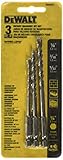
For a standard cordless drill with hammer mode, use a carbide-tipped masonry bit rated for hammer drilling. Its blunt carbide tip breaks material as it rotates and impacts. A basic masonry bit is usually the economical choice for a handful of small holes. For regular work or harder concrete, a bit with a more durable carbide head and a stronger flute design tends to last longer and clear dust better.
An SDS-plus rotary hammer uses a different shank and delivers more impact energy than most hammer drills. SDS-plus bits are a good choice for repeated holes, larger diameters, or tough aggregate, but they do not fit a conventional three-jaw chuck. Don’t buy one unless your tool accepts SDS-plus bits.
For a few anchor holes, a carbide-tipped masonry bit set is often enough. If you drill concrete often, consider a set of SDS-plus concrete bits—but only if you own a compatible rotary hammer.
Bit options at a glance
| Bit type | Best use | Trade-off |
|---|---|---|
| Basic carbide masonry bit | Occasional small holes in block or concrete | Low cost; may drill slowly and wear sooner in hard aggregate |
| Higher-quality carbide hammer bit | Several holes or regular DIY use with a hammer drill | Costs more, but typically holds up better and clears dust more effectively |
| SDS-plus carbide bit | Repeated or larger holes with an SDS-plus rotary hammer | Fast and robust; requires a compatible tool |
| Diamond core bit | Large, clean openings where the tool and bit are rated for the job | Specialized and usually unnecessary for ordinary anchor holes |
Check the drill and bit before starting
A cordless drill’s hammer mode is useful for small holes, but it is not the same as a rotary hammer. If a hole is larger than about 1/2 inch, unusually deep, or slow despite a sharp bit and steady progress, a rotary hammer may save time and reduce strain. Use a bit within the drill’s stated capacity, and follow the anchor maker’s instructions for hole depth and diameter.
Inspect the bit for a chipped carbide tip, bent shank, or packed flutes. A damaged tip can wander and make an oversized hole. If the bit gets hot, stop and let it cool; forcing it harder can dull the carbide or overheat the tool. Avoid using an impact driver with a conventional round-shank masonry bit unless both the bit and adapter are explicitly rated for that use.
Drill without breaking the face shell
Mark the hole and check for pipes, cables, or other services before drilling. Keep holes away from block edges and corners: drilling close to an edge raises the risk of cracking or spalling, especially in hollow units. The required edge distance depends on the anchor and block, so use the fastener maker’s guidance rather than guessing.
Start slowly with the drill square to the surface. Once the tip has made a shallow seat, increase speed and use hammer mode if the tool has it. Apply firm, even pressure; leaning hard on the drill usually adds heat, not useful cutting force. Pull the bit out periodically to clear dust, particularly in deeper holes. Dust packed in the flutes slows drilling and can make an anchor sit too shallow.
In a hollow block, stop if resistance suddenly disappears or the bit breaks through into a cavity. That may be expected, but it means a standard expansion anchor may not hold as intended. Choose an anchor designed for hollow masonry, or relocate the fastening point to a solid web if the installation allows. Don’t overtighten: crushing a thin face shell can loosen the connection or crack the block.
What to buy for the job
For three or four small holes in ordinary retaining block, a sharp carbide-tipped masonry bit matched to the anchor is a sensible, low-cost purchase. A premium bit is worthwhile when you have many holes, hard aggregate, or bits that have repeatedly dulled early. If the work calls for larger holes or a long run of anchors, renting or borrowing an SDS-plus rotary hammer may be better value than pushing a cordless hammer drill beyond its comfort zone.
Before fastening anything that supports a railing, gate, or other safety-critical load, verify that the block and anchor are suitable for that load. The drill bit makes the hole; it cannot make an unsuitable block or anchor reliable.