What's inside
As an Amazon Associate I earn from qualifying purchases. This post may contain affiliate links at no extra cost to you.
What we cover
Choose the right drill for brick mortar
For occasional holes in mortar joints, a standard cordless drill with a masonry bit may be enough. For repeated holes, harder mortar or holes larger than about 1/4 inch, a hammer drill is quicker and puts less strain on your hands. The key is to use the right mode and bit: hammer action helps masonry bits cut, but it can damage a bit intended for wood or metal.
Mortar is usually easier to drill than the brick around it, which makes joints a useful place to put small fixings when the load and anchor instructions allow it. Mortar also varies widely in hardness and condition. Old, crumbly joints can break out around an anchor; very hard mortar may take longer to penetrate than expected. If the fixing must carry a substantial load, follow the anchor maker’s instructions and choose the location accordingly.
As an Amazon Associate we earn from qualifying purchases at no extra cost to you.


What type of drill to buy
A cordless hammer drill is the best all-around choice if you expect to drill masonry regularly and also want one tool for ordinary drilling and driving. It has a selector for rotary-only and hammer drilling, plus a clutch for screwdriving. It is bulkier than a compact drill, and hammering can drain the battery faster.
A regular drill is a reasonable cheaper choice for a handful of small holes in soft mortar, especially with a sharp masonry bit and a patient pace. It lacks the rapid impacts that help a hammer drill cut masonry, so progress can be slow. Don’t force it: if the bit stops advancing, clear dust from the hole, check the bit and consider borrowing or buying a hammer drill.
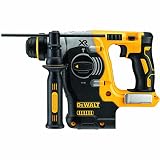
A rotary hammer is a different, more powerful tool, usually intended for concrete and frequent masonry work. It is generally excessive for small anchor holes in mortar, and its stronger impact can damage weak joints. Consider one only if you drill larger holes or substantial amounts of masonry. For typical DIY fixings, a corded rotary hammer is worth comparing only when a hammer drill is plainly underpowered for the work.
Quick comparison
| Tool | Best for | Trade-off |
|---|---|---|
| Standard cordless drill | A few small holes in soft mortar | Slower; may struggle in dense material |
| Cordless hammer drill | Regular small and medium masonry holes | Heavier, costlier and more battery-hungry than a standard drill |
| Rotary hammer | Frequent drilling or larger holes in hard masonry | More tool than most mortar-joint jobs need; can damage weak mortar |
Features that matter
Look for a hammer drill with a clearly marked hammer mode and a conventional three-jaw chuck that accepts the bit sizes you need. A 1/2-inch chuck gives flexibility, but is not necessary for small anchor holes. For drilling common holes of roughly 3/16 to 3/8 inch, battery voltage alone is a poor buying guide: tool design, battery condition, bit quality and masonry hardness all affect performance.
A kit with two batteries is useful if you’ll drill many holes or use the drill for other demanding tasks. For just a few holes, one battery is usually fine. Consider weight and grip as well: a heavy drill held at shoulder height is tiring, and a side handle helps control larger tools. Avoid choosing purely by maximum torque figures; high torque matters more for driving large fasteners than for accurately drilling a small hole in a mortar joint.
Bits, anchors and sizing
Use a carbide-tipped masonry bit, matched to the hole diameter specified for your anchor. A carbide-tipped masonry bit set is a practical purchase if you need several sizes. Check the bit and anchor packaging rather than assuming that a screw’s diameter is the hole size. A worn or overheated bit cuts slowly and may wander; replace it when it no longer advances cleanly.
For a plastic wall plug, drill to the stated diameter and depth, then remove dust before inserting the plug. The hole must be deep enough for the plug and screw without leaving loose debris at the bottom. Use a depth stop or wrap a small piece of tape around the bit as a visual guide. Don’t assume a plug rated for brick will perform equally well in damaged or soft mortar.
How to drill cleanly
Check for hidden cables and pipes before drilling, and wear eye protection: masonry dust and chips can fly even from a small hole. Mark the joint and hold the drill square to the wall. Start in rotary-only mode at a slow speed to establish the hole; once the bit is steady, switch to hammer mode if the drill has it and the mortar is sound. Keep steady pressure without leaning hard on the tool. Excess force can overheat the bit, enlarge the hole or break up the joint.
Withdraw the bit occasionally to clear dust, especially in a deeper hole. Stop if the bit binds, the drill gets unusually hot, or the mortar begins to crumble around the entry. Let the bit cool rather than dunking a hot bit in water. After drilling, clear dust with a suitable brush or other method allowed by the anchor instructions; dust left in the hole can prevent a plug from seating or reduce its grip.
Common mistakes to avoid
Do not use hammer mode on a wood or metal bit, and don’t use a hammer drill’s impact action for screwdriving unless the tool specifically supports that operation. If the mortar joint is cracked, loose or visibly deteriorated, drilling there may worsen it; choose sound material or reconsider the fixing location. If you need a heavy-duty anchor, or the hole is large enough that the joint may split, stop and check the anchor manufacturer’s guidance rather than increasing drill power.
For a couple of small holes in soft mortar, buying a hammer drill is not automatically worthwhile. A sharp masonry bit in a standard drill can do the job. For repeated holes or hard mortar, a cordless hammer drill is the more useful buy; reserve a rotary hammer for work that genuinely calls for its extra impact.