What's inside
As an Amazon Associate I earn from qualifying purchases. This post may contain affiliate links at no extra cost to you.
What we cover
What matters for repeated screw fastening
For driving the same type of screw over and over, the best drill is not necessarily the one with the highest torque rating. Control, weight, battery endurance and a clutch that behaves consistently matter more. A tool that drives 200 screws without tiring your hand is more useful than a heavy drill that can drive one stubborn fastener exceptionally hard.
Start by matching the tool to the screws and material. Cabinet screws in predrilled hardwood, for example, call for a different setup from 3-inch construction screws in framing lumber. Screw length, diameter, wood density and whether you drill pilot holes all affect how much torque the tool needs. For ordinary screws up to about 2 inches in softwood, most current 18V or 20V compact drills have ample power.
As an Amazon Associate we earn from qualifying purchases at no extra cost to you.



Use a sharp, correctly sized driver bit. A worn Phillips bit or a bit that does not fully seat in the screw head can cam out, damaging the head and the work surface. Torx and square-drive screws tend to stay engaged better during repetitive fastening, though they still need the matching bit size.
Drill/driver or impact driver?
A drill/driver is usually the better first choice when fasteners need to stop at a consistent depth. Its adjustable clutch slips when resistance reaches the selected setting, helping prevent overdriving screws and stripping smaller fasteners. It is also quieter and typically easier to control in delicate work.
An impact driver delivers short rotational blows. That makes it effective for long or large screws, dense framing lumber and jobs where a drill/driver repeatedly stalls. It can be faster, but it is easier to drive a screw too deep or damage a head if you squeeze the trigger without easing off near the end. Impacts are also noisier, so hearing protection is sensible during extended use.
If you fasten hundreds of medium-to-large screws into framing, an 18V cordless impact driver kit is a practical specialist tool. For furniture assembly, cabinetry and mixed drilling and fastening, a compact cordless drill/driver kit is often the more versatile buy.
Which tool fits the job?
| Tool | Best for | Main advantage | Trade-off |
|---|---|---|---|
| Compact drill/driver | Cabinets, furniture and general fastening | Clutch control and versatility | Can stall on long screws in dense material |
| Impact driver | Repeated long screws and framing | Fast driving with less wrist reaction | No conventional clutch; easier to overdrive |
| Drill/driver with an impact driver as a pair | Frequent mixed drilling and fastening | Each tool stays set up for its task | Higher cost and two tools to carry |
A combo kit can be worth the extra cost if you regularly switch between drilling pilot holes and driving screws. One tool can hold a drill bit while the other holds a driver bit, avoiding repeated bit changes. For occasional household repairs, buying a compact drill/driver alone is generally enough.
Features worth paying for
Look for a two-speed gearbox, a variable-speed trigger and a clutch with clearly marked settings. Low gear offers more control for starting screws and driving larger fasteners; high gear is useful for drilling. A useful clutch is not a substitute for careful technique, but it can reduce stripped screws and crushed surfaces.
Weight matters over a full workday. A compact tool around 3 to 4 pounds with its battery is easier to use overhead or in cabinets than a heavy high-torque model. Check the quoted weight with the battery attached: bare-tool figures can make a tool seem lighter than it feels in use. A belt hook and a well-positioned light are small conveniences that help on repetitive jobs.
For battery capacity, a 2.0Ah pack keeps the tool lighter and is often adequate for short jobs. A 4.0Ah or larger pack usually lasts longer between charges but adds weight. If you already own compatible batteries, staying on that platform can be more economical than buying a new kit. For extended work, a spare battery prevents a pause when the first pack runs down.
Set up for consistent results
Before starting a production run, test several screws on scrap from the same material. Begin with a low clutch setting and increase it until screws seat flush without stripping the head or crushing the surface. Clutch numbers are not standardized between brands, so a setting that works on one drill may not transfer to another. If the clutch cannot seat the screw reliably, switch to a slower trigger speed, drill a pilot hole or use an impact driver with more careful depth control.
For hardwood, screws near the edge of a board, or screws over about 2 inches long, pilot holes can reduce splitting and lower the load on the tool. Hole size depends on the screw: the pilot should generally match the screw’s solid core diameter, not the outside diameter of its threads. Test on scrap if the fit is uncertain. In softwood, many smaller screws can be driven directly, but a pilot hole is still helpful near an edge.
Keep the driver bit straight and apply firm pressure along the screw’s axis. If the bit slips, stop rather than continuing to chew up the head. Replace the bit, clear wood chips from the recess and check that the screw is not cross-threaded. On an impact driver, use short trigger pulls as the head nears the surface; a long final burst can bury the screw or break it.
A sensible buying choice
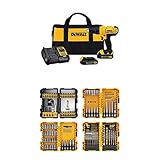
For regular household repairs and moderate screw work, choose a compact drill/driver with a clutch and a 2.0Ah battery. It costs less, handles pilot holes and general drilling, and gives better feedback than an impact driver. If your main task is installing long construction screws in batches, choose an impact driver and keep a sharp spare bit on hand. Buyers already committed to a battery platform can compare a compact cordless drill/driver sold as a bare tool with the cost of a new kit.
Do not pay extra for maximum torque unless the work demands it. For repeated fastening, a manageable tool, suitable screws, a good bit and a setup tested on scrap usually make a bigger difference than a premium top-speed specification.