What's inside
As an Amazon Associate I earn from qualifying purchases. This post may contain affiliate links at no extra cost to you.
Dense concrete is a different job from hanging a picture in a hollow block wall. A small cordless drill with a hammer setting may start a hole, then stall, overheat or wear out its bit before it reaches the depth you need. For occasional 1/4-inch holes, a good hammer drill can be enough. For repeated or larger holes in a foundation, a rotary hammer is usually the better tool: its stronger hammering action makes progress faster and puts less pressure on your hands.
As an Amazon Associate we earn from qualifying purchases at no extra cost to you.


What we cover
Choose the right drill for the hole
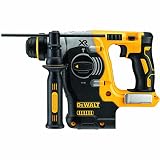
A hammer drill rotates the bit while two toothed plates create a rapid, short hammering action. It is compact and useful for small holes, especially around 1/4 inch. A rotary hammer uses a piston-driven mechanism to strike the bit. That action is more effective in hard concrete, particularly as hole diameter and depth increase. Rotary hammers typically accept SDS-Plus bits; hammer drills use round or hex-shank masonry bits.
If you are drilling a handful of shallow holes for light-duty anchors, a cordless hammer drill may be the sensible buy, especially if you already own compatible batteries. For several holes, holes deeper than about 2 inches, or diameters above roughly 3/8 inch, look at an SDS-Plus rotary hammer instead. These are practical guidelines, not strict limits; concrete mix, aggregate and bit quality all affect drilling speed.
Hammer drill vs. rotary hammer
| Tool | Best fit | Trade-off |
|---|---|---|
| Compact hammer drill | A few shallow holes, usually 1/4 inch or smaller | Slower in dense concrete; demands more pressure and can heat the bit |
| Full-size hammer drill | Occasional holes up to about 3/8 inch | More capable, but still less effective than a rotary hammer on bigger or deeper holes |
| SDS-Plus rotary hammer | Repeated anchor holes and moderate-size holes in hard concrete | Costs more and needs SDS bits; bulkier than a drill |
For most foundation-anchor work, an SDS-Plus tool with a two- to three-joule impact rating is a useful middle ground. Check the manufacturer’s stated maximum drilling diameter and duty guidance rather than choosing solely by voltage or advertised torque. If your work needs holes larger than about 1/2 inch, or many deep holes, compare the tool’s recommended capacities and consider a larger rotary hammer.
Bits and batteries matter
Use a sharp carbide-tipped masonry bit for a hammer drill and a compatible SDS-Plus masonry bit for a rotary hammer. A four-cutter SDS bit can be less prone to snagging on rebar than a two-cutter design, but hitting steel still slows work and may damage the bit. Do not force a bit through rebar: stop, withdraw it and reassess the hole location. Never drill blindly into a foundation where utilities, reinforcing steel or post-tensioning may be present; check plans and use appropriate detection before drilling.
For cordless tools, a higher-capacity battery generally allows more work per charge, but adds weight. A 4.0- or 5.0-Ah battery is a practical starting point for sustained drilling; a compact battery can suit a few small holes. If you already own a battery platform, compare bare-tool cost with the price of a kit and battery. A corded rotary hammer can be cheaper for a fixed workshop or frequent long sessions, but it needs an outlet and a suitable extension lead.
Buy bits in the diameter and working length your anchors require. Extra-long bits flex more and make it harder to keep a hole straight. For common concrete anchors, a quality SDS-Plus concrete bit is usually a better investment than a large assortment of inexpensive bits you may not use.
Drill cleanly and avoid common failures
Confirm the anchor’s specified hole diameter and depth before drilling. Mark the bit with tape or use a depth stop, then hold the tool square to the surface. Start slowly until the tip has seated; after that, use steady pressure and let the hammering action work. Excessive force can stall the motor, overheat the bit and make the hole wander.
Withdraw the bit every few seconds to clear dust, especially in a deep hole. Concrete dust packs around the flutes, raising heat and slowing the cut. Wear eye protection and a properly fitted respirator suitable for silica dust, and use dust extraction or an appropriate vacuum attachment where possible. Do not blow dust out with your mouth. After drilling, clean the hole according to the anchor maker’s instructions; dust left inside can reduce holding strength.
Stop if progress suddenly drops, the tool repeatedly binds, or the bit becomes unusually hot. Let it cool naturally rather than quenching it, which can damage the carbide. If you hit a hard obstruction, do not keep leaning on the tool. The obstruction may be reinforcing steel, a stone aggregate or something you should not drill through. A hammer drill that makes little progress in dense concrete is not necessarily defective: it may simply be the wrong tool for the hole.
A practical buying choice
Choose a hammer drill if you will make only a few small, shallow holes and want a versatile drill for wood, metal and general fastening too. Choose an SDS-Plus rotary hammer if the job involves several foundation anchors, harder concrete, or holes around 3/8 inch and larger. For a one-off job, renting a rotary hammer may cost less than buying one. Match the bit to the anchor, protect yourself from dust, and check what lies behind the drilling area before you start.