What's inside
As an Amazon Associate I earn from qualifying purchases. This post may contain affiliate links at no extra cost to you.
Dense concrete is hard on both the drill and the bit. A general-purpose masonry bit may get through a few holes in a concrete block, but reinforced concrete, cured slabs, and foundation walls call for a different level of tooling. The best choice depends on the drill’s chuck, hole diameter, depth, and whether you may encounter rebar.
As an Amazon Associate we earn from qualifying purchases at no extra cost to you.


What we cover
Choose the right bit system first
There are two common setups. A regular hammer drill uses a three-jaw chuck and accepts round-shank masonry bits. A rotary hammer uses SDS-plus or SDS-max bits, which slide into the tool without tightening a chuck. For dense concrete, a rotary hammer with an SDS-plus bit is usually faster, creates less strain, and produces more consistent holes.
For occasional holes up to about 3/8 inch, a cordless hammer drill and quality carbide-tipped bit are adequate. Once you need several holes, diameters above 1/2 inch, or depths beyond roughly 3 inches, an SDS-plus rotary hammer is the more sensible purchase. Look at SDS-plus rotary hammer drills if your current drill is struggling or repeatedly overheating.
| Bit type | Best use | Typical strength | Main limitation |
|---|---|---|---|
| Round-shank carbide masonry bit | Occasional small anchor holes | Works in a standard hammer drill | Slower and more prone to slipping or overheating |
| SDS-plus two-cutter bit | General concrete drilling | Fast, affordable, widely available | Can bind or lose speed around rebar |
| SDS-plus four-cutter bit | Reinforced or very dense concrete | More stable cutting and better rebar tolerance | Costs more than a two-cutter bit |
| SDS-max bit | Large holes and heavy demolition work | Handles bigger diameters and deeper drilling | Requires a larger rotary hammer |
The best bit design for dense concrete
For most demanding homeowner and trade work, choose a carbide-tipped SDS-plus bit with a four-cutter head. The four cutting edges keep the tip centered and are less likely to catch when they hit aggregate or a small piece of steel. They also produce a rounder hole, which matters when installing sleeve anchors or close-fitting hardware.
A two-cutter SDS-plus bit is still a good value. It is often the right choice for holes in ordinary poured concrete, brick, and block when you are installing plastic expansion plugs or small Tapcon-style screws. Two-cutter bits generally drill quickly and cost less. Replace one when the carbide edges are visibly rounded, the bit wanders, or a hole takes much longer than comparable holes.
For holes larger than 1 inch, consider an SDS-max rotary hammer and bit, or a core bit if the hole needs to be exceptionally clean and large. Do not force an SDS-plus bit beyond its intended diameter. A small tool can drill a large hole eventually, but the extra heat and vibration shorten the life of the motor, clutch, and bit.
Match the bit to the anchor
The anchor package should specify the bit diameter. For a plastic wall plug, the bit normally matches the plug diameter. Concrete screws also require a specific pilot-hole size, commonly 3/16 or 1/4 inch, depending on the screw. Wedge anchors and sleeve anchors require more precise diameters, and the hole must usually be slightly deeper than the embedment length.
As a practical rule, drill at least 1/4 inch deeper than the anchor will sit so dust has somewhere to collect. For a 2-inch anchor embedment, a hole around 2-1/4 inches deep is a reasonable starting point unless the manufacturer specifies otherwise. A depth stop is useful because drilling too shallow leaves dust under the anchor and reduces holding power.
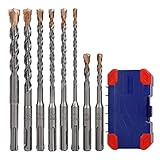
If you need a range of common holes, a four-cutter SDS-plus concrete bit set is usually more economical than buying individual bits. Check that the set includes the diameters you actually use. Cheap sets often contain many small sizes but omit useful 7/16- and 1/2-inch bits.
How to drill dense concrete without burning the bit
Mark the hole, put on eye protection, and check for electrical wiring or plumbing before drilling. Start with the drill square to the surface. Run the tool at full hammer speed with firm, steady pressure; pressing harder does not make the carbide cut faster and can stall the bit.
Every 10 to 20 seconds, pull the bit out while it is still rotating. This clears dust from the flutes and cools the tip. If the hole fills with powder, the bit starts squealing, or progress stops, withdraw it completely and clean the hole with a vacuum or bulb blower. Do not use your mouth, since concrete dust contains respirable silica.
For holes deeper than 3 or 4 inches, clear dust more often. Dust-packed flutes can make a bit appear dull even when the carbide is still usable. If the tool has a hammer-only or rotation-only setting, use rotation-only when clearing the hole; this reduces unnecessary impact wear.
What to do when you hit rebar
A sudden change in sound, vibration, or drilling speed often means the bit has reached steel reinforcement. Stop applying extra pressure. Continuing with a standard two-cutter bit can chip the carbide or wedge the bit in the hole.
Move the hole if the location allows it. If it cannot move, use a bit designed for reinforced concrete, such as a four-cutter head, and follow the tool and bit manufacturer’s instructions. Some jobs call for a separate rebar-cutting bit, but ordinary concrete bits are not a substitute for one. Never cut structural rebar casually in a beam, column, foundation wall, or load-bearing slab.
Where spending more makes sense
Buy premium four-cutter bits when you are drilling dense poured concrete, working near rebar, making many holes, or relying on accurate anchor placement. The extra cost is small compared with replacing a stalled tool or repairing a misaligned anchor.
A cheaper two-cutter bit is fine for a handful of small holes in normal concrete, especially for plastic anchors or light-duty concrete screws. The important minimum is a genuine carbide tip, a straight shank, and a bit diameter that matches the fastener instructions. Avoid unbranded sets with poorly brazed tips or flutes that are visibly uneven.
For standard hammer drills, shop for carbide-tipped masonry bits for concrete. For repeated heavy drilling, an SDS-plus four-cutter bit is the better long-term choice. Keep bits clean, store them dry, and replace them when drilling speed drops rather than trying to compensate with excessive force.