What's inside
As an Amazon Associate I earn from qualifying purchases. This post may contain affiliate links at no extra cost to you.
Drilling through a concrete slab is harder on a drill than drilling into a wall or wood framing. The right tool depends mainly on hole diameter, slab thickness, aggregate, and how many holes you need. For occasional holes up to about 3/8 inch, a cordless hammer drill can be enough. For repeated holes, deeper holes, or diameters above 1/2 inch, a rotary hammer is usually the better buy.
As an Amazon Associate we earn from qualifying purchases at no extra cost to you.


What we cover
Hammer drill versus rotary hammer
A hammer drill uses a rattling clutch to add small, rapid impacts while the bit rotates. It is relatively light and works well for plastic anchors, Tapcon-style screws, and small holes. The drawback is that it requires substantial pushing force, makes slower progress in dense concrete, and transfers more vibration to your hands.
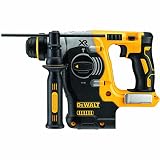
A rotary hammer uses a piston mechanism to strike the bit much harder. Most have rotary-only, hammer-drill, and chisel modes. They accept SDS-Plus or SDS-Max bits, which transfer impact more efficiently than a standard round-shank bit. For drilling a 1/2-inch hole several inches deep, a rotary hammer can finish in a fraction of the time and with less effort.
If you already own a strong cordless drill, adding a cordless hammer drill is reasonable for light anchor work. If the job involves a dozen or more holes, look at a cordless SDS-Plus rotary hammer instead.
Best tool by job
| Job | Recommended tool | Typical bit | Practical limit |
|---|---|---|---|
| Small plastic anchors | Hammer drill | Carbide masonry bit | 1/4 to 3/8 inch holes |
| Concrete screws | Hammer drill or rotary hammer | Rated masonry bit | Usually 3/16 to 1/4 inch holes |
| Repeated 1/2-inch holes | Rotary hammer | SDS-Plus carbide bit | Several inches deep |
| Large anchors or through-holes | Heavy-duty rotary hammer | SDS-Plus, SDS-Max, or core bit | Over 5/8 inch, depending on tool |
| Breaking out concrete | Rotary hammer with chisel mode | SDS chisel | Small demolition and tile work |
What to look for when buying
For a cordless tool, voltage is only a rough guide. A compact 18V or 20V hammer drill may be excellent for anchors but slow in hard slab concrete. Look for a two-speed gearbox, a side handle, a mechanical clutch, and a hammer mode that can be switched off. A brushless motor generally gives better runtime and durability, but it does not turn a light drill into a rotary hammer.
For a rotary hammer, check the maximum recommended drilling diameter rather than relying on battery voltage. SDS-Plus models are the useful middle ground for homeowners: they commonly handle holes from 1/4 inch to around 1 inch, depending on the model and bit. SDS-Max tools are heavier and intended for larger holes and demanding work. Their extra capacity is wasted if you are only installing shelf anchors.
Battery size affects both runtime and balance. A 4Ah or 5Ah battery is a sensible starting point for cordless concrete drilling. A compact battery makes the tool lighter but may run down quickly when drilling deep holes. Corded rotary hammers remain a good value for one large project, provided you can safely manage the extension cord.
Choose the bit for the hole
Use carbide-tipped masonry bits for hammer drills. Cheap bits can work for two or three small holes, but they often overheat, dull quickly, or wander when they hit hard aggregate. For a rotary hammer, use SDS-Plus bits matched to the tool. Four-cutter bits cost more but are less likely to jam or snag on reinforcement than basic two-cutter designs.
Match the hole diameter and depth to the anchor manufacturer’s instructions. A 1/4-inch concrete screw does not necessarily use a 1/4-inch hole. Many require a smaller bit, while expansion anchors require a hole matching the anchor’s outside diameter. Drill at least 1/4 inch deeper than the embedment so dust and bit debris do not prevent the anchor from seating.
For a useful selection of bits, compare SDS-Plus concrete bit sets by stated diameter, working length, and tip design. Do not buy a long bit when a short one will reach; excessive length increases flex and makes straight holes harder.
How to drill through a concrete slab
First, locate electrical conduit, plumbing, radiant heating, and post-tension cables before drilling. A general-purpose stud finder is not enough for every slab. Check building plans, inspect both sides where possible, and use a suitable scanner if the location is uncertain. Never drill where a damaged cable or pipe could create a serious hazard.
Mark the hole with a pencil or marker, then use a small bit to start a shallow pilot depression if the surface is smooth. Hold the drill perpendicular to the slab. With a hammer drill, use firm pressure without forcing the bit. With a rotary hammer, moderate pressure is usually enough; excessive force can slow the impact mechanism and overheat the motor.
Withdraw the bit every few seconds on deeper holes to clear dust. For a 3-inch hole, stop two or three times rather than drilling continuously. Dust buildup can lock the bit, reduce cutting action, and make the hole undersized. A vacuum held beside the hole, or a drilling dust shroud, is cleaner and safer than blowing dust into the air.
When the hole reaches the required depth, remove loose dust with a vacuum or the manufacturer’s recommended cleaning method. A dirty hole reduces holding strength, especially with expansion anchors and adhesive systems. If the bit suddenly stops or the tool kicks, stop immediately: you may have hit rebar, embedded metal, or a void.
Common mistakes and when the cheaper drill is fine
The most common mistake is using a standard drill with a masonry bit and expecting it to work like a hammer drill. It may eventually penetrate soft block, but dense concrete will polish the bit and overheat the motor. Another mistake is using hammer mode on tile, hollow block, or delicate finished surfaces where the impact can crack the material.
A basic cordless hammer drill is fine for installing a few curtain brackets, conduit clips, or light-duty shelves. It is also the cheaper option when holes are small and shallow. Rent or buy a rotary hammer when the holes are numerous, larger than 1/2 inch, deeper than about 3 inches, or located in hard, aggregate-rich concrete. The faster drilling and reduced strain usually matter more than the higher purchase price.
Wear safety glasses, hearing protection, and a dust mask rated for fine concrete dust. Keep both hands on the tool when possible, use the side handle, and let the bit do the cutting. For larger anchor systems, check the anchor’s load rating and edge-distance requirements; a powerful drill cannot compensate for a hole too close to an edge or a fastening method unsuitable for the slab.