What's inside
As an Amazon Associate I earn from qualifying purchases. This post may contain affiliate links at no extra cost to you.
The right impact-driver bit matters most when you’re driving a lot of deck screws, working near the ends of boards, or using coated fasteners outdoors. A poor fit can round the screw recess, chew up the bit, or leave a screw head proud. For most deck work, buy impact-rated bits that match the fastener’s drive style and size; don’t assume a tougher-looking bit will compensate for a loose fit.
As an Amazon Associate we earn from qualifying purchases at no extra cost to you.



What we cover
Match the bit to the screw
Deck screws commonly use T25 or T20 star drives, while exterior structural screws may use larger star drives or a manufacturer-specific recess. Check the screw packaging or head before buying. A T25 bit in a T20 recess may seem to engage, but it can slip under load and damage the head. The reverse mismatch usually won’t seat fully either.
Star-drive bits are a good default for exterior screws because their multiple contact points tend to resist cam-out better than Phillips. Square-drive screws are also common, particularly in some decking applications; use the specified square bit rather than substituting a Phillips. For a screw with a damaged or unusual recess, a fresh bit in the exact size is often the only practical fix.
Which bit type to buy
Impact-rated bits are designed to tolerate the repeated twisting pulses of an impact driver. They often use a torsion zone that flexes slightly under load. Standard driver bits may work for occasional fastening, especially in a drill or at low torque, but they can snap sooner in an impact driver. “Impact rated” does not mean unbreakable: a badly seated bit, excessive speed, or a jammed screw can still damage it.
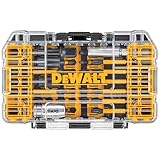
For routine deck building, a short, single-piece bit is inexpensive and gives good control. A 1-inch bit is useful in a magnetic bit holder; a 2-inch bit can reach past a board edge or into a recessed fastening point. If you drive screws all day, a small pack of replacement bits is more useful than relying on one bit until it fails. Compare impact-rated T25 bits or the size that matches your screws.
Bit choices at a glance
| Bit choice | Best for | Trade-off |
|---|---|---|
| Short impact-rated bit | Most deck screws; direct, controlled driving | Limited reach in tight or recessed spots |
| Long impact-rated bit | Fasteners set back from edges or behind obstructions | More flex and wobble; can be harder to keep straight |
| Magnetic bit holder with insert bit | Quick bit changes and ordinary screw lengths | Extra length; magnet strength varies and may not hold every screw securely |
| Standard non-impact bit | Occasional work with a drill or driver at modest load | More likely to wear or break under repeated impact-driver use |
Choose length and holder for control
A short bit puts less distance between the driver and the screw, making it easier to keep the tool square. That matters near board ends, where a tilted screw can split the wood or pull the head off-center. Use a longer bit only when access requires it, and support the driver so it doesn’t lean as the screw bites.
A magnetic holder can speed up changes, but it adds length and a connection point that may wobble. For screws with deep heads or awkward access, a direct 2-inch bit may feel steadier. If the screw starts crooked, stop and back it out rather than trying to force it straight. A bent or rounded screw head is harder to remove, especially after the fastener is driven flush.
Drive without stripping or snapping
Seat the bit fully in the recess before pulling the trigger. Start slowly, keep the driver aligned with the screw, and increase speed only after the threads have engaged. Press firmly enough to maintain contact, but don’t lean so hard that you lose control. If the bit rides out of the recess, stop; continuing to trigger the driver can quickly round the screw head.
For a screw that stalls, check for knots, dense material, or a fastener that is too long for the application. Back it out, clear the hole, and consider a pilot hole where the decking or manufacturer’s instructions call for one. At board ends, a pilot hole can reduce splitting, but it should be sized for the screw and material rather than guessed. Don’t treat an impact driver’s extra force as a substitute for proper fastening guidance.
Set the driver to a lower speed or use a drill with a clutch when you need more control over depth. Impact drivers typically don’t have a clutch that stops reliably at a chosen depth, so they can bury a head or damage the board if you keep driving. A depth stop or a light touch near the end helps, but inspect the first few screws and adjust your technique.
What to check before buying
Confirm the drive size, buy impact-rated bits if you’ll use an impact driver regularly, and choose a length that reaches the work without sacrificing control. A square-drive bit set makes sense only if your screws use square recesses; a star-drive set is no improvement when the fastener calls for square. For mixed jobs, a small impact-rated bit set with common T20 and T25 sizes can cover many exterior fasteners, but verify the actual screw before starting.
Replace a bit when its edges are rounded, it no longer seats firmly, or it repeatedly slips in an undamaged screw. The cheapest standard bit is fine for a few low-load screws in a drill. For a full deck or repeated exterior fastening with an impact driver, impact-rated bits in the correct size are a modest cost that can prevent wasted fasteners and damaged heads.