What's inside
As an Amazon Associate I earn from qualifying purchases. This post may contain affiliate links at no extra cost to you.
A good impact driver can make repetitive fastening into laminated timber beams faster, but maximum torque is not the main buying criterion. The right tool needs controllable speed, a solid bit holder and enough battery capacity for the screw size and workload. Just as important: use screws approved for structural timber and follow their installation instructions. An impact driver is not a substitute for the correct fastener or a sound connection design.
As an Amazon Associate we earn from qualifying purchases at no extra cost to you.



What we cover
What to look for in an impact driver
For ordinary beam work, a quality 18V or 20V-platform impact driver is usually the sensible choice. These tools handle common structural timber screws without the bulk of a high-torque impact wrench. A 12V driver can work for shorter, smaller-diameter screws, but may slow down or need more frequent battery changes on long screws and repeated installations.
Prioritize a variable-speed trigger and, if available, selectable speed or fastening modes. Laminated timber can be dense, and a screw that enters too quickly can strip its drive recess, overheat or break. A slower setting gives you more control during the first few turns and near the end of the drive. Check that the driver has a standard 1/4-inch hex collet; most impact-rated driver bits use this fitting.
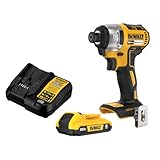
For a first tool, a 18V cordless impact driver kit with two batteries is a practical starting point. If you already own batteries from a cordless-tool platform, buying the bare tool is often cheaper. Stick to the same battery system unless the price difference or a specific feature justifies adding another.
Match the tool to the work
| Tool or setup | Best fit | Main trade-off |
|---|---|---|
| 12V impact driver | Shorter screws, occasional repairs, overhead work | Less reserve for long structural screws |
| 18V/20V impact driver | Most beam fastening and regular DIY work | More noise and impact than a drill driver |
| High-torque impact driver | Frequent large fasteners or demanding site work | Can be harder to control; often costs more |
| Drill driver | Pilot holes and carefully controlled final seating | Can stall on large screws; slower in repetitive driving |
“High-torque” is not automatically better. Manufacturers measure torque in different ways, and published maximum figures do not tell you how smoothly a tool drives a particular screw. For one beam connection, a standard 18V driver may be plenty. For a large number of long screws, a higher-capacity battery and a tool with a slower mode can matter more than a headline torque number.
Choose screws and bits before driving
Use structural timber screws specified for the connection, not general-purpose drywall or deck screws. Check the screw maker’s guidance for diameter, length, edge and end distances, required washers, and whether pilot holes are needed in your timber. Laminated timber products and connection details differ; don’t assume a screw that works in ordinary framing is suitable for a structural beam.
Match the bit to the screw’s drive recess and use an impact-rated bit. A worn or poorly seated bit cams out, damaging the screw head and potentially leaving a fastener only partly installed. Keep a spare bit nearby. For long screws or dense material, a set of impact-rated driver bits is a modest expense compared with losing time to a stripped recess.
Drive the screw without damaging the connection
Mark the location and confirm the screw will meet the specified edge and end distances. Where the screw manufacturer calls for a pilot hole, drill it to the stated diameter and depth; guessing too small can split timber, while an oversized hole can reduce holding capacity. For angled screws, use the specified angle and a guide or jig if the connection requires repeatable placement.
Hold the driver in line with the screw and apply steady pressure. Start on a low speed setting if your tool has one, then increase speed once the threads have engaged cleanly. Keep the tool square to the drive recess: leaning on the driver increases cam-out and can bend or break a long screw. Stop when the head reaches the specified position. Driving past the surface can crush fibers, damage a washer or compromise the connection.
Impact drivers are loud and can send vibration through the workpiece. Wear eye and hearing protection, secure the timber, and keep hands clear of the fastener path. If a screw stops advancing, don’t hold the trigger and hope it will finish. Back it out if possible, inspect the bit and hole, and check for a misaligned pilot, knot, obstruction or unsuitable screw. A hot screw, burnt timber or repeated bit damage is a sign to pause and diagnose the cause.
Battery size and useful features
A compact 2.0Ah battery keeps the driver lighter and is fine for a few connections. For a long fastening session, a 4.0Ah or larger pack generally means fewer interruptions, though it adds weight. If you will be driving screws overhead or in tight spaces, the lighter pack may be more comfortable. Two batteries are convenient when one can charge while the other is in use.
Look for a short tool body if access between beams is tight, but check the actual length from the back of the tool to the bit tip. A belt hook, work light and electronic brake are useful extras, not reasons to pay a large premium. A three-mode driver can be worthwhile when you switch between delicate screws and large fasteners; a basic variable-speed model is adequate when the work is straightforward and you can control the trigger.
When a drill driver is the better choice
Impact drivers excel at fast repetitive screw driving, but their hammering action makes them less suitable for precision drilling and delicate fastening. Use a drill driver for pilot holes, especially where clean placement matters, and use the impact driver for the screw only if its instructions allow it. If the final seating needs very fine control, a drill driver with a clutch may be easier to manage. A cheaper standard 18V impact driver is sufficient for occasional beam work; pay extra for higher capacity or additional modes only when the screw size, volume or access conditions make those features useful.