What's inside
As an Amazon Associate I earn from qualifying purchases. This post may contain affiliate links at no extra cost to you.
What we cover
What matters for cabinet screws
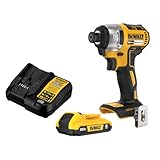
For installing cabinets, an impact driver’s job is to drive long screws into wall framing without stripping the head, splitting a rail, or pulling the cabinet out of position. Most 18-volt or 20-volt cordless impact drivers have ample power for this. The useful differences are speed control, size, balance, and how gently the tool can start a screw—not headline torque.
Cabinet screws are commonly 2½ to 3 inches long. They pass through a cabinet hanging rail and drywall before reaching a stud, so the driver needs to manage several inches of fastening without forcing the screw too fast. A compact 12-volt driver can handle occasional cabinet work, especially with pilot holes. For a full kitchen, a variable-speed 18-volt driver gives more reserve and usually a wider choice of batteries and accessories. Browse 18-volt cordless impact driver kits if you want the best balance for regular DIY use.
As an Amazon Associate we earn from qualifying purchases at no extra cost to you.



Which type to buy
| Driver type | Best fit | Trade-off |
|---|---|---|
| Compact 12-volt impact driver | A few cabinets, tight spaces, lighter tool preference | Less runtime and reserve for repeated long screws |
| 18-volt or 20-volt impact driver | Several cabinets or regular fastening work | Heavier, and easy to overdrive screws on high speed |
| Drill/driver with clutch | Careful, controlled driving and pilot-hole work | Slower on long screws; clutch can slip before a screw is seated |
| Dedicated cabinet installation tool | Frequent professional cabinet installs | Costly for a one-off project |
A basic, well-reviewed 18-volt tool is enough; premium torque is not a substitute for control. A 12-volt tool is also a reasonable buy if you already own its batteries and are installing only a few cabinets. Check the tool’s low-speed behavior and trigger smoothness in person if possible. A driver that jumps abruptly from stopped to fast is harder to use near the end of a screw’s travel.
Features worth paying for
Look for a variable-speed trigger and, ideally, a low-speed or assist mode. These help reduce the chance of burying the screw head or damaging the cabinet rail. Three speed settings can be useful, but a skilled user can do the same job with one setting and a light trigger. A bright work light is handy inside a cabinet, though it does not matter as much as a controllable trigger.
Tool length and balance matter when working inside an installed cabinet or close to a wall. A short impact driver is easier to position, but it still needs clearance for the bit and screw. Battery size is another trade-off: a small battery keeps the tool lighter overhead; a larger one lasts longer but can make a compact driver feel awkward. Compare compact 12-volt impact driver kits if low weight matters more than all-day runtime.
Impacts are loud and transmit sharp pulses through the handle. Wear hearing protection, and avoid using the tool one-handed to hold a cabinet in place. Get the cabinet supported and aligned first. If you already own a drill/driver with a working clutch, it may be the better choice for the final turn, even if you use an impact driver to start the screw.
Use the right screw and bit
Use cabinet or structural screws specified for fastening cabinets to framing, not drywall screws. Drywall screws are brittle and can snap under the load or impact. Choose a screw long enough to pass through the cabinet rail and wall finish and achieve solid stud engagement; follow the cabinet and screw manufacturers’ guidance. A 2½- or 3-inch screw is common, but the right length depends on rail thickness and the wall build-up.
Match the driver bit to the screw head exactly. A loose-fitting bit can cam out, chew up the recess, and leave a screw stuck halfway in. Keep a spare bit nearby; worn tips slip more readily. For long screws, a quality impact-rated bit is less likely to break than a standard driver bit. Check the screw packaging for the required bit type rather than assuming every star-shaped recess uses the same size.
Drive screws without damage
Locate and mark the studs, then clamp or otherwise support the cabinet in its final position. Drill a clearance hole through the cabinet rail if the screw manufacturer or cabinet instructions call for one; a clearance hole lets the screw pull the rail snug without binding. A pilot hole in the stud can also reduce splitting, especially near a stud edge or when driving a large screw. Use a bit sized for the screw’s core, and avoid drilling through the cabinet face or back.
Start each screw slowly with the driver square to the surface. Once the threads have engaged, increase speed, then ease off as the head approaches the rail. The goal is a snug, seated head—not crushing the wood or deforming the rail. If the driver begins hammering heavily and the screw stops advancing, do not keep pulling the trigger. Back it out, check for a wrong bit, misalignment, a knot, or an undersized pilot hole, then try again.
Do not use the impact driver to pull cabinets together or force a cabinet into alignment. Correct gaps with shims and adjust the cabinet position before fastening. Overdriving can strip a screw hole, crack a rail, or make later adjustment difficult. For repeated installs, a box of impact-ready cabinet installation screws is more useful than buying a higher-torque driver.
A practical buying choice
For one kitchen or regular home projects, buy a variable-speed 18-volt impact driver with a comfortable grip and a small battery, especially if you already use that battery platform. Spend more only for a clear benefit such as a smoother low-speed mode, a shorter body, or a kit that includes batteries you need. For a handful of screws, borrow a tool or use a clutch-equipped drill/driver if you already own one. Careful setup, a sharp matching bit, and a supported cabinet matter more than extra torque.