What's inside
As an Amazon Associate I earn from qualifying purchases. This post may contain affiliate links at no extra cost to you.
A pergola beam job usually means driving a lot of long screws overhead or at shoulder height, often through treated lumber that is not perfectly straight or dry. An impact driver makes that work faster than a drill, but raw torque is not the only thing that matters. Control, battery size, screw choice, and the way you support the joint all affect whether the fastener seats cleanly or twists off.
As an Amazon Associate we earn from qualifying purchases at no extra cost to you.



What we cover
What to buy for pergola beam screws
For most homeowners, a 18V or 20V cordless impact driver with a 1/4-inch hex chuck, variable-speed trigger, and at least two speed settings is the practical choice. A compact brushless model is pleasant for overhead work, but a brushed driver will also install structural screws. Brushless tools generally run longer per battery charge and have no motor brushes to wear; they are not necessary for a one-time pergola.
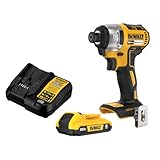
Look for a kit with a 2.0Ah or larger battery and a charger. A small 2.0Ah pack keeps the tool light, while a 4.0Ah pack can reduce battery swaps during a large build but adds noticeable weight. If you already own cordless tools, staying with that battery platform is usually better value than buying a new system for one driver. Compare cordless impact driver kits by battery compatibility, trigger control, and included batteries—not advertised torque alone.
Impact driver options at a glance
| Type | Best for | Trade-off |
|---|---|---|
| Basic brushed driver | Occasional projects and a tight budget | Often less efficient; speed and mode control may be limited |
| Brushless compact driver | Repeated overhead fastening and regular DIY use | Costs more; the extra runtime may not matter for a small pergola |
| High-torque, feature-rich driver | Frequent construction work and a range of fasteners | Can be heavier and easier to overdrive screws with |
| Cordless drill/driver | Predrilling and controlled work near edges | Slower on long screws; may stall in dense lumber |
Match the driver to the fastener
Use exterior-rated structural wood screws or the specific fasteners required by your pergola plans. Do not substitute drywall screws: they are brittle and not designed for structural joints or outdoor exposure. Screw length and diameter depend on the joint design, lumber dimensions, and manufacturer instructions. A common 1/4-inch structural screw needs a driver bit that fits its head exactly; many use a T25 or T30, but check the package rather than guessing.
Impact-rated bits are worth buying for repeated driving. They are designed to flex under impact pulses and are less likely to snap than ordinary bits. Keep a spare on hand: a worn bit can cam out, chew up the screw recess, and leave a fastener difficult to remove. For structural screws with a supplied washer head or proprietary drive, use the matching bit.
Drive screws without splitting or overdriving
Clamp or firmly support the beam so it cannot shift as the screw bites. Start the screw square to the surface, use a low-speed mode if available, and squeeze the trigger gradually. Let the driver’s impacts do the work; leaning hard on the tool can make the bit slip or push the screw off line. Stop as the head seats flush or reaches the specified position. Continuing to hammer after seating can bury the head, crush wood fibers, strip the drive, or snap the screw.
Predrill near board ends, near edges, or in dry, dense hardwood. Use a pilot-hole diameter and depth recommended by the screw maker. A pilot hole reduces splitting and driving effort, though it takes extra time and can be unnecessary for many self-drilling structural screws in softwood. If a long screw stalls, do not keep pulsing it until the bit or fastener fails. Back it out, check for a knot or misalignment, and drill a pilot hole if appropriate.
When a driver has selectable modes, start in the gentler setting and move up only if the screw will not advance. A clutch-equipped drill offers finer torque control, which is useful for smaller screws or delicate trim, but it can stop repeatedly on long structural fasteners. An impact driver is typically the faster choice for those larger screws.
Battery, weight, and handling
For a few dozen screws, one charged 2.0Ah battery may be enough, depending on screw size, lumber, and tool efficiency. For a long build, two batteries are more useful than chasing a higher torque rating. Keep the pack warm in cold weather; a cold lithium-ion battery can deliver less power and appear to run down sooner. If you expect all-day use, a brushless compact driver kit with a second battery may save interruptions.
Consider the tool’s balance with the battery attached. A lighter driver reduces fatigue when fastening overhead, but a very small battery may need more frequent changes. A belt hook is handy on a ladder, though it does not replace safe ladder positioning. Wear eye protection: impacts can throw wood chips, and a broken bit or screw head can become a projectile.
When a drill is the better choice
A drill/driver is often better for pilot holes, small screws, and work where you need to limit torque precisely. Use a separate drill bit for predrilling rather than trying to make the impact driver do every task. If you do not already own an impact driver and only have a handful of screws to install, a capable cordless drill may be sufficient—especially when paired with the correct pilot holes. For repeated long structural screws, however, the impact driver is usually faster and less prone to stalling.
Before fastening the beam, confirm the joint layout and fastener schedule against the pergola plans. An impact driver can make an incorrect fastener go in quickly, but it cannot make an undersized screw, poor edge distance, or weak connection safe.