What's inside
- Best Router Bit for Cutting Plywood: The Short Answer
- Straight, Upcut, Downcut, and Compression: What Changes?
- Choose by the Face You Need to Keep Clean
- Match Bit Diameter and Cutting Length to Plywood Thickness
- Setup for a Cleaner, Safer Cut
- Metal-Cutting Bits Are a Different Tool Category
- Which Bit Makes Sense for Your Shop?
- Ownership: Wear, Cleaning, and Replacement
- Related Guides
- Best Router Bit for Cutting Plywood: The Short Answer
- Straight, Upcut, Downcut, and Compression: What Changes?
- Choose by the Face You Need to Keep Clean
- Match Bit Diameter and Cutting Length to Plywood Thickness
- Setup for a Cleaner, Safer Cut
- Metal-Cutting Bits Are a Different Tool Category
- Which Bit Makes Sense for Your Shop?
- Ownership: Wear, Cleaning, and Replacement
- Related Guides
As an Amazon Associate I earn from qualifying purchases. This post may contain affiliate links at no extra cost to you.
What we cover
- Best Router Bit for Cutting Plywood: The Short Answer
- Straight, Upcut, Downcut, and Compression: What Changes?
- Choose by the Face You Need to Keep Clean
- Match Bit Diameter and Cutting Length to Plywood Thickness
- Setup for a Cleaner, Safer Cut
- Metal-Cutting Bits Are a Different Tool Category
- Which Bit Makes Sense for Your Shop?
- Ownership: Wear, Cleaning, and Replacement
- Related Guides
Best Router Bit for Cutting Plywood: The Short Answer
The best router bit for cutting plywood is usually a compression spiral bit when both faces need clean edges; choose an upcut spiral for fast, efficient chip removal, a downcut spiral for a clean top face, or a straight bit for occasional shallow work on a budget.
Bit choice depends on which face must stay clean, the plywood’s actual thickness, your router’s collet size, and whether you’re making a full-depth cut or several shallow passes. No bit can fully compensate for a dull edge, poor support, or a feed rate that is too fast.
As an Amazon Associate we earn from qualifying purchases at no extra cost to you.
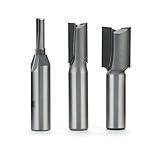


Straight, Upcut, Downcut, and Compression: What Changes?
| Bit type | Cut direction | Best use in plywood | Typical trade-off |
|---|---|---|---|
| Straight | Shears across the cut; no spiral chip direction | Simple grooves, shallow dados, occasional trimming | Can leave more tear-out than a sharp spiral bit; chips may stay in the cut |
| Upcut spiral | Pulls chips upward and out | Deep slots, through-cuts, and efficient chip clearing | Can splinter the top veneer |
| Downcut spiral | Pushes fibers down toward the workpiece | Clean top face, shallow grooves, and visible top edges | Can pack chips into deep cuts and fray the underside |
| Compression spiral | Upcut near the tip and downcut near the shank | Through-cuts where both faces need a neat edge | Needs enough cutting depth for both spiral sections to engage correctly |
These directions describe how the flutes move chips and fibers, not which way to push the router. For handheld work, feed against the bit’s rotation and follow the router manufacturer’s instructions. A router table changes the viewpoint, so verify feed direction before cutting.
Choose by the Face You Need to Keep Clean
- Both faces visible: A compression bit is usually the strongest choice for a through-cut. Set its cutting depth so the upcut portion reaches through the lower veneer while the downcut portion engages the upper face. Check the bit maker’s specified compression zone; if the cut is too shallow, one face may tear out.
- Top face visible, underside hidden: Use a downcut spiral for shallow cuts or a suitable compression bit for a full-depth cut. Support the sheet closely to reduce vibration and underside breakout.
- Underside visible or deep chip-clearing matters: An upcut spiral is often a better fit. Place a sacrificial backer beneath the plywood if the top veneer is at risk, and clamp the work securely.
- Small grooves or occasional shop work: A sharp straight bit can be economical and effective. Use multiple shallow passes rather than forcing a deep cut in one pass.
Plywood varies: veneer species, glue, voids, and core construction all affect edge quality. A test cut in offcut material from the same sheet is more useful than relying on a bit label alone.
Match Bit Diameter and Cutting Length to Plywood Thickness
Do not choose a bit by the plywood’s nominal label alone. A sheet sold as 3/4-inch plywood may measure less than 3/4 inch, and thickness can vary across a panel. Measure the actual sheet, then check the bit’s cutting length and compression geometry.
| Measured plywood thickness | Practical starting bit size | Setup note |
|---|---|---|
| 1/4 in (6.35 mm) | 1/4 in (6.35 mm) cutting length, or shorter for grooves | Use a light pass; a full-depth compression bit may not suit thin stock |
| 1/2 in (12.7 mm) | 1/2 in (12.7 mm) cutting length | Confirm that the compression zone matches the actual cut depth |
| 3/4 in (19.05 mm) | 3/4 in (19.05 mm) cutting length or longer | For a through-cut, account for the sacrificial backer and avoid unnecessary stick-out |
These are starting points, not a guarantee of fit: manufacturers may list cutting length differently, and the bit must not bottom out in the collet. Keep the shank inserted to the depth specified by the manufacturer, with clearance at the collet bottom. A 1/2-inch shank is generally stiffer than a 1/4-inch shank of comparable design, which can help with larger cutters and demanding cuts. But the router must have a matching collet; never force a bit into the wrong size.
For small trim routers, a 1/4-inch shank may be the available option. Use a modest cutter diameter, keep the bit projection short, and take lighter passes. Larger diameters and long cutting lengths increase leverage and load, so use only combinations approved for your router’s speed and capacity.
Setup for a Cleaner, Safer Cut
- Measure and mark. Check the sheet thickness and the bit’s cutting length. Confirm the bit can make the intended cut without excessive projection.
- Support the panel. Put the plywood on a flat surface with the cut area supported. Clamp it so the offcut cannot shift or pinch the bit; use a sacrificial board beneath through-cuts.
- Set the guide. Use a straightedge, template, or router-table fence as appropriate. Test the setup on scrap to check the finished dimension and face quality.
- Make shallow passes when needed. For deep cuts, split the depth into several passes. This reduces strain, helps clear chips, and is easier to control than forcing a full-depth cut.
- Inspect and clear chips. Stop the router before adjusting or clearing the work. Packed chips, especially in a deep downcut slot, can cause heat, burning, or a rough finish.
If tear-out persists, first check for a dull or resin-coated edge, loose workholding, excess bit stick-out, or a cut depth that does not suit the bit. A sharp carbide bit is typically more durable than high-speed steel in abrasive plywood, but it can still chip if dropped or used with a loose collet.
Metal-Cutting Bits Are a Different Tool Category
Searches for metal cutting router bits, router bits for cutting metal, or a metal cutting router bit often lead to confusion. Standard woodworking router bits are not general-purpose metal cutters. Likewise, router bits for aluminum cutting and router bits for cutting aluminum must be specifically designed and rated for the machine, material, and operating conditions. Do not use a plywood bit on metal or assume a metal-rated cutter is safe in a wood router. Follow the cutter and machine makers’ specifications; for sheet metal or substantial metal removal, use the appropriate metalworking equipment.
Which Bit Makes Sense for Your Shop?
| Your situation | Good starting choice | Why |
|---|---|---|
| Occasional grooves, tight budget | Sharp straight bit with a 1/4-in or 1/2-in shank to fit your router | Versatile for light work, though edge quality may be less consistent than a spiral bit |
| Frequent through-cuts; both faces matter | Compression spiral bit sized for the measured thickness | Opposing flute directions help control tear-out on both faces |
| Deep slots or strong chip removal needed | Upcut spiral bit | Pulls chips out of the cut; protect the top face if it will be visible |
| Clean top edge on a shallow cut | Downcut spiral bit | Pushes the top veneer toward the workpiece; plan for chip clearing on deeper cuts |
| Compact trim router | Small-diameter bit with the router’s matching shank collet | Keeps cutter load manageable; confirm the router’s limits before use |
Ownership: Wear, Cleaning, and Replacement
Plywood’s glue and layered construction can dull edges faster than clean, solid softwood. Watch for rising feed effort, burn marks, fuzzy veneers, or a finish that degrades despite a stable setup. Resin and dust buildup also reduce cutting performance; clean the bit with a product intended for router cutters, following its directions, and avoid scraping carbide edges with hard tools.
Replace or professionally sharpen a bit when its edge is chipped, badly worn, or still produces poor cuts after cleaning and correcting the setup. Do not keep pushing a dull cutter: it can overheat, burn the work, and put extra load on the router. For most shoppers, a sharp 1/2-inch-shank compression bit that matches the sheet thickness is the best all-around choice for clean plywood through-cuts; a straight or single-direction spiral bit is the better value when the cut depth or the visible face makes that specialization unnecessary.