What's inside
- Best offset smokers at a glance
- Old Country Brazos: best overall for heat stability
- Yoder Wichita: best premium backyard offset
- Oklahoma Joe’s Highland: best budget entry point
- Oklahoma Joe’s Longhorn: best for larger cooks on a budget
- What matters more: grate area or steel thickness?
- Firebox design and airflow control
- Decision matrix: which offset smoker fits your situation?
- Ownership costs and maintenance
- Bottom line
- Best offset smokers at a glance
- Old Country Brazos: best overall for heat stability
- Yoder Wichita: best premium backyard offset
- Oklahoma Joe’s Highland: best budget entry point
- Oklahoma Joe’s Longhorn: best for larger cooks on a budget
- What matters more: grate area or steel thickness?
- Firebox design and airflow control
- Decision matrix: which offset smoker fits your situation?
- Ownership costs and maintenance
- Bottom line
As an Amazon Associate I earn from qualifying purchases. This post may contain affiliate links at no extra cost to you.
The best offset smokers for most backyard cooks are the Old Country Brazos for heat stability, the Oklahoma Joe’s Highland for a lower-cost starting point, and the Yoder Wichita for frequent cooking and long-term durability.
Offset smokers reward careful fire management, but their performance is determined less by headline cooking capacity than by four practical details: cooking grate area, steel thickness, firebox design, and airflow control. A large, thin smoker can be harder to run than a smaller, heavier pit because it loses heat rapidly and reacts sharply to wind and fuel changes.
As an Amazon Associate we earn from qualifying purchases at no extra cost to you.


What we cover
- Best offset smokers at a glance
- Old Country Brazos: best overall for heat stability
- Yoder Wichita: best premium backyard offset
- Oklahoma Joe’s Highland: best budget entry point
- Oklahoma Joe’s Longhorn: best for larger cooks on a budget
- What matters more: grate area or steel thickness?
- Firebox design and airflow control
- Decision matrix: which offset smoker fits your situation?
- Ownership costs and maintenance
- Bottom line
Best offset smokers at a glance
| Smoker | Approx. grate area | Typical steel construction | Best for | General market range |
|---|---|---|---|---|
| Oklahoma Joe’s Highland | About 619 sq. in. | Light-gauge steel, roughly 2–3 mm on many current configurations | Beginners and occasional backyard cooks | $300–$500 |
| Oklahoma Joe’s Longhorn | About 1,060 sq. in. | Light-to-medium-gauge steel; model specifications vary | Larger gatherings on a moderate budget | $500–$800 |
| Old Country BBQ Pits Brazos | About 1,000 sq. in. | Commonly specified with 1/4-inch steel in the main chamber | Serious backyard cooks wanting steadier heat | $1,000–$1,500 |
| Yoder Smokers Wichita | About 1,070 sq. in. | 1/4-inch steel construction | Frequent use, cold-weather cooking, and long service life | $2,000–$3,000 |
Dimensions and options can change between model years, so confirm the current manufacturer specification before buying. The table is most useful as a comparison of smoker classes: lightweight entry-level pits, larger thin-wall pits, heavy backyard offsets, and premium competition-style construction.
Old Country Brazos: best overall for heat stability
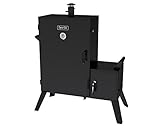
The Brazos is a strong choice when the priority is holding a steady temperature during a six- to twelve-hour cook. Its approximately 1/4-inch steel body stores more heat than the thinner walls used on many entry-level offsets. That thermal mass does not eliminate fire management, but it reduces the size of temperature swings caused by opening the door, adding a split, or cooking in cool weather.
Its roughly 1,000-square-inch grate area is enough for several pork shoulders, racks of ribs, or a large brisket with room for airflow around the food. A traditional offset layout also keeps the firebox separate from the food, allowing smoke and heat to travel across the cooking chamber rather than placing meat directly above the fuel.
The trade-offs are weight, price, and startup time. A thick steel pit takes longer to preheat and demands a stable, level location. It is also less convenient to move across a lawn than a lightweight supermarket smoker. Choose the Brazos if the smoker will be used regularly and predictable heat matters more than portability.
Yoder Wichita: best premium backyard offset
The Yoder Wichita is aimed at cooks who expect to use an offset frequently and want a robust pit that can handle demanding cooks. Its 1/4-inch steel construction and large cooking chamber give it substantial thermal stability. The cooking area is generous without being so large that a backyard cook must build an oversized fire for every brisket.
Yoder’s design typically includes a substantial firebox, adjustable exhaust, and multiple intake adjustments. These controls matter because an offset smoker needs both fuel and oxygen management. The intake controls how vigorously the fire burns; the exhaust helps draw hot smoke through the chamber. Closing the exhaust to “trap smoke” can produce stale, acrid smoke and unstable temperatures, so the exhaust should generally remain open while the fire is regulated at the intake.
The Wichita costs considerably more than an entry-level pit and is heavy enough that delivery and placement deserve planning. It makes the most sense for someone cooking several times a month, hosting large meals, or intending to keep one smoker for many years.
Oklahoma Joe’s Highland: best budget entry point
The Highland is one of the more accessible ways to learn offset cooking. Its approximately 619-square-inch grate provides practical capacity for a family meal while keeping the footprint and fuel requirement manageable. A smaller chamber can also be easier for a beginner to understand: there is less cooking space to monitor and fewer places for temperature differences to hide.
The limitation is thin steel. Lightweight offsets lose heat quickly in wind and cold weather, and their doors and lids may not seal perfectly. That means more frequent fuel additions and greater sensitivity to wood-split size. Small, dry splits can burn too intensely if the intake is opened too far, while oversized splits may smolder and create dirty smoke.
The Highland is a sensible choice for occasional use, especially if the budget does not support a heavy pit. Plan to improve its performance with a reliable digital thermometer, a cover, and careful fire management rather than expecting it to behave like a 1/4-inch steel smoker.
Oklahoma Joe’s Longhorn: best for larger cooks on a budget
The Longhorn expands cooking capacity to roughly 1,060 square inches, making it useful for parties and holiday meals. It can cook multiple briskets or a large quantity of ribs, but its larger chamber also requires more fuel and more attention to temperature distribution than the Highland.
This is the key head-to-head distinction between capacity and stability: the Longhorn gives you more grate area, but not necessarily the same heat retention as a heavier Brazos or Wichita. If the smoker will be filled frequently, allow space between cuts and rotate food when the temperature map of the chamber calls for it. The grate nearest the firebox is usually hotter, so it is not automatically the best place for every item.
What matters more: grate area or steel thickness?
For most backyard cooks, steel thickness matters first when long cooks and difficult weather are involved. Grate area matters first when the cooker must feed a crowd. A useful sizing calculation is to reserve approximately 25% of the grate for airflow and handling. A 1,000-square-inch smoker therefore provides about 750 square inches of comfortably usable loading area.
For example, if a brisket occupies approximately 200 square inches after allowing clearance, and a rack of ribs occupies approximately 120 square inches, a 1,000-square-inch grate may comfortably hold three briskets or a mixed load of brisket and ribs. The exact number depends on the cuts and rack layout, but the calculation prevents a common mistake: buying a large smoker and filling every inch of it, which restricts airflow and makes temperature management harder.
Firebox design and airflow control
A good firebox should provide enough room for a small, clean-burning fire rather than forcing wood against the cooking-chamber wall. Look for:
- A raised grate or fire basket that allows ash to fall away from the fire.
- An adjustable intake vent with a precise range of movement.
- A firebox door that closes firmly without excessive gaps.
- A properly sized opening between the firebox and cooking chamber.
- An adjustable chimney or exhaust stack positioned to draw smoke across the food.
- A removable ash area that can be cleaned without dismantling the pit.
Extra vents are not automatically better. Poorly placed openings can create cold spots or let uncontrolled air feed the fire. A heavy smoker with simple, well-sealed controls is often easier to run than a thin smoker with many loose dampers.
Decision matrix: which offset smoker fits your situation?
| Your situation | Recommended direction | Why |
|---|---|---|
| First offset, occasional cooks, limited budget | Oklahoma Joe’s Highland | Manageable capacity and lower purchase cost; expect more active fire tending. |
| Large family or frequent parties | Oklahoma Joe’s Longhorn | More grate area without moving into premium pricing. |
| Weekly or monthly long cooks | Old Country Brazos | Heavier steel and a balanced capacity-to-fuel relationship. |
| Cold climate, frequent use, long ownership horizon | Yoder Wichita | Heavy construction, substantial heat retention, and durable hardware. |
| Small patio or limited storage | A compact offset or a smaller vertical smoker | Large horizontal offsets need clearance, fuel storage, and a safe operating area. |
Ownership costs and maintenance
Wood is the main ongoing expense. A long brisket cook may consume roughly 10–20 pounds of dry smoking wood, depending on pit efficiency, weather, and whether charcoal is used for the initial fire. At a general retail cost of $1–$2 per pound for packaged hardwood, fuel can add approximately $10–$40 per cook. Buying properly seasoned local hardwood can reduce that cost, but only if it is untreated, dry, and suitable for cooking.
Remove ash after every cook because ash absorbs moisture and accelerates corrosion. Brush loose residue from the grates, then apply a thin coat of high-smoke-point cooking oil to clean cast-iron or steel surfaces. Inspect firebox seams, door hinges, wheels, and thermometer mounts several times a season. High-temperature gasket material and door seals are consumable parts; replacing them can improve control more effectively than adding a decorative chimney extension.
Avoid spraying water inside a hot pit, burning painted or treated lumber, or closing all vents while coals are still glowing. Those shortcuts can damage the finish, create excessive smoke, or leave the cooker vulnerable to rust. Keep the smoker covered only after it is completely dry, and store wood off the ground under ventilation.
Bottom line
The best offset smokers are not simply the largest models. Choose the Oklahoma Joe’s Highland to learn the technique economically, the Longhorn when capacity is the main requirement, the Old Country Brazos for the best balance of heavy steel and backyard practicality, and the Yoder Wichita when frequent use and long-term durability justify the investment. Whichever model you choose, prioritize thick steel, a raised fire grate, controllable intake airflow, a clear exhaust path, and enough grate space to leave food room to breathe.