We research everything we recommend. When you buy through our links, we may earn a commission. As an Amazon Associate we earn from qualifying purchases.
Best Safety Glasses for Workshops, Labs and Yard Work
Compare the best safety glasses for workshop, lab and yard work, with ANSI Z87.1 picks for anti-fog clarity, sealed dust protection and fit.
Eye protection is the cheapest insurance in any workshop, yet it is also the gear most often left hanging on a nail. A grinding wheel throws sparks and grit, a drill press flings metal chips, and a string trimmer turns pebbles into projectiles. The right pair blocks those hazards without fogging up, sliding down your nose, or pinching until you take them off for good.
This guide covers five proven options for workshop benches, lab benches, and weekend yard work, from featherweight everyday glasses to a sealed goggle for heavy dust, plus a wide-coverage frame for prescription wearers. Every model meets the ANSI Z87.1 impact standard, so the differences come down to fit, coatings, and fog control.
As an Amazon Associate, we earn from qualifying purchases.
For most workshop and yard jobs, the NoCry Clear Safety Glasses are the top pick thanks to their anti-fog wraparound lens and adjustable fit. The 3M SecureFit 400 is the comfort choice for long sessions, the DEWALT Concealer goggle seals out dust, the Pyramex Intruder covers basic protection in bulk, and the Uvex Genesis XC suits prescription wearers.
The best safety glasses compared
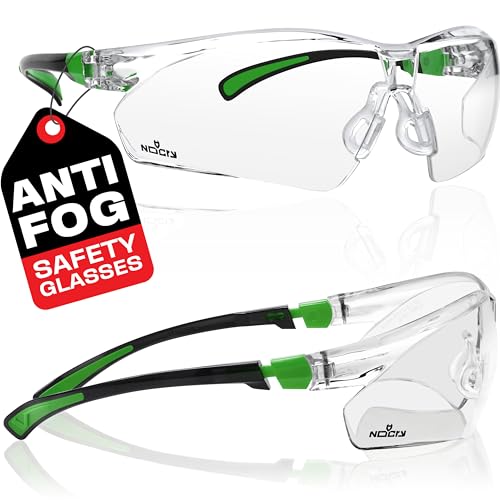
NoCry Clear Safety Glasses
Top Pick
NoCry Clear Safety Glasses
Best for: all-round workshop, lab, and yard work in one pair.
The NoCry Clear Safety Glasses are the pair to buy if you want one dependable set for the garage, the bench, and the yard. The wraparound polycarbonate lens curves around the sides of the eyes, closing the gap that straight-front glasses leave open to angled debris. A Vanguard Plus coating on the lens resists both fogging and scratches, which are the two problems that make people stop wearing eye protection in the first place.
Fit is the other strong point. The temples extend to suit different head sizes, the soft nose pad adjusts instead of digging in, and rubber grips keep the frame from sliding when you sweat. The clear lens carries full UV protection for outdoor work, stays untinted for indoor bench tasks, and meets ANSI Z87.1.
Specs:
– Lens: clear polycarbonate, wraparound design
– Coating: Vanguard Plus anti-fog and anti-scratch
– Fit: extendable temples, adjustable soft nose pad, non-slip grips
– Standard: ANSI Z87.1 rated
– UV protection: full UV shielding for outdoor use
3M SecureFit 400 Safety Glasses
Runner-Up
3M SecureFit 400 Safety Glasses
Best for: long sessions where comfort decides whether eye protection stays on.
The 3M SecureFit 400 is built around comfort over long stretches. Its Pressure Diffusion Temple technology uses flexible slotted ribs that spread pressure across the side of the head instead of concentrating it above the ear, so the glasses stay secure without the clamp-and-headache feel of stiff frames. The low-profile temples also sit flat, which makes them easier to wear under earmuffs and hearing protection.
This version pairs an anti-fog, anti-scratch clear lens with a removable foam gasket. Clip the gasket on and it cushions the brow while limiting the dust and grit that drift in from above; take it off and you have a lighter open pair for indoor work. The lens blocks UV rays for outdoor jobs, and the frame meets ANSI Z87.1 impact requirements.
Specs:
– Lens: clear polycarbonate with anti-fog and anti-scratch coating
– Frame feature: removable foam gasket for dust-prone tasks
– Temples: Pressure Diffusion Temple design, low profile for hearing protection
– Standard: ANSI Z87.1 rated
– Fit: soft, adjustable nose bridge area and flexible temples
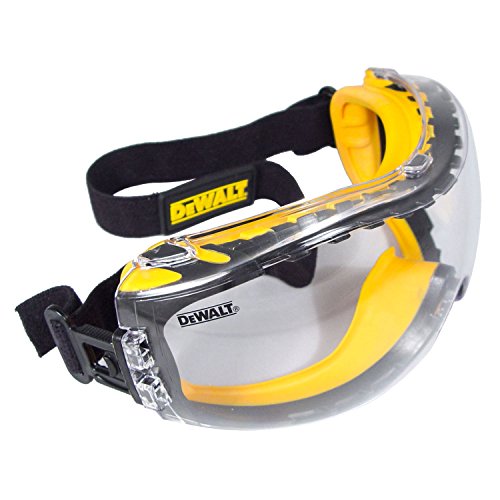
When the job makes dust instead of occasional chips, glasses stop being enough and a sealed goggle takes over. The DEWALT Concealer wraps the eyes in a soft, dual-mold rubber seal that conforms to the face and keeps fine dust, sanding flour, and debris out. An elastic head strap holds it in place through overhead work and awkward angles.
The clear lens has a hard anti-fog coating, and built-in ventilation channels move air across the inside of the lens to slow fogging without opening a direct path for particles. The roomy frame fits over most prescription glasses, which makes it the practical pick for glasses wearers doing demolition, concrete cutting, insulation work, or heavy sanding.
Specs:
– Style: sealed goggle with dual-mold rubber face seal
– Lens: clear polycarbonate with anti-fog hard coat
– Retention: adjustable elastic head strap
– Ventilation: indirect channels to reduce fog build-up
– Fit: roomy enough for most prescription glasses underneath
– Standard: ANSI Z87.1 rated
Best for: heavy dust, grinding, sanding, and demolition work.
Pyramex Intruder Safety Glasses
Pyramex Intruder Safety Glasses
Best for: spare pairs, visitors, and light-duty tasks around the shop.
The Pyramex Intruder is the simple, frameless workhorse that shops buy by the handful. A single lightweight polycarbonate lens with an integrated nosepiece keeps the design about as basic as safety eyewear gets, and that simplicity is the point: pairs live in the truck, on the bench, in the lab drawer, and on the hook by the door, so a pair is always within reach for a quick cut or trim.
The clear lens carries a hard coat that shrugs off casual scratches, and the frameless shape gives an unobstructed field of view for measuring, marking, and machine setup. It meets ANSI Z87.1 for impact protection. There is no anti-fog coating and no adjustability, so it is not the pair for steamy or precision all-day work, but as a spare, a visitor pair, or a loaner for helpers, nothing else here is easier to stock.
Specs:
– Lens: clear polycarbonate, hard-coated against scratches
– Design: frameless single lens with integrated nosepiece
– Standard: ANSI Z87.1 rated
– Weight: among the lightest styles in this guide
– Sold as: single pairs and multi-packs for stocking up
Honeywell Uvex Genesis XC Safety Glasses
Honeywell Uvex Genesis XC Safety Glasses
Best for: lab and inspection work, plus prescription wearers using the insert.
The Genesis XC is the coverage specialist in the Uvex line. Its extended wraparound lens reaches further around the cheek and brow than standard Genesis frames, closing off the side and top gaps that matter when chips come off a wheel at odd angles. This version carries the SCT-Vermillion lens with Uvextreme anti-fog coating; the vermillion tint sharpens contrast, which lab and inspection workers like for spotting detail under flat indoor lighting.
The Genesis XC also answers the prescription problem differently. Instead of stretching over your everyday glasses, it accepts an optional Rx insert that sits behind the protective lens, so your prescription stays shielded and the outer lens takes the scratches. Adjustable temples fine-tune the fit. Clear-lens versions of the Genesis XC exist in the same line if the vermillion tint does not suit your work.
Specs:
– Lens: SCT-Vermillion polycarbonate, extended wraparound coverage
– Coating: Uvextreme anti-fog
– Prescription option: accepts the Genesis XC Rx insert behind the lens
– Temples: adjustable length for a custom fit
– Standard: ANSI Z87.1 high-impact rated
How to choose safety glasses
Start with the marking on the lens or frame. ANSI Z87.1 is the baseline standard for occupational eye protection in the United States, and eyewear that meets it has passed impact and coverage tests. A Z87 marking alone means basic impact resistance, while Z87+ signals the higher-velocity, higher-mass impact tests. For power tools, grinding, and yard equipment, treat Z87+ as the sensible floor and skip eyewear with no ANSI marking at all.
Anti-fog coatings matter because fogged glasses get pushed up onto foreheads, where they protect nothing. Not all coatings are equal. Bonded coatings, such as Uvex Uvextreme and premium bonded coatings from 3M, are fused to the lens and survive repeated cleaning. Cheaper surface treatments wear away after weeks of wiping with a shirttail. Whatever you buy, clean lenses with water and a microfiber cloth rather than paper towels, which grind grit into the coating.
Glasses versus goggles comes down to what is in the air. Open glasses with wraparound lenses handle flying chips and fragments well. Fine dust from sanding, concrete, drywall, and insulation drifts around the edges of any glasses, so those jobs call for a sealed goggle with a face gasket like the DEWALT Concealer. Chemical splash work needs an indirect-vent goggle with the appropriate splash marking, which is a step beyond anything in this guide.
Prescription wearers have three routes. Over-glasses designs fit on top of everyday frames and are cheap and simple, though bulky. Rx inserts, like the one the Genesis XC accepts, put your prescription behind a replaceable safety lens. Dedicated prescription safety glasses cost the most but wear the best for daily use. Whichever route you take, confirm the outer eyewear still carries its Z87 marking.
Lens tint is the last choice. Clear lenses suit indoor shops and labs and work outdoors on overcast days. Gray and smoke tints cut glare for bright yard work but make indoor detail harder to see. Amber and vermillion tints boost contrast under flat indoor light, which helps with inspection and fine work, though they shift color perception enough that electricians and finishers usually prefer clear. Match the tint to where you actually spend your hours, not to the job you do twice a year.
Who should skip these picks
Welders should skip everything here and use a proper welding helmet or shade-rated filter glasses, since none of these lenses block welding arc radiation. Anyone doing heavy grinding or cutting should add a face shield over glasses rather than relying on glasses alone. Workers handling aggressive chemicals need splash-rated indirect-vent goggles chosen for that hazard, and people who need corrective lenses all day will be happier in dedicated prescription safety glasses than in any over-glasses compromise.
FAQ
What does the ANSI Z87.1 marking actually guarantee?
It means the eyewear passed standardized tests for impact resistance, lens coverage, and optical quality. A Z87+ marking adds high-mass and high-velocity impact tests, which better match the fragments thrown by grinders, saws, and trimmers. Unmarked fashion sunglasses and novelty eyewear have passed none of these tests.
How can I keep safety glasses from fogging up?
Choose a bonded anti-fog coating, keep the lenses clean with water and microfiber, and store glasses somewhere dry. Fit matters too: a frame that sits slightly off the face vents better than one pressed tight, and sealed goggles with indirect vents fog less than fully closed designs.
Can I wear safety glasses over my prescription glasses?
Yes, with the right design. Roomy goggles such as the DEWALT Concealer fit over most frames, and some glasses, including the Genesis XC with its optional insert, carry your prescription behind the safety lens. Check that your frames do not push the eyewear so far forward that side coverage is lost.
When should safety glasses be replaced?
Replace them when the lens is scratched enough to blur vision, when the anti-fog coating has worn away and fogging becomes constant, or after any significant impact, even if the lens looks intact. Cracks, crazing, and loose or bent temples are also retirement signs, since damaged eyewear may fail exactly when it is needed.
Final verdict
For one pair that handles most workshop, lab, and yard tasks, the NoCry Clear Safety Glasses earn the top spot with their adjustable fit and durable anti-fog coating. Choose the 3M SecureFit 400 if you wear eye protection for hours at a stretch, step up to the DEWALT Concealer goggle when dust is the main enemy, keep Pyramex Intruders stocked as spares, and look at the Uvex Genesis XC for maximum coverage or a prescription insert. Match the design to your work, and wear them every time.
M
Miller the Driller Editorial Team
We compare specs, warranty terms, long-term owner feedback and street pricing before anything earns a spot. Rankings are never paid.
Affiliate disclosure. As an Amazon Associate we earn from qualifying purchases at no extra cost to you. Prices accurate as of the date shown.
Three wireless routers for small offices compared on device capacity, network separation, wired speed, and coverage, with specs taken from their Amazon listings.
Compare 5 mechanic tool sets for car repairs: a 247-piece DEWALT kit, a 450-piece CRAFTSMAN set, a drawer-box GEARWRENCH set, a 170-piece Crescent set and a 450-piece WORKPRO set.
Four splitting axes and mauls that actually split firewood: a long 36-inch axe for tall users, a shorter 28-inch option, and two 8 lb mauls for knotty rounds.
Learn whether a 20V rechargeable drill battery can be repaired, which faults you can check safely at home, and when replacing the pack is the safer choice.
A specs-based review of the officially licensed Retro-Bit Sega Saturn 2.4 GHz wireless controller: dual receivers, Genesis Mini and Switch support, battery, layout, limits, and FAQs.
Find the best drill battery for Power Wheels ride-on toys for families, with DeWalt, Milwaukee and Ryobi adapters, voltage and safety guidance in this guide.
Find the best hole saw for noching dom pipe: bi-metal saws, deep cups, and the right sizes for clean, tight notches in DOM tube for fabrication shops today.
Find the best diy tile saws for home tiling projects. Compare wet tile saws by blade size, cutting capacity, and features for ceramic and porcelain tile.



 Honeywell Uvex Genesis XC Safety Glasses
 DEWALT DPG82-11 Concealer Clear Anti-Fog Dual Mold SafetyOne Size7.2 x 3.8 x 4 Inches0.1 PoundsCheck on Amazon









