What's inside
- Quick picks by repair situation
- What makes a screwdriver kit worth buying?
- Head-to-head: manual sets versus interchangeable-bit kits
- Choosing the best PC screwdriver kit
- Choosing the best laptop screwdriver kit
- When a cordless screwdriver is the better choice
- Storage, durability, and ownership costs
- Final buying advice
- Quick picks by repair situation
- What makes a screwdriver kit worth buying?
- Head-to-head: manual sets versus interchangeable-bit kits
- Choosing the best PC screwdriver kit
- Choosing the best laptop screwdriver kit
- When a cordless screwdriver is the better choice
- Storage, durability, and ownership costs
- Final buying advice
As an Amazon Associate I earn from qualifying purchases. This post may contain affiliate links at no extra cost to you.
The best screwdriver kit for most homes is a mixed set with 10–20 precision and standard drivers, magnetic or secure bit retention, comfortable non-slip handles, and a case that keeps sizes easy to identify; regular workshop users should pay more for hardened tips, stronger shafts, and replaceable bits.
As an Amazon Associate we earn from qualifying purchases at no extra cost to you.


What we cover
- Quick picks by repair situation
- What makes a screwdriver kit worth buying?
- Head-to-head: manual sets versus interchangeable-bit kits
- Choosing the best PC screwdriver kit
- Choosing the best laptop screwdriver kit
- When a cordless screwdriver is the better choice
- Storage, durability, and ownership costs
- Final buying advice
Quick picks by repair situation
| Situation | Best type of kit | Useful specification | Why it fits |
|---|---|---|---|
| General household repairs | Standard multi-piece screwdriver set | 8–16 drivers, Phillips #0–#3, slotted 3–6 mm, Torx T10–T30 | Covers furniture, switch plates, toys, appliances, and hardware without excessive duplication |
| PC building and upgrades | Precision electronics kit | 24–64 bits, 4 mm shank, Phillips #00/#0/#1, Torx T5–T15, nut drivers | Reaches recessed screws and reduces the chance of damaging small fasteners |
| Laptop and phone repair | Precision kit with security bits | 4 mm bits, pentalobe P2/P5, Torx T2–T6, tri-point Y bits, opening tools | Includes the unusual tamper-resistant screws found in compact electronics |
| Frequent workshop use | Professional insulated or heavy-duty set | 10–20 drivers, hardened steel tips, S2 or similar alloy bits, 100–250 mm shafts | Better wear resistance, reach, grip, and replacement availability |
| Many repetitive screws | Cordless electric screwdriver plus manual bits | 3.6–12 V, adjustable clutch, 1/4-inch hex holder, 5–20 Nm torque range | Speeds cabinet, shelving, and assembly work while preserving manual control for final tightening |
What makes a screwdriver kit worth buying?
Start with coverage, not the number printed on the package. A 100-piece kit can contain several duplicates and bits that rarely match the screws in your home. A smaller set with the right Phillips, slotted, Pozidriv, Torx, hex, and security profiles is often more useful.
For household repairs, look for Phillips #1 and #2, slotted blades around 3–6 mm, Torx T10 through T30, and a few hex sizes. Pozidriv tips are valuable for European cabinetry and construction screws because a Phillips driver can slip in a Pozidriv recess. For a workshop, add longer shafts, cabinet-tip slotted drivers, larger Phillips #3, Torx T40, and nut drivers.
Tip material and fit
Chrome-vanadium steel is common in fixed drivers and can provide long service when properly heat-treated. S2 tool steel is widely used for higher-quality interchangeable bits and offers good hardness and wear resistance. Hardness alone is not everything: an excessively brittle tip can chip, while a soft tip rounds quickly.
The tip should fill the recess with minimal side-to-side movement. Press firmly along the shaft rather than relying on the handle. If a Phillips driver cams out repeatedly, the screw may be damaged, the size may be wrong, or the fastener may actually be Pozidriv.
Handle comfort and control
A thick, shaped handle produces more torque with less hand pressure. Soft elastomer zones improve comfort during repeated work, but extremely soft rubber can become sticky after years in heat or contact with oils. A hexagonal or square section near the handle can accept a wrench for stubborn fasteners, although this feature is unnecessary for light household use.
Short stubby drivers are useful inside electrical boxes and cramped cabinets. Medium shafts around 75–100 mm are the most versatile. Long shafts of 150–250 mm reach recessed screws but can be awkward where clearance is limited. A kit with several shaft lengths is more useful than one containing only many tip profiles.
Head-to-head: manual sets versus interchangeable-bit kits
Fixed-shaft drivers are faster to grab and usually feel better when breaking loose a tight screw. Their handles are larger, their shafts are less likely to flex, and the tip is permanently aligned. They also occupy more drawer space.
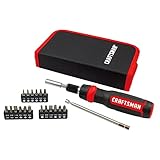
Interchangeable-bit kits provide much broader coverage in a compact case. They are particularly strong for electronics, appliances, bicycles, and computer repairs. Their limitations are a smaller handle, shorter bits in some cases, and the possibility of losing small pieces. For high-torque work, use a bit holder with a locking collar rather than a loose magnetic holder.
Wera Kraftform Kompakt systems are a strong example of the compact bit-holder approach, while Wiha’s multi-piece driver sets are known for offering fixed drivers and precision options across household and professional work. The iFixit Mako and Pro Tech Toolkit are sensible choices for electronics because they include small bits and opening tools rather than only conventional Phillips and slotted tips. Choose by the actual profiles you need, not brand familiarity alone.
Choosing the best PC screwdriver kit
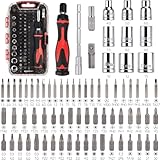
The best PC screwdriver kit normally includes Phillips #0 and #1, Torx T5, T6, T8, and T10, 2.5–3 mm hex bits, and small flat blades. A magnetic tip helps retrieve motherboard and case screws, but it should be moderate rather than excessively strong around loose components. A 4 mm precision-bit system gives more coverage than a traditional fixed-driver set.
Prioritize a rotating end cap for one-handed precision work, a textured 4 mm bit handle, and a case with a labeled bit grid. Nut drivers for 5.5 mm and 6.0 mm standoffs can save time during PC assembly. Plastic spudgers and tweezers are useful additions, but metal pry tools can scratch housings or short exposed contacts.
Choosing the best laptop screwdriver kit
Laptops often use screws that a general PC kit misses. Look for pentalobe P2 or P5, Torx T2 through T6, Phillips #00 and #000, and tri-point Y000 or Y00 where applicable. The exact profiles vary by manufacturer and model, so check a repair guide or service documentation before buying.
The case should separate tiny bits from larger ones and prevent them from spilling into a toolbox. A magnetic project mat or screw tray is nearly as important as the driver: it keeps screws organized by location, since similar-looking screws may have different lengths. Never force a bit into a partially matching recess; small fasteners strip easily and replacement parts may be difficult to source.
When a cordless screwdriver is the better choice
The best 12V cordless screwdriver suits repeated household or workshop assembly: shelving, cabinets, electrical fittings, and light construction. It delivers more speed and torque than a small USB-rechargeable driver while remaining lighter and easier to control than an 18V drill. Look for a two-speed gearbox, variable trigger, LED, 1/4-inch hex chuck, and an adjustable clutch.
A battery powered screwdriver in the 3.6–4 V class is better for flat-pack furniture, curtain fittings, and small repairs. It is compact and less likely to overdrive a screw, but it may stall on long screws or dense hardwood. A 12V model is more versatile; an 18V drill-driver is preferable when drilling holes or driving large structural fasteners.
Among electric screwdrivers cordless shoppers may consider Bosch Go for compact clutch-controlled work, or a 12V professional platform such as the Milwaukee M12 range when they already own compatible batteries. Compare the tool’s lowest clutch setting, bare-tool weight, battery cost, and bit holder—not just maximum torque. For cabinet hinges, use a low clutch setting and finish with a manual driver to avoid stripping the hinge or crushing soft material.
Storage, durability, and ownership costs
A good case has labeled positions, closes securely, and leaves enough finger room to remove bits. A soft roll is space-efficient, while a molded case protects precision bits better. Avoid storing precision tools loose with heavy pliers; repeated impact can chip small tips and deform case inserts.
The parts that wear first are usually Phillips tips, tiny Torx bits, magnetic holders, and soft handle surfaces. Replace a bit as soon as its edges round. Continuing to use it damages screw heads and can turn a five-minute repair into an extraction job. Wipe oily shafts, keep carbon-steel tips dry, and do not use precision bits as pry bars or chisels.
For a simple ownership calculation, suppose a $25 household set is used twice a month for three years: 72 repair sessions, or about $0.35 per session. A $90 professional set used weekly for the same period costs about $0.58 per session, but may be the cheaper choice if it prevents stripped fasteners and replacement tools during regular work. Frequency and failure cost matter more than the initial piece count.
Final buying advice
Choose a 10–16-piece fixed set for ordinary home maintenance, a labeled 24–64-bit precision set for PCs and laptops, or a professional mixed set with multiple shaft lengths for workshop use. Add a compact 3.6–4 V electric screwdriver for light assembly, or a 12V cordless model with a clutch when repetitive driving is part of the job. Whichever kit you choose, prioritize correct tip fit, a comfortable handle, secure storage, and replacement bits over an inflated accessory count.