What's inside
As an Amazon Associate I earn from qualifying purchases. This post may contain affiliate links at no extra cost to you.
The best splatter screen for frying pans for most home cooks is a 13-inch stainless-steel model with fine mesh, a long heat-resistant handle, and a dishwasher-safe frame. Choose a smaller screen for pans under 10 inches, or a solid silicone lid if keeping steam in matters more than crispness.
As an Amazon Associate we earn from qualifying purchases at no extra cost to you.
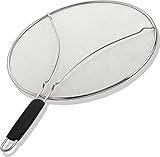
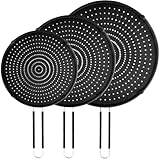

What we cover
Our Top Picks
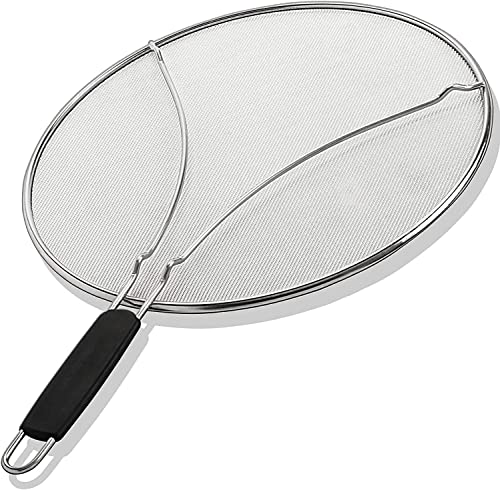

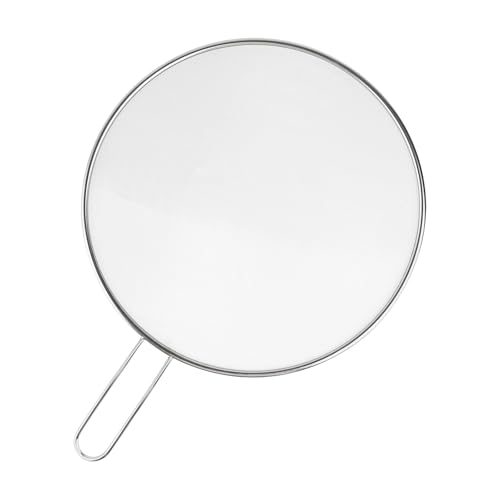
Choose for your pan and cooking style
A screen works best when it covers the pan opening without resting in the food or sitting so far beyond the rim that it tips. Measure the pan’s inside diameter across the top—not the cooking surface—and compare it with the screen’s usable mesh area. Manufacturers may list the full diameter, including the rim or handle attachment, so check the product dimensions rather than relying on “fits most pans.”
| Screen type | Typical diameter | Mesh or surface | Best fit | Trade-off |
|---|---|---|---|---|
| Compact stainless mesh | 8–10 in | Fine woven metal | Small skillets and occasional frying | May not cover a standard 12-inch pan |
| Standard stainless mesh | 11–13 in | Fine woven metal | Everyday 10–12-inch frying pans | Mesh can trap oil and food particles |
| Large stainless mesh | 13–15 in | Fine or medium woven metal | Wide pans and cooks who want one screen for several pans | Can overhang small pans or crowd storage |
| Silicone splatter guard | About 10–13 in | Perforated, solid material | Easy washing and flexible storage | Often vents less freely than mesh |
These are common size ranges, not guarantees of compatibility. A 12-inch screen may be too small for a pan with a wide 12-inch rim, while a large screen may be awkward on a narrow burner. If you use several pans, choose a diameter that sits securely on the most-used one rather than buying the largest available.
What matters beyond diameter
Mesh fineness: splatter control versus cleanup
Fine mesh catches more small oil droplets than coarse mesh, which can make it the better choice for bacon, shallow-fried cutlets, and other foods that sputter. The trade-off is that fine mesh is more likely to hold sticky grease and crumbs. Coarser mesh rinses more easily and lets steam escape freely, but may allow more fine spray through.
Mesh is not a sealed barrier. Oil can still escape around the pan rim, especially if the screen is undersized, warped, or lifted to turn food. For a useful balance, look for closely spaced woven mesh without a heavy coating of grease-trapping trim. Avoid pressing the screen down onto food: that can clog the mesh and make cleaning harder.
Handle design: reach, stability, and storage
A long handle keeps your hand farther from the pan, but length alone is not enough. Prefer a handle that is firmly attached, comfortable to grip, and angled so the screen lies flat when placed on the pan. A small hanging loop helps if you store tools on hooks; a folding handle can save drawer space but introduces a hinge that needs cleaning and can loosen over time.
Metal handles can become hot from prolonged contact with a hot pan or burner. Heat-resistant grips reduce that risk, but still use care and a dry cloth or mitt when removing a screen after cooking. Check whether the handle is oven-safe only if you plan to use it in the oven—many splatter screens are intended for stovetop use.
Steam venting and crispness
Open mesh lets steam escape, helping fried food stay drier than it would under a solid lid. That makes a mesh screen the better choice for browning and crisping. A perforated silicone guard blocks some splatter while retaining more heat and moisture; it may suit gentle simmering or reheating, but food can soften if steam cannot escape quickly enough.
If the main goal is preventing oil marks on the stovetop while frying, choose mesh. If you need to trap heat or liquid, use a lid designed for that purpose rather than expecting a splatter screen to serve as a tight cover.
Dishwasher safety and real-world cleaning
Many stainless-steel screens are labeled dishwasher-safe, but that does not mean every component is. A wooden handle, plastic grip, nonstick coating, or folding joint may have separate care requirements. Check the maker’s instructions for the entire assembly. If the screen has a rim that catches water, shake it out and let it dry fully before storing.
For easier cleanup, rinse the screen soon after it cools, before grease dries. Use a soft brush or sponge to work through the mesh; abrasive pads can damage coatings and may bend delicate wire. If dishwasher cleaning leaves residue in the weave, soak the screen in hot water with dish soap and brush both sides. Don’t handle or rinse it while it is still hot: sudden temperature changes can warp some frames, and hot oil residue can burn.
Best pick by situation
| Your situation | What to choose | Why |
|---|---|---|
| One screen for a 10–12-inch pan | 12–13-inch fine-mesh stainless steel | Good coverage and open steam venting for routine frying |
| Small pan or limited drawer space | 8–10-inch screen, or a securely locking folding-handle model | Less overhang and easier storage |
| Frequent frying and quick cleanup | Dishwasher-safe stainless steel with a simple, nonfolding handle | Fewer joints and coatings to inspect or clean |
| Maximum splash reduction | Fine woven mesh sized to the pan | Small openings intercept more droplets than coarse mesh |
| Flexible storage or a soft-touch surface | Perforated silicone, after checking heat limits | Flexible material is easy to store, though it may retain more steam |
As a general market guide, basic stainless mesh screens often fall in the roughly $10–$20 range; sturdier frames, specialty handles, and multi-size sets commonly cost more. Price is less useful than checking the mesh attachment, handle construction, fit, and care instructions.
How to check fit before buying
-
Measure the pan’s outside rim across its widest point.
-
Check the screen’s stated diameter and whether it includes the handle or outer rim.
-
Confirm that the screen can rest flat and securely without touching food or extending so far that it balances precariously.
-
If you use more than one pan, repeat the check for each. A screen that covers a 12-inch pan may be cumbersome on an 8-inch skillet.
As a rough starting point, a screen about 1–2 inches wider than the pan opening provides some coverage beyond the rim, but the shape of the frame and handle can change how securely it sits. When in doubt, prioritize stable contact over extra diameter.
What wears out first
On an inexpensive screen, the weak points are often the handle joint, a loose or warped rim, and mesh that pulls away from its frame. Folding mechanisms add another potential wear point. Inspect these areas periodically, especially if the screen rattles, no longer lies flat, or has sharp wire ends. Replace a damaged screen rather than trying to bend it back over a hot pan.
For the simplest long-term choice, look for a stainless-steel frame with securely attached fine mesh, a fixed handle, and clear dishwasher-care instructions. That combination suits most frying tasks without adding hinges or soft parts that complicate storage and washing.
Bottom line
For most kitchens, a well-fitting 12–13-inch fine-mesh stainless-steel screen is the best splatter screen for frying pans: it balances coverage, steam escape, and durability. Choose a smaller size for compact cookware, a folding handle only when storage is a real constraint, and silicone when flexible storage or gentler splatter control matters more than maximum crispness.