What's inside
As an Amazon Associate I earn from qualifying purchases. This post may contain affiliate links at no extra cost to you.
What we cover
Why Step Bits Work Well on Sheet Metal
Step drill bits are among the easiest ways to make clean holes in thin sheet metal. Instead of cutting with a long spiral flute, a step bit uses a series of increasing diameters. Each step enlarges the hole while leaving a relatively smooth edge and little risk of the bit grabbing as it breaks through.
They work best in mild steel, aluminum, copper, brass, and other sheet materials roughly 24 gauge through 1/8 inch thick. A step bit is especially useful for electrical boxes, ductwork, automotive panels, junction boxes, and mounting holes for cable glands or fittings. It is not the right tool for thick plate, hardened steel, or deep holes in solid material.
As an Amazon Associate we earn from qualifying purchases at no extra cost to you.
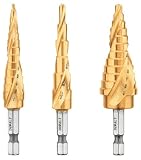
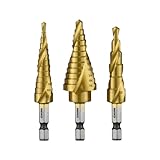
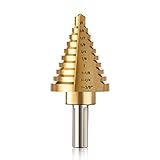

For most home and shop work, a titanium-coated step drill bit set is the sensible starting point. You get several useful diameters without buying a large collection of standard twist bits.
Features That Matter When Buying
The most important specification is the diameter range. A compact bit covering 1/8 to 1/2 inch handles many wiring and fastening jobs. A larger bit reaching 1-1/4 inches or more is useful for conduit, pipe fittings, and cable pass-throughs, but it requires more drill torque and costs more.
Look for clearly etched or laser-marked steps. Painted numbers can disappear after repeated use, especially when cutting oily steel. A split-point tip helps the bit start without skating, although a center punch is still the best way to locate a hole accurately.
Two-flute designs usually cut smoothly and shed chips well. Three-flute designs can make a more stable, round hole but may require slightly more pressure. Avoid extremely cheap bits with vague sizing, uneven steps, or no stated material. They may work once in thin aluminum, but their edges often dull quickly in steel.
| Type | Best use | Advantages | Limitations |
|---|---|---|---|
| High-speed steel | Occasional aluminum and thin steel | Lowest cost; adequate for light work | Dulls faster; coating is often absent |
| Titanium-coated HSS | General household and workshop use | Better wear resistance and reduced friction | Coating wears through if overheated or sharpened |
| Cobalt HSS | Frequent work in stainless or tougher steel | Handles more heat and keeps an edge longer | More expensive and more brittle |
| Carbide-tipped | Abrasive materials and specialized work | Very hard cutting edge | Expensive; chips if twisted or dropped |
Which Size and Material Should You Choose?
For thin mild steel up to about 18 gauge, a standard HSS or titanium-coated set is usually enough. If you only need a few holes for a project, the cheaper option is fine. There is little benefit in buying cobalt bits for two holes in a light-gauge electrical panel.
For repeated work, stainless steel, or material near the upper thickness limit, choose cobalt step drill bits. Stainless work-hardens quickly if the bit spins too fast or is allowed to rub without cutting. Cobalt will not make poor technique disappear, but it gives you a larger margin before the cutting edges lose their temper.
Check the shank size before buying. A 1/4-inch hex shank fits many drill chucks and some impact drivers, but it is not automatically impact-rated. Do not use a conventional step bit in an impact driver unless the manufacturer specifically allows it. The hammering action can chip the steps and loosen the shank. A regular cordless drill is the safer tool.
How to Drill a Clean Hole
Clamp the work securely and support the sheet close to the hole. Unsupported metal vibrates, bends, and produces a ragged exit. Mark the center with a punch. On very thin sheet, placing a scrap of plywood behind the panel can reduce distortion, though the bit will still cut better if the panel cannot flex.
Start at a low speed. For a step bit in thin mild steel, roughly 300 to 600 rpm is a useful starting range for larger steps; smaller steps can run somewhat faster. Aluminum can tolerate more speed, while stainless steel generally needs slower speed and firm pressure. The exact setting depends on the bit diameter and drill, so treat these numbers as a starting point rather than a rule.
Keep steady pressure on the bit so it cuts continuously. Too little pressure creates heat and polishes the metal instead of removing it. Too much pressure can catch the next step and twist the sheet. Use cutting oil on steel and stainless. A few drops reduce heat, improve finish, and extend bit life. For aluminum, use a light lubricant if chips begin sticking to the flutes.
Stop as soon as the desired step passes through the sheet. Continuing to run the bit deeper can enlarge the hole by one or two sizes before you notice. Withdraw the bit while it is still rotating slowly, then remove the sharp burr with a deburring tool or a larger twist bit turned by hand.
Common Failures and How to Avoid Them
The most common mistake is using high speed with no lubricant. The cutting edge turns blue, the coating discolors, and the bit becomes dull after only a few holes. If the bit starts squealing or producing smoke, stop and let it cool.
A second problem is drilling through a single unsupported panel. The metal can wrap around the bit as it breaks through, making an oversized or oval hole. Clamping the sheet and backing it with wood helps considerably.
Step bits also struggle with thick material. Their short cutting sections are designed for sheet, not a 1/2-inch steel plate. For thick stock, use a cobalt twist bit, annular cutter, or hole saw matched to the job. If you need large holes regularly, a metal-cutting hole saw kit may be a better investment.
Safety and Maintenance
Wear eye protection because step bits throw sharp spiral chips and burrs. Gloves can help when handling the cut sheet, but keep them away from a rotating bit. Disconnect the drill before changing bits. After use, wipe away cutting oil and chips, inspect the steps for chipped edges, and store the bits where they cannot knock against other hardened tools.
For occasional holes in thin aluminum or mild steel, an inexpensive HSS set is perfectly adequate. Spend more on titanium or cobalt when you drill frequently, work in stainless, need consistent hole sizes, or cannot afford premature dulling. The drill technique—slow speed, firm pressure, support, and lubrication—usually matters more than the label on the case.