What's inside
As an Amazon Associate I earn from qualifying purchases. This post may contain affiliate links at no extra cost to you.
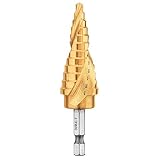
A step drill bit is a practical choice for enlarging a hole in thin sheet metal, especially when you need a clean, round opening without changing bits several times. Its stepped cutting edges make progressively larger holes as the bit advances. The trade-off: it is meant for sheet and other thin materials, not thick plate or deep holes.
As an Amazon Associate we earn from qualifying purchases at no extra cost to you.



What we cover
Choose by material and hole range
Check the material rating and the diameter markings before buying. Most general-purpose step bits are intended for mild steel, aluminum, plastic, or similar thin stock. Stainless steel is harder on cutting edges; use a bit specifically rated for it, work slowly, and apply cutting fluid. A bit’s advertised maximum diameter is not the same as its useful range: compare the individual step sizes with the hole sizes you actually need.
For occasional electrical-box or workshop jobs in thin sheet, a basic high-speed-steel (HSS) bit is often enough. A titanium-nitride coating can help reduce friction, but it does not make a poor-quality or dull bit suitable for heavy use. Cobalt-alloy bits cost more and can be worthwhile for frequent work in tougher metals, though correct speed and lubrication still matter. See HSS step drill bit sets for a budget-friendly starting point.
Step bit, twist bit, or hole saw?
| Tool | Best use | Main trade-off |
|---|---|---|
| Step drill bit | Several hole sizes in thin sheet | Limited by step range and material thickness |
| Twist drill bit | Small holes, or a single size in thicker stock | Large holes can grab; often needs a pilot hole |
| Hole saw | Larger openings in sheet or other materials | More setup, rougher edges, and a center pilot to manage |
A step bit usually leaves less burr than a large twist bit in thin sheet, but it will not produce a perfectly finished edge every time. If you need one large opening in material thicker than the bit’s rated capacity, a hole saw or an appropriate punch may be a better tool.
Features worth paying for
Look for clearly marked step diameters, a shank compatible with your drill chuck, and a cutting range that covers your target sizes. A two-flute design is common and works well for many general jobs. Split-point tips can help the bit start without wandering, but a center punch is still useful on smooth metal. A hex shank can reduce slipping in a chuck, though it does not turn the bit into an impact-driver accessory: use a regular drill, not an impact driver.
Single bits make sense when you only need one range. Sets are convenient when you regularly work across multiple hole sizes, but check that the set’s steps are useful rather than paying for duplicate coverage. For frequent cutting in stainless steel, compare cobalt step drill bits with ordinary HSS options and confirm that the manufacturer lists stainless as a suitable material.
How to enlarge a hole cleanly
First secure the workpiece so it cannot spin or chatter. Clamp sheet metal to a sacrificial backing board where practical, and support the area close to the hole. Wear eye protection; thin chips and sharp burrs can cut skin, so gloves are useful when handling the workpiece but should be kept away from rotating machinery.
Mark the center and make a small dimple with a center punch. Set the drill to low speed, keep it square to the sheet, and use light, steady pressure. For thin mild steel, roughly 500–1,000 rpm is a sensible starting range for many small step bits; reduce speed for larger diameters, tougher alloys, or a bit that starts to squeal. Follow the bit maker’s speed guidance when available. Use cutting fluid on steel, especially stainless, and withdraw the bit occasionally to clear chips. Stop as soon as the desired diameter reaches the workpiece; going one step too far means the hole cannot be made smaller.
Deburr both sides with a hand deburring tool or file. Do not try to control a spinning bit by grabbing the sheet or pushing sideways. If the metal begins to vibrate, the edge turns blue, or the drill stalls, stop and check clamping, speed, and bit condition.
Common problems and fixes
Oversized or out-of-round hole: The sheet moved, the drill tilted, or the bit advanced past the intended step. Re-clamp, center-punch, and check the diameter markings as you work. If the hole must meet a close tolerance, a step bit may not be the right finishing tool.
Ragged edge or heavy burr: A dull bit, excessive pressure, or unsupported sheet can cause tearing. Back the sheet with wood, slow down, and let the cutting edge do the work. Replace or sharpen the bit if it rubs instead of cutting.
Bit squeals or overheats: Excessive speed, dry cutting in steel, or a worn edge can produce heat quickly. Stop, let the bit cool, apply suitable cutting fluid, and resume at a lower speed. Do not quench a hot bit; sudden cooling can damage it.
Bit slips in the chuck: Clean the shank and tighten the chuck firmly. A drill with a sound keyed or keyless chuck is adequate for most sheet-metal work. Spending more is justified for repeated jobs, harder alloys, or better wear life; for a few holes in thin aluminum or mild steel, a basic HSS step bit and a steady cordless drill are usually enough.