We research everything we recommend. When you buy through our links, we may earn a commission. As an Amazon Associate we earn from qualifying purchases.
4 Best Variable Speed Presses for Precision (November 2026)
Variable speed drill presses with verified Amazon specs: Powermatic PM2800B, JET JWDP-12 and two WEN models for precision drilling in wood and metal.
As an Amazon Associate I earn from qualifying purchases. This post may contain affiliate links at no extra cost to you.
Precision drilling is mostly a speed problem. A bit that spins too fast in steel overheats and work-hardens the hole; too slow in wood and it tears instead of cutting. A variable speed press lets you set the RPM the material and bit diameter actually call for, and change it in seconds when the next operation uses a different cutter. The decision is which type of variable drive, how wide the range runs, and whether the machine around it is rigid enough for the setting to matter.
This guide is for woodworkers, metalworkers and mixed-material shops that change bits and materials often enough that fixed pulley steps feel like a compromise. The four machines below were chosen from their Amazon listings, and each one states its variable speed range, motor and swing in the product details. Two are benchtop models for smaller shops, one is a compact second option, and one is a full floor-standing press for buyers who want variable speed at production scale.
A benchtop press with a wide range and digital readout
1/2 HP, variable 530-3,100 RPM, 12 in. swing
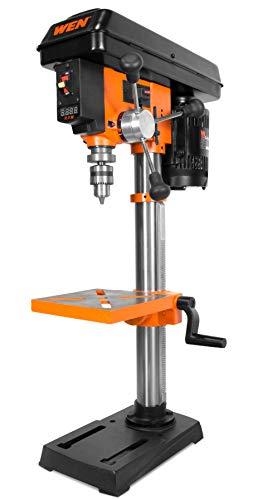
WEN 12-Inch Benchtop Drill Press, 6.2-Amp Variable Speed Motor with Cast Iron Construction, Laser and LED Work Light (DP1263V)
Variable speed with laser, light and a roller table
6.2A, variable 580-3,100 RPM, 12 in. swing
WEN 10-Inch Benchtop Drill Press, 6.2-Amp Variable Speed Motor with Cast Iron Construction, and Laser (DP1062V)
Compact variable speed for smaller benches
6.2A, variable 530-3,100 RPM, 10 in. swing
How to Choose
Separate mechanical variable drive from electronic control
Both approaches appear in this list, and they behave differently. A mechanical variable system, used by the Powermatic and both WEN models here, changes pulley geometry while the motor runs, so speed changes are immediate and torque stays strong at low RPM. Electronic control on a smaller motor can feel convenient but may lose torque at the bottom of the range. For precision drilling in metal, where low speeds carry the hardest work, a mechanical drive with a clear RPM readout is the safer specification to shop for.
Check both ends of the speed range
The range endpoints tell you what the press can really do. A low end near 250 to 530 RPM suits larger bits in steel and big Forstner bits in hardwood, while a top end around 3,000 to 3,100 RPM suits small bits in wood and plastics. All four machines here reach roughly 3,000 RPM or more; the floor-standing Powermatic goes lowest, at 250 RPM, which is a genuine advantage for large-diameter work. Buy for the slowest work you do regularly, not the fastest.
Let chuck size and spindle travel filter the list
A 5/8 inch chuck, fitted to three of these four machines, accepts the larger bits that precision project work tends to need, while the compact WEN’s 1/2 inch chuck suits smaller tooling. Spindle travel matters just as much: the Powermatic’s 6 inches handles deep holes in one stroke, the two 12 inch benchtop models offer 3-1/8 inches, and the compact model offers 2 inches. If your projects involve thick stock or deep mortise-style boring, short travel means repositioning work and risking alignment.
Weigh the bench models before you assign them a home
The two 12 inch benchtop presses here each weigh about 85 pounds, which is heavy enough to stay planted during drilling but heavy enough that nobody will move them casually. The compact 10 inch WEN, at 57 pounds, can share a bench with other tools. Plan a permanent, level bench position with room for the table to tilt and for long stock to pass on either side, because a variable speed press earns its keep only when it is set up and ready, not stored.
Floor-standing precision work, including large bits and deep holes in wood and metal
Watch out for
It is a full-height floor press that needs dedicated floor space, and it is wired 115V as shipped, so check the listing if your shop plans to run it on 230V.
The PM2800B is the precision pick when low speed is the priority. Its mechanical variable drive runs from 250 to 3,000 RPM with no belt changes, so a large bit in steel or a wide Forstner in hardwood can turn slowly with torque behind it, and the 6 inch spindle travel is the deepest here by a wide margin. The 18 inch swing and floor-standing build suit cabinet-scale and machine work alike. It is the largest and heaviest commitment in this list, and the one that behaves most like a permanent shop fixture.
JET’s JWDP-12 pairs a 530 to 3,100 RPM variable range with a digital RPM readout, so the speed you intend is the speed displayed before the bit touches the work. The 1/2 HP motor, 5/8 inch chuck and 3-1/8 inch spindle travel match the capacity most precision project work needs, and the cast iron base helps an 85 pound benchtop machine stay composed under load. The table tilts 45 degrees both ways for angled holes. It suits a dedicated bench in a shop that splits time between wood and light metal.
WEN 12-Inch Benchtop Drill Press, 6.2-Amp Variable Speed Motor with Cast Iron Construction, Laser and LED Work Light (DP1263V)
The WEN DP1263V covers the same 12 inch swing class as the JET with a 6.2-amp motor and a mechanical variable range of 580 to 3,100 RPM shown on a digital LED readout. Where it differs is setup help: the listing includes a laser guide, an LED work light and a table roller extension that supports longer stock, all of which matter when precision work means lining up many holes in sequence. Its cast iron construction and 85 pound weight keep it planted. It is the most feature-complete benchtop option in this group.
Specs
Motor: 6.2-amp induction motor, 120V, per the listing
Speed: mechanical variable speed, 580 to 3,100 RPM, with a digital LED readout
Swing: 12 in.
Spindle travel: 3-1/8 in.
Chuck: 5/8 in. keyed chuck
Table: 9-1/2 x 9-1/2 in., bevels 45 degrees left and right, with a roller extension
Listing features: laser guide, LED work light, adjustable depth stop
Weight: 85 lb
Best for: Benchtop shops that drill long stock and want alignment aids built into the listing
Watch out for: The low end starts at 580 RPM, higher than the JET and Powermatic, so very large bits in steel run faster than ideal; check your biggest cutter against that floor.
ASIN: B0DQ9F3DX8
WEN 10-Inch Benchtop Drill Press, 6.2-Amp Variable Speed Motor with Cast Iron Construction, and Laser (DP1062V)
WEN 10-Inch Benchtop Drill Press, 6.2-Amp Variable Speed Motor with Cast Iron Construction, and Laser (DP1062V)
Best for: Compact benches doing precision work in small parts and light materials
Motor: 6.2-amp induction motor, 120V, per the listing
Speed: mechanical variable speed, 530 to 3,100 RPM, with a digital readout
The DP1062V shrinks the variable speed idea into a 10 inch swing, 57 pound machine that still offers a mechanical drive from 530 to 3,100 RPM and a digital readout. That combination is rare at this size: most compact presses force you into five fixed speeds. The trade-offs are a 1/2 inch chuck and 2 inches of spindle travel, which cap bit size and hole depth. For precision work in small parts, jewelry-scale metal, models and light woodworking, those limits rarely bind, and the smaller table is easier to keep clear.
Which One Fits Your Situation
A mixed shop switching between steel and hardwood daily
Choose the Powermatic PM2800B if floor space allows. Its 250 RPM low end is the only one here truly suited to large bits in steel, and the mechanical drive holds torque there. If the work must live on a bench, the JET JWDP-12 is the fallback, accepting a higher 530 RPM floor in exchange for the smaller footprint.
A furniture bench drilling repeated, aligned holes
The WEN DP1263V fits this work because the laser guide, work light and roller extension all support repeatable setups on longer stock. Variable speed lets you slow down for large Forstner bits in hardwood without opening the head to move a belt, which keeps a production rhythm intact across a run of identical parts.
A small bench reserved for detail and model work
The WEN DP1062V is the right scale here. Its 10 inch swing, light weight and full variable range suit small parts, and the 2 inch travel is rarely a limit at this size. It leaves bench room for the vises, fixtures and measuring tools that detail work accumulates around the press.
A training or shared bench with several operators
The JET JWDP-12 suits shared use because the digital readout makes the set speed visible to everyone, which removes a whole category of setup arguments and mistakes. Its cast iron base and mid-range motor tolerate varied work, and the 5/8 inch chuck accepts the tooling a shared shop typically owns.
Common Mistakes
Judging a variable speed press by its top speed and ignoring the low end, where large bits in metal actually run.
Assuming every variable drive holds torque at low RPM; mechanical and electronic systems behave differently under load.
Buying a 1/2 inch chuck machine for work that needs 5/8 inch tooling.
Setting an 85 lb benchtop press on a wobbly stand and blaming the machine for poor holes.
Never using the depth stop on repeat work, then wondering why blind holes vary.
Frequently Asked Questions
What RPM do I actually need for precision drilling?
It depends on bit size and material. Large bits and hard metals want low speeds, often a few hundred RPM, while small bits in wood run happily near 3,000 RPM. The low end of a variable range matters more than the top: every press here reaches about 3,000 RPM, but their low ends run from 250 to 580 RPM, and that difference decides your largest usable bit in steel.
Is a digital RPM readout worth having?
For repeat work, yes. A readout turns speed setting from a guess into a recorded number, so a setup that worked last month can be repeated exactly. Three of the four machines here include one. Without a readout you can still work precisely, but you are trusting a lever position or a chart, and small errors show up as overheated bits in metal or torn grain in wood.
Can a benchtop variable speed press drill steel accurately?
Yes, within its capacity. The 12 inch models here pair a 5/8 inch chuck with 3-1/8 inches of travel and enough rigidity for accurate holes in mild steel at sensible bit sizes. The limits are motor power and that low-speed floor: keep large bits slow, use cutting fluid, and clamp the work. For sustained large-hole work in steel, the floor-standing model is the more honest tool.
What is the difference between swing and spindle travel?
Swing is twice the distance from the spindle center to the column, so it sets the widest workpiece you can center a hole in: a 12 inch swing centers a hole in a 12 inch panel. Spindle travel is how far the quill moves in one stroke, which sets single-pass hole depth. Buyers confuse the two; a press can have generous swing and still force repositioning of thick work.
M
Miller the Driller Editorial Team
We compare specs, warranty terms, long-term owner feedback and street pricing before anything earns a spot. Rankings are never paid.
Affiliate disclosure. As an Amazon Associate we earn from qualifying purchases at no extra cost to you. Prices accurate as of the date shown.
Find the best golf headcovers for woods, driver, fairway wood, and hybrid clubs. Compare knit, nylon, and leather sets that protect clubheads and fit modern woods.
Compare the best Porter-Cable routers for woodworking, from the compact 450 to the 691 D-handle router and the 693LRPK two-base kit, by motor and base.
Compare the best wood spoon sets in teak and sheesham, from 7-piece and 10-piece cooking sets with spatulas and ladles for nonstick pans and daily use.
Compare four tool box sets, from a stackable three-piece tower to steel boxes on wheels, with drawer, latch and capacity checks for home and site work.
Current Windows laptops for photographers chosen by colour-accurate screens, RAM, SSD storage and card readers, with a clear note on Windows 7 support.
Compare four insect repellent sprays for beach days, from picaridin and DEET aerosols to a plant-based pump, with sizes, coverage times and beach-bag fit.