
Our Short List of 3
All 3 Picks at a Glance
| Product | Specs | Action |
|---|---|---|
 Milwaukee M18 Compact Brushless Drill/Driver Kit (2801-22CT) | Check price on Amazon | |
 Makita 18V LXT Brushless Driver-Drill Kit (XFD131) | Check price on Amazon | |
 Ryobi 18V ONE+ Drill/Driver Kit (PCL201K1) | Check price on Amazon |
Our Top Picks
- Makita XFD131 18V LXT® Lithium-Ion Brushless Cordless 1/2"One Size10.16 x 15.08 x 6.06 inches7.25 poundsCheck on Amazon

What's inside
As an Amazon Associate I earn from qualifying purchases. This post may contain affiliate links at no extra cost to you.
- Top Pick: Milwaukee M18 Compact Brushless Drill/Driver Kit (2801-22CT)
- Runner-up: Makita 18V LXT Brushless Driver-Drill Kit (XFD131)
- Also consider: Ryobi 18V ONE+ Drill/Driver Kit (PCL201K1)
Black Friday falls on 27 November 2026, and drill kits will fill the event pages from every major platform. This guide is not another ranked list. It is a framework for comparing kits line by line, so the kit you order is the one that fits your work, your bench and your future tool plans. Offers change quickly during the event, and listings change with them, so check the current price and the current offer on the Amazon product page before you order anything.
A cordless drill kit is really a platform decision with a drill attached. The batteries and charger in the box shape every tool you buy afterward, which is why comparing kits well matters more than comparing drills alone. The sections below walk through what to compare, what a kit actually includes, when buying during the event window makes sense, and when waiting is the wiser call.
As an Amazon Associate, we earn from qualifying purchases.
What we cover
Quick answer
Compare kits by platform first, then by what is in the box: battery count and capacity, charger type, and case. Pick the voltage class that matches your work, choose a drill/driver unless you drill masonry, and buy during the event only when the kit fits a plan you already had. Otherwise, waiting loses you nothing.
How to choose
Begin with the battery platform. Each brand’s batteries fit only that brand’s tools, so a first kit quietly commits you to one system for years. DEWALT 20V MAX, Milwaukee M18, Makita 18V LXT, Bosch 18V and Ryobi 18V ONE+ are all mature systems with deep tool catalogues. If you already own batteries from one of them, that platform wins by default, and a bare tool may serve you better than any kit.
Next, settle the voltage class. Compact 12V kits suit flat-pack furniture, cabinet work and light household jobs, and they weigh less in the hand. The 18V and 20V MAX class is the mainstream choice for general work, from hanging doors to building a deck frame. Above that, heavy-duty lines exist for daily trade use, but most home workshops gain little from them.
Then decide between a drill/driver and a hammer drill. A drill/driver covers wood, metal and plastic, plus driving screws with its clutch. A hammer drill adds a percussion mode for brick and block. If you rarely touch masonry, the plain drill/driver is usually lighter and shorter, and it is the tool you will reach for more often.
Motor type comes next. Listings describe brushed and brushless motors, and the wording on the page tells you which you are getting. Brushless models tend to be more compact for their output and are the current direction of every major line. Brushed models remain simple, proven and widely sold in entry kits. Neither label decides a purchase alone; it is one line in the comparison.
Finally, read the kit contents as carefully as the drill. Two batteries let you work while one charges; a single battery means downtime on long jobs. Note the charger type the listing names, and whether the box holds a hard case, a soft bag or neither. The kit maths is simple: a kit only helps if you will use the second battery and stay on that platform. Paying for batteries you will never rotate is waste, and a bare tool plus one battery can be the smarter shape for an owner who already has a charger.
What a kit actually includes
A typical kit holds five things: the drill, one or two batteries, a charger, a belt clip or bit holder, and a case or bag. Event listings sometimes bundle extras, so read the included components list on the product page line by line rather than trusting the headline photo.
Check the battery count and the amp-hour figure printed for each pack, because two kits with the same drill can ship with very different batteries. Check whether the charger is a standard or rapid unit as the listing describes it, since that shapes how a single-battery kit behaves in real work. Check the case, too: a hard case stacks and protects, while a soft bag carries more and weighs less.
Also confirm the chuck size, most often 1/2 inch in this class, and whether the chuck is metal or plastic as listed. Confirm the model number in the title matches the model number in the details, because similar kits with different battery bundles sit side by side during the event. If a line in the box contents matters to you and the page does not name it, treat it as absent.
Buy during the event if
- You already planned to buy a drill kit this season and know which platform you want.
- Your current drill is failing, borrowed or shared, and a project is waiting on it.
- You are entering a platform for the first time and the kit’s batteries match tools you plan to add later.
- The kit in front of you includes two batteries and a case, the shape you had already decided on.
- You have read the full listing, confirmed the model number, and the contents match your plan.
Wait if
- You are choosing a platform on impulse and have not thought about which tools you want next.
- You already own a healthy drill on a system you like, and the event kit adds nothing but a spare.
- The listing is unclear about battery count, charger type or case, and a clearer listing may appear later.
- Your real need is a hammer drill, an impact driver or a bare tool, not the drill/driver kit being promoted.
- The project that would justify the kit is months away, giving you time to compare without a deadline.
Five kits to compare
These five kits anchor the comparison. They span the main platforms and both motor types, and each one shows a different kit shape worth weighing against the framework above.
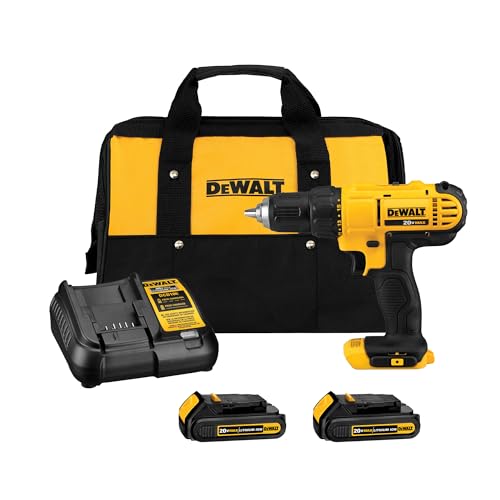
DEWALT 20V MAX Drill/Driver Kit (DCD771C2)
A long-running entry point into the DEWALT system, built around a compact two-speed drill/driver. The box is generous for its class: two batteries, a charger and a contractor bag, which makes it a clean example of a two-battery first kit. It suits new homeowners and anyone beginning a 20V MAX collection from zero.
Specs:
– Platform: DEWALT 20V MAX
– Chuck: 1/2 inch
– Speeds: 0-450 and 0-1,500 RPM, as listed
– Motor output: 300 UWO, as listed
– Batteries: two 1.3Ah lithium-ion packs included
– Case: contractor bag included
Milwaukee M18 Compact Brushless Drill/Driver Kit (2801-22CT)









