What's inside
As an Amazon Associate I earn from qualifying purchases. This post may contain affiliate links at no extra cost to you.
What we cover
Drill Press Tables and Fences: Features Worth Buying
For most benchtop drill presses, the best drill press table and fence is a rigid, flat table roughly 12 by 24 inches, with usable T-slots, a fence that adjusts and locks square, and mounting hardware that fits your machine’s column or original table. Choose a smaller, lighter setup for occasional work and limited space; choose a larger table with more secure clamping for wide panels, repetitive hole patterns, or frequent shop use.
Start with the workpiece, not the advertised table size
Table dimensions matter most when they support the material around the hole and leave room for clamps. A 12-by-12-inch surface can suit small parts and general repairs, but it may not support a cabinet door or long board without additional rollers or a separate support surface. A 12-by-24-inch table provides more room for stops and clamps while remaining manageable on many benchtop machines. Larger tables can be useful for panel work, but they add leverage and weight, so confirm that the press can support them.
As an Amazon Associate we earn from qualifying purchases at no extra cost to you.

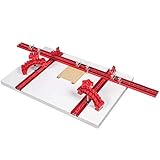


Check the usable flat area, not just the overall dimensions. A fence, removable insert, edge lip, or handle can reduce the space available for the workpiece. Also check whether the table’s front-to-back depth lets the fence sit far enough from the bit for your usual drilling positions.
| Table size (approx.) | Best fit | Trade-off | Fence and slot features to prioritize |
|---|---|---|---|
| 12 × 12 in. | Small parts, hobby projects, tight benches | Limited support for wide stock | One reliable slot for a stop or clamp; compact fence |
| 12 × 24 in. | General woodworking and repeat drilling | Needs more bench and machine capacity | Two or more parallel slots; fence long enough to support the stock |
| 16 × 24 in. or larger | Wide panels and frequent production tasks | Heavier, costlier, and more demanding to mount securely | Multiple slots, adjustable fence, and strong mounting points |
These are practical size categories, not guaranteed standards. Measure your press and work area before buying; product dimensions and mounting layouts vary.
When a fence is worth paying for
A fence makes it easier to position stock consistently and keep it from rotating, especially when drilling a row of holes. Look for a straight, rigid face with secure locks at both ends. If one end can slide while the other is tight, the fence may skew under pressure. A fence that adjusts across the table is more useful than one fixed permanently in place, and a replaceable sacrificial face lets you drill close to the fence without damaging its main body.
For occasional one-off holes, a basic fence or a clamped straightedge may be enough. For repeated hole spacing, prioritize smooth adjustment, a readable scale if provided, and a stop block that locks without shifting. A scale helps with rough positioning, but verify critical dimensions against a rule or square rather than assuming the scale is perfectly calibrated.
A fence is not a substitute for holding the work securely. Clamp small parts, round stock, and pieces that could catch on the bit. Keep hands clear and avoid relying on friction against the fence alone.
T-slots, inserts, and mounting compatibility
T-slots let you secure a fence, stop block, or clamp without drilling holes in the table. Check the slot shape and width against the hardware you plan to use: “T-slot” does not guarantee that every bolt or accessory will fit. More slots offer flexibility, but their placement matters. Slots running parallel to the fence are useful for stops; slots across the table can help position other fixtures. Confirm that clamps can reach the work without interfering with the drill chuck or column.
A replaceable center insert is useful because the bit can pass through it without striking the table. Inserts are consumables: repeated drilling enlarges the opening, and a worn insert gives less support to the workpiece. Choose a table with readily available replacements or a design that accepts a shop-made insert.
Before ordering, check how the table mounts. Some aftermarket tables attach to the drill press’s existing table; others use a collar or bracket around the column. Compare the mounting method, column diameter, available clearance, and the press’s original table dimensions. Make sure the new surface can be raised, lowered, tilted, and locked as intended. A heavy table that technically fits but blocks the press’s adjustments is not a good match.
Pick by shop and task
| Your situation | What to choose | Why |
|---|---|---|
| Occasional projects, limited budget or space | Compact table, basic adjustable fence, secure mounting | Provides useful support without adding much bulk or cost |
| Newer user drilling mixed parts | Medium table, two locking fence points, replaceable insert | Offers room to work and makes setup easier to repeat |
| Frequent drilling or repeated hole patterns | Larger rigid table, multiple compatible T-slots, stop block | Improves support and speeds consistent positioning |
| Wide panels or long stock | Table sized to the work plus auxiliary support | A large table alone cannot safely support material that extends far beyond it |
| Older or unusual drill press | Measure first; consider a mounting plate or custom adapter | Compatibility is more important than advertised universal fit |
Buying a replacement—or building your own
A replacement drill press table makes sense if the original is too small, damaged, or poorly suited to clamping. Compare its mounting pattern with the press and account for the added height: a thick table can reduce the maximum distance between the chuck and workpiece. If the original table tilts, confirm that the replacement arrangement preserves a practical way to set and lock the angle.
A DIY drill press table can be a good choice when you need a nonstandard size or want a replaceable center insert. Plans for a drill press table are most useful when they specify mounting details and fence travel—not just the top dimensions. A simple design can use a flat, stable top, a sacrificial insert, and a straight fence secured with bolts or clamps. For a drill press table DIY project, measure the column and original table, check clearance through the full height range, and make the mounting structure rigid enough that the surface does not shift under drilling pressure.
Shop-made tables can cost less, but the real trade-off is time spent making the surface flat, aligning the fence, and ensuring the mount cannot rotate. Avoid a top that flexes or a mount that depends on a loose friction fit. Whether you buy a table or build one, test fence alignment with a square and check that all locks stay tight before drilling.
Ownership details that affect long-term value
On a table used often, the center insert and fence face usually show wear first. Replace or rotate them when the opening becomes too large, the face is badly grooved, or the fence no longer supports the stock evenly. Sawdust packed in T-slots can make accessories bind, so brush out the slots and keep bolts and sliding hardware clean. Check mounting fasteners periodically; vibration can loosen them.
Common setup mistakes include buying by surface dimensions alone, assuming T-slot hardware is universal, and overlooking the press’s weight and clearance limits. A square, a tape measure, and a quick check of the machine’s full adjustment range can prevent an expensive mismatch. The most useful setup is not necessarily the biggest: it is the one that supports your actual stock, locks securely, and fits the press without compromising its adjustments.