What's inside
- Kreg Adaptive Cutting System: Track, Saw, and Kit Options
- What the system includes—and what “track” means
- Key numbers and practical limits
- Which option fits your shop?
- Setup that helps the system cut accurately
- Track saw versus table saw versus circular-saw guide
- Ownership, maintenance, and the bottom line
- Kreg Adaptive Cutting System: Track, Saw, and Kit Options
- What the system includes—and what “track” means
- Key numbers and practical limits
- Which option fits your shop?
- Setup that helps the system cut accurately
- Track saw versus table saw versus circular-saw guide
- Ownership, maintenance, and the bottom line
As an Amazon Associate I earn from qualifying purchases. This post may contain affiliate links at no extra cost to you.
What we cover
- Kreg Adaptive Cutting System: Track, Saw, and Kit Options
- What the system includes—and what “track” means
- Key numbers and practical limits
- Which option fits your shop?
- Setup that helps the system cut accurately
- Track saw versus table saw versus circular-saw guide
- Ownership, maintenance, and the bottom line
Kreg Adaptive Cutting System: Track, Saw, and Kit Options
The Kreg Adaptive Cutting System makes the most sense if you want a guided plunge saw that can also serve as the basis for a portable work surface; choose the Master Kit for a ready-to-use setup, or the track and saw separately if you already have compatible support and accessories. It sits between a basic circular-saw guide and a full table saw: more controlled for breaking down sheet goods than a bare circular saw, but less suited to repeated narrow ripping, joinery, or production work than a well-equipped table saw.
What the system includes—and what “track” means
The core is Kreg’s 62-inch guide track and a dedicated plunge saw. The track uses an anti-slip underside and a guide edge to help keep the saw on course. The saw’s splinter guard is intended to align with the cut line, while the plunge mechanism lets you start a cut within a panel rather than only at its edge. Together, these features are useful for cabinet sides, doors, shelving, and other large parts that are awkward to feed across a small shop table saw.
As an Amazon Associate we earn from qualifying purchases at no extra cost to you.
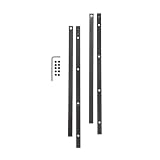


The track is not a substitute for a work surface. You still need to support the sheet or board on a suitable sacrificial surface, such as foam insulation board on a stable floor or a compatible cutting table. Clamps may be needed when the track or workpiece could shift. Check the current package contents before buying: track, saw, blade, clamps, storage, and table components vary by kit and retailer.
Key numbers and practical limits
| Item | Published specification | What it means in use |
|---|---|---|
| Guide track | 62 in. (about 1,575 mm) | Long enough for many crosscuts across 4 × 8 ft. sheet goods; longer rips require repositioning or an extension-compatible arrangement. |
| Saw blade | 6½ in. diameter | A smaller blade than the common 7¼-in. circular saw; use the system’s specified blade type and do not assume standard saw blades are interchangeable. |
| Cutting depth at 90° | 2⅛ in. (about 54 mm) | Enough for typical sheet goods and many solid-wood cuts within that depth, but not for thicker stock that a larger saw may handle. |
| Cutting depth at 45° | 1½ in. (about 38 mm) | Bevel capacity is lower, as expected; verify the thickness of the material before planning a bevel cut. |
| Power | 120 V corded | No battery runtime or charger to manage, but the cord needs routing so it cannot catch the track or workpiece. |
Specifications can vary by model or revision, so confirm the exact saw and kit documentation before purchase. The important trade-off is clear: the 62-inch track favors controlled cuts across common panel dimensions, while the 6½-inch blade limits depth compared with many full-size circular saws.
Which option fits your shop?
| Your situation | Best starting point | Why |
|---|---|---|
| You are new to track-guided cutting and need the main components together | Kreg Adaptive Cutting System Master Kit | It is the simplest route to a coordinated saw-and-track setup; check whether the particular package includes the table and accessories you expect. |
| You already own a suitable work surface, clamps, or storage | Saw and track package, if offered | A smaller package can avoid paying twice for support gear, but confirm compatibility and included blade and connectors. |
| You make occasional straight cuts on panels and prioritize low cost | Circular saw with a straightedge or guide | Usually the least expensive approach. It can be accurate with careful setup, but may take more effort to align and control. |
| You regularly rip narrow boards, repeat identical parts, or use jigs | Table saw | A fence and stable infeed/outfeed support are more efficient for repeatable narrow cuts and many shop operations. |
| Your projects involve large sheets but your shop has little permanent floor space | Adaptive system with a folding or stowable support setup | The saw and track store more compactly than a large cabinet saw; the work surface still takes space while in use. |
Is the Master Kit worth choosing?
The Kreg Adaptive Cutting System Master Kit is the sensible pick when you want a coordinated package rather than assembling the essentials one by one. Its value depends on what is actually in the box: kits can bundle a cutting table, track, saw, clamps, and storage, but package contents may change. Compare the itemized contents against your existing equipment before treating “kit” as synonymous with “everything needed.” You will still need a stable, level setup and an appropriate surface beneath the cut.
For a buyer who already owns clamps and a suitable panel-cutting surface, a less-complete package may be better value. Conversely, if you would otherwise buy the table and accessories individually, the kit can simplify compatibility and setup.
Setup that helps the system cut accurately
- Support the whole panel. Place sheet goods on a stable sacrificial surface so the offcut cannot drop or pinch the blade. Foam board is a common option because it supports the panel while allowing a shallow blade pass.
- Mark and place the track deliberately. Align the guide edge to the intended cut line, accounting for the saw’s reference edge and the actual kerf. For a first cut, verify the alignment on scrap rather than trusting a mark made for a different saw or guide.
- Prevent movement. Keep the panel flat and secure the track where needed. A long track cannot compensate for a shifting workpiece.
- Set depth just beyond the material. A modest amount of blade protrusion through the panel reduces unnecessary cutting into the sacrificial surface. Follow the saw manual for blade and depth adjustments.
- Manage the cord and make a test cut. Route the cord behind the saw’s travel path, then check the cut edge and dimensions before processing the remaining parts.
These steps matter because a track saw’s accuracy depends on the whole setup—not just the track. A bowed or unsupported panel, a track that creeps, or an incorrect offset can produce a clean-looking cut in the wrong place.
Track saw versus table saw versus circular-saw guide
Choose the Kreg system for controlled breakdown of large stock. A track-supported saw is easier to bring to a full sheet than a table saw is to bring the sheet to. That is especially useful when working alone, in a garage, or in a small shop. It also makes plunge cuts and cut-line alignment more manageable than a bare circular saw.
Choose a table saw for repeatability and small parts. A good fence makes repeated rips fast, and the table supports smaller workpieces more naturally. It needs more permanent space and safe infeed and outfeed room, and handling full-size panels on a table saw can be cumbersome.
Choose a circular-saw guide for the lowest-cost occasional solution. A guide or straightedge can deliver accurate cuts with careful measurement and clamping. The trade-off is usually slower setup and fewer integrated features, not an inability to make a straight cut.
The Adaptive system is not automatically the best choice for every cut. Its dedicated saw and track are a focused investment; if you mostly cut short boards or make repeated narrow rips, a table saw may earn its footprint more often. If you only break down a few sheets a year, a simpler guide may cover the job.
Ownership, maintenance, and the bottom line
Keep the track’s contact surfaces clear of sawdust and debris; grit can affect grip and cause the guide to sit unevenly. Inspect the splinter guard and replace it when it no longer supports a clean reference edge. The blade is a consumable: dull or pitch-coated teeth can worsen cut quality and make the saw work harder. Use a blade intended for the material and finish you need, and follow the manual for cleaning, adjustment, and replacement.
Protect the track from impacts and avoid storing it where it can bend. Before a critical cut, check that the track is straight, the saw runs smoothly on it, and the workpiece is secure. Common avoidable problems include cutting with inadequate panel support, allowing the offcut to pinch the blade, assuming the printed mark is the cut line without checking the offset, and buying a kit without confirming its exact contents.
In short, the Kreg Adaptive Cutting System is a strong fit for woodworkers who often break down sheet goods and need a stowable, guided alternative to moving large panels across a table saw. The 62-inch track and 2⅛-inch maximum 90-degree depth suit many cabinet and furniture panels, while the smaller blade and setup time make it less of an all-purpose replacement for a table saw. Buy the Master Kit when its bundled support gear fills real gaps; otherwise, compare a saw-and-track package with a simpler circular-saw guide based on how often you will use the added control.