What's inside
As an Amazon Associate I earn from qualifying purchases. This post may contain affiliate links at no extra cost to you.
What we cover
What these anchors do
Self-drilling drywall anchors and toggle bolts both attach objects to hollow walls, but they work differently. A self-drilling anchor cuts or screws into the drywall and holds by gripping the board. A toggle passes through a drilled hole, opens behind the drywall, and spreads the load over a larger area.
That difference matters more than the name on the package. Drywall is brittle, and neither anchor turns it into a stud. Choose based on the load, how far it sticks out from the wall, how often it will be bumped, and whether the item needs to come down later.
As an Amazon Associate we earn from qualifying purchases at no extra cost to you.


Quick comparison
| Feature | Self-drilling anchor | Toggle bolt |
|---|---|---|
| Typical installation | Drive into drywall with a screwdriver or drill | Drill a larger hole, insert toggle, tighten screw |
| Wall space needed behind board | Little | Enough for the toggle to open |
| Hole size and repair | Small; usually easier to patch | Larger; patch is more noticeable |
| Best suited to | Light to moderate, mostly stationary loads | Heavier or more demanding hollow-wall attachments |
| Common failure | Anchor spins, strips, or pulls out of drywall | Toggle fails to open, or drywall crushes around it |
Published load ratings vary by anchor design, drywall thickness, installation quality, and test method. Treat package ratings as upper limits for specified conditions, not a promise for any wall or load. For critical or overhead loads, fasten into framing or use a suitable mounting system designed for the application.
When self-drilling anchors make sense
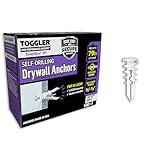
Self-drilling anchors are convenient for items such as small frames, lightweight shelves, and towel hooks that will not be pulled on hard. Many are made of plastic; metal versions are also common. Check the package for the intended wall material, drywall thickness, screw size, and stated load rating.
Installation is quick: mark the spot, confirm there is no stud or hidden wiring or plumbing, then turn the anchor straight into the board. A hand screwdriver gives good control. If using a drill or impact driver, use the correct bit, keep the tool at low speed, and stop as soon as the anchor is seated. Excess torque can strip the drywall, spin the anchor, or snap a plastic body. An impact driver is especially easy to overdo.
The main limitation is the drywall itself. A load that hangs close to the wall is less demanding than an object projecting outward, because projection creates leverage. A coat hook regularly yanked sideways or a shelf loaded toward its front edge can loosen an anchor even when the total weight seems modest. If the anchor starts spinning during installation, stop; driving harder will not restore the damaged hole. Move the fastener to sound drywall or choose another mounting method.
For routine light-duty jobs, compare self-drilling drywall anchor kits with the job’s screw size and drywall thickness in mind. A mixed kit is useful for repairs, but do not assume every anchor in it has the same capacity.
When to choose toggle bolts
A toggle bolt uses a spring-loaded metal wing that opens behind the wall. Once open, the wing bears against the back of the drywall, distributing force over a wider area than a small screw anchor. Traditional toggles are a better choice for many heavier hollow-wall attachments, including some brackets and fixtures, provided the wall and the attachment are suitable.
Installation takes more care. Drill the hole size listed for that toggle; it is often substantially larger than the screw diameter. Slide the toggle onto the bolt, fold the wings, and push them through the hole. Hold the bolt outward while tightening so the wings stay against the back of the board. The bolt may turn without tightening if the toggle did not open or lost contact. Do not keep cranking: remove it if possible and check the installation.
Traditional toggles have a practical drawback: when you remove the bolt, the loose wing can fall inside the wall. They also need clear space behind the drywall to open, so they are a poor choice near a stud, pipe, cable, or obstruction. Measure the fixture’s mounting hole and thickness too; the bolt must be long enough to pass through both the fixture and drywall before the toggle opens.
For installations that need a broad bearing surface, look at toggle bolts in the required diameter and length. Match the hardware to the fixture hole and the wall thickness rather than choosing by a large package rating alone.
Drilling and installation
Before drilling, locate studs and check for hidden services using an appropriate detector; detectors have limits, so avoid suspicious locations and follow local electrical safety practice. A hammer drill is not needed for drywall. Its hammer action is intended for masonry and can damage a gypsum-board hole. Use a regular drill or hand tools, and use a sharp bit sized to the anchor instructions.
Keep holes away from damaged, damp, or crumbling board. On a toggle installation, the hole must be clean and large enough for the folded wing, but not unnecessarily oversized. On a self-drilling anchor, drive straight and stop when flush; countersinking it too deeply weakens the surrounding board. If the anchor or toggle shifts while tightening, loosen it and inspect rather than trying to hide the movement with extra force.
Choose by load and consequence
For a light object that is easy to replace and has little leverage, a properly installed self-drilling anchor is cheaper, faster, and usually adequate. For a heavier object in hollow drywall, or one that experiences repeated pulling or movement, a toggle offers a more secure bearing arrangement, at the cost of a larger hole and more installation effort.
For cabinets, grab bars, large televisions, ceiling loads, or anything whose failure could injure someone or cause major damage, do not rely on a generic drywall-anchor rating. Attach to studs or structural backing, or use a mounting system specifically engineered for the wall and load. If a stud is close, moving the mounting point slightly can be safer and simpler than increasing anchor size.