What's inside
As an Amazon Associate I earn from qualifying purchases. This post may contain affiliate links at no extra cost to you.
Anyone specifying or upgrading a Vesda fire detection system faces a practical problem: the market offers dozens of compatible components, and the differences between them are not always obvious from a spec sheet alone. Sampling connectors, strobe sirens, manual call points, and reference literature all play different roles in a working installation, and choosing the wrong piece can mean wasted budget, commissioning delays, or gaps in coverage that only surface during an inspection.
What separates a worthwhile purchase from a disappointing one in this category comes down to three things: voltage and protocol compatibility with your existing panel, build quality that holds up in the environment where it is installed, and whether the documentation or support material is clear enough to get the component commissioned without a consultant. Below we compare eight products that appear consistently in Vesda-adjacent procurement lists, ranked by overall value and suitability for common deployment scenarios.
As an Amazon Associate we earn from qualifying purchases at no extra cost to you. Product prices and availability are accurate as of the date shown and are subject to change.




Quick Picks
| Product | Best for | Price |
|---|---|---|
| Data Center Fire Alarm Engineering Handbook | Designers and commissioning engineers | $34.99 |
| E700-CAP-KIT Vesda Capillary Sampling Connector | Aspirating detection network runs | $130 |
| QWORK Wired Emergency Sound and Light Station | Small commercial zones needing alarm and notification | $20.97 |
| E700-CAP-KIT Vesda Capillary Sampling Connector (second unit) | Multi-zone sampling expansion | $130 |
| System Sensor SWL White Fire Strobe | Open-plan areas requiring clear visual alert | $39.99 |
| QWORK Dual Action Fire Alarm Call Point 2-Pack | Labs, warehouses, and workshops | $24.47 |
| QWORK Fire Alarm Strobe Siren Horn | Budget notification in smaller spaces | $11.97 |
| QWORK Fire Alarm 2-Pack Strobe Siren Horn | Covering two zones on a tight budget | $17.47 |
How We Picked
We focused on four criteria: compatibility with Vesda aspirating detection panels and standard fire alarm wiring conventions, real-world durability as reflected in owner reports over multiple years of service, clarity of installation documentation or included materials, and price relative to the functional scope each product covers. A component that costs more but saves a technician an hour of troubleshooting earns its premium; a cheap unit that fails in a dusty workshop does not.
The 8 Best Vesda Fire Alarm System Components in 2026
Data Center Fire Alarm Engineering Handbook
Targeted at fire alarm engineers, consultants, and commissioning professionals who need to design or validate detection layouts in data centers, this handbook walks through Vesda aspirating system planning alongside broader fire alarm engineering principles. It is not a product you install, but it can prevent costly specification errors.
- Detailed guidance on sampling pipe layout and detection zone sizing for high-airflow environments
- Widely referenced by commissioning teams, reducing the time spent resolving design questions
- Paperback format means it does not receive updates between printings
Skip this if your project already has a dedicated fire engineer or if your scope is limited to a single-zone retrofit where the panel documentation is sufficient.
E700-CAP-KIT Vesda Capillary Sampling Connector
This connector joins capillary sampling tubes to a Vesda detection network, enabling aspirating coverage in hard-to-reach areas where a standard sampling hole is impractical. It suits facilities managers expanding an existing Vesda panel into secondary zones.
- OEM-compatible fit with Vesda aspirating panels, eliminating adapter mismatches
- Allows sampling points in confined spaces like server rack interiors or ceiling voids
- The $130 price is steep for a single connector, and installation requires proper crimping tools
Skip this if your detection zones are open and already covered by standard sampling points; the cost per point is not justified when a basic hole would suffice.
QWORK Wired Emergency Sound and Light Fire Alarm Station
A combined strobe siren and manual call point in one enclosure, this unit serves small commercial spaces where both notification and manual activation are needed without installing two separate devices.
- Dual action call point with key reset reduces accidental triggering in busy environments
- Operates across 12/24V DC, matching most Vesda auxiliary circuits
- Build quality is functional but not rated for outdoor or corrosive settings
Skip this in cleanrooms or outdoor installations where a sealed IP-rated notification device is required.
E700-CAP-KIT Vesda Capillary Sampling Connector (second unit)
Procurement lists commonly pair two of these connectors for projects covering opposite ends of a long sampling run, where a single unit cannot reach both zones from the panel. Each connector extends detection range without requiring a second panel.
- Enables multi-directional sampling from one panel location, cutting equipment costs
- Same OEM compatibility as the first unit, so no mixed-fitting concerns
- Buying two at $130 each still totals $260 for connectors alone
Skip this if your layout permits a single sampling point to cover the entire zone; doubling up wastes budget.
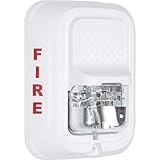
System Sensor SWL White Fire Strobe Wired
System Sensor is a recognized name in notification devices, and this white strobe delivers clear visual alerting for open-plan floors, corridors, and areas where audible sirens compete with HVAC noise. Its compatibility with Vesda panels is straightforward at 24V DC.
- High-candela output visible in brightly lit areas, confirmed by owner reports in office settings
- System Sensor brand carries broad installer familiarity and parts availability
- Audible tone is not included, so pairing with a siren is necessary where sound is needed
Skip this if your space already has adequate sound coverage and you only need visual confirmation in an adjacent room.
QWORK Dual Action Fire Alarm Call Point 2-Pack
Two manual pull stations with key reset, designed for labs, warehouses, and workshops where multiple exit points need activation access. The dual action mechanism requires a deliberate sequence, which owners report reduces false alarms from incidental contact.
- Two-pack pricing at $24.47 covers two locations for less than many single units
- Key reset prevents unauthorized or accidental resets by staff
- Enclosure is not rated for washdown or high-moisture industrial environments
Skip this in food processing areas or outdoor gates where a sealed stainless housing is mandatory.
QWORK Fire Alarm Strobe Siren Horn
At $11.97, this is the most economical strobe siren in our roundup. It suits single-zone commercial applications where notification coverage is needed in a room, hallway, or small warehouse section without a full panel upgrade.
- Combines audible horn and visual strobe in one compact housing
- 12/24V DC compatibility means it pairs with most Vesda auxiliary outputs
- Owner feedback notes mounting hardware feels thin and may need replacement
Skip this for multi-room or high-noise environments; the sound pressure is adequate for quiet or moderate spaces only.
QWORK Fire Alarm 2-Pack Strobe Siren Horn
Identical in function to the single unit above but sold as a pair at $17.47, this lets you cover two adjacent zones for roughly the price of two singles. Ideal for small workshops or retail back-of-house layouts with limited notification points.
- Per-unit cost drops to under $9, making multi-zone notification affordable
- Same voltage flexibility (12/24V DC) as the single version
- Both units share the same thin mounting hardware limitation
Skip this if you need a certified EN 54 or UL-listed notification device; this product is sold for general security use without those specific certifications.
Buying Guide
Voltage and Panel Compatibility
Vesda panels typically operate on 24V DC for auxiliary circuits, though some configurations use 12V. Before selecting a strobe, call point, or horn, confirm the operating voltage range your panel supports and match it to the component. The QWORK units rated 9-28VDC offer the widest tolerance, making them forgiving on older or mixed installations where panel output drifts slightly from nominal.
Dual Action vs. Single Action Call Points
Single action call points require one motion to trigger. Dual action versions require two deliberate steps, often pulling and pressing, or breaking glass and pulling a lever. In workshops and labs where equipment bumps or personnel rush past, dual action significantly reduces false alarms. The tradeoff is a fraction-of-a-second delay during an actual emergency, which in practice is negligible compared to the downtime and evacuation cost of a false pull.
Sampling Method: Capillary vs. Standard Sampling Points
Capillary sampling connectors like the E700-CAP-KIT extend Vesda’s aspirating detection into locations a rigid sampling pipe cannot reach. They add cost per detection point but eliminate the need for multiple panels or long pipe runs. For a single confined zone, the connector pays for itself versus panel expansion. For open areas with clear sightlines, standard sampling holes on the existing pipe remain the more economical choice.
Our Verdict
Our top overall pick is the E700-CAP-KIT Vesda Capillary Sampling Connector for anyone expanding detection coverage within an existing Vesda system without adding a second panel. It is the component that solves the core limitation of aspirating systems and earns its premium through reduced hardware complexity.
For budget notification, the QWORK Fire Alarm 2-Pack Strobe Siren Horn at $17.47 delivers the most sound-and-light coverage per dollar in this group.
If your priority is visual alerting in a bright open-plan space and you already have audio coverage, the System Sensor SWL White Fire Strobe is the clear choice due to its higher candela output and brand-supported parts availability.
FAQ
Can a Vesda panel control third-party strobe sirens and call points?
Yes, provided the devices operate within the panel’s auxiliary voltage range, typically 24V DC. The QWORK and System Sensor units listed here are compatible with standard 12/24V DC circuits. Always verify the current rating does not exceed the panel’s output capacity per zone.
What is the difference between a capillary connector and a sampling hole?
A sampling hole is a fixed opening drilled into a rigid sampling pipe. A capillary connector, like the E700-CAP-KIT, attaches a flexible capillary tube that reaches into a separate zone or confined space. The connector extends detection flexibility but costs more per point.
Is the Data Center Fire Alarm Engineering Handbook relevant outside data centers?
Partially. The detection layout principles, zone sizing calculations, and commissioning procedures apply to any aspirating system. Data center-specific guidance on high-airflow challenges is the section most directly transferable to large warehouse or atrium applications.
Do dual action call points violate fire code requirements?
Most codes require that manual activation be achievable in a single deliberate motion. Dual action call points typically satisfy this because the two steps happen in sequence and take under a second. Verify with your local authority having jurisdiction, as interpretation varies by region.