What's inside
As an Amazon Associate I earn from qualifying purchases. This post may contain affiliate links at no extra cost to you.
What we cover
The short answer
For a steel base plate or bracket that needs a dependable, repeatable hold in sound concrete, a wedge anchor is usually the better choice. Its expansion clip is designed to grip the wall of a drilled hole as the nut is tightened. A sleeve anchor is more versatile and often easier to remove, making it a reasonable choice for lighter-duty attachments or jobs where the fixture’s thickness and the concrete conditions make a wedge anchor less suitable.
Neither anchor is automatically safe just because it fits the hole. Anchor diameter, embedment, edge distance, concrete strength, spacing, and the fixture all affect capacity. For overhead work, structural connections, guardrails, or any application where failure could injure someone, use the anchor type and installation specified by the project engineer or manufacturer.
As an Amazon Associate we earn from qualifying purchases at no extra cost to you.


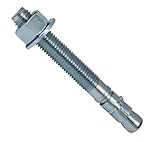

How wedge and sleeve anchors work
A wedge anchor has a threaded stud and an expansion clip near its bottom. You drill a hole, insert the anchor, position the fixture, and tighten the nut. Tightening pulls the stud upward, forcing the clip against the sides of the hole. That expansion creates the grip. Most wedge anchors are intended for solid concrete, not brick, hollow block, or mortar joints.
A sleeve anchor has a cone-shaped end, an expansion sleeve, and a bolt or threaded stud. Tightening draws the cone into the sleeve, pressing it outward against the hole. Sleeve anchors are sold in configurations intended for various base materials, but do not assume a particular anchor is suitable for hollow masonry or other materials; check its listing and installation instructions.
Wedge anchors vs. sleeve anchors
| Factor | Wedge anchor | Sleeve anchor |
|---|---|---|
| Best fit | Permanent or higher-demand fastening in sound, solid concrete | Light- to medium-duty attachments and some applications where removal matters |
| Grip | Expansion clip bears against the concrete near the hole bottom | Sleeve expands along part of the hole |
| Hole size | Typically drilled to the anchor’s nominal diameter | Typically drilled to the anchor’s nominal diameter |
| Fixture thickness | Must leave enough stud for the fixture, washer, nut, and required embedment | Available lengths may offer flexibility, but still must suit fixture thickness and embedment |
| Removal | Usually difficult; the remaining stud may need cutting or grinding | Often easier to remove, though the sleeve may remain in the hole |
| Common risk | Insufficient embedment, poor edge distance, or a hole that is too shallow | Over-expansion, wrong base material, or an anchor that turns while tightening |
These are practical differences, not a substitute for published load ratings. Compare the manufacturer’s data for the exact diameter, embedment, concrete condition, and installation method you plan to use.
Which anchor should you buy?
Choose a wedge anchor when the connection needs a robust hold in solid concrete and the anchor can remain in place. It is a common choice for steel plates, equipment feet, and brackets. For a typical small fixture, diameters might start around 1/4 inch or 3/8 inch, but those sizes are examples, not a design recommendation. A larger anchor is not automatically better: it needs more concrete around it and can cause cracking if placed too close to an edge.
Choose a sleeve anchor when the attachment is lighter-duty, may need to be removed, or the selected anchor’s instructions better suit the base material and fixture. It can be a sensible lower-cost choice for a noncritical bracket or accessory, provided the load and installation match the manufacturer’s limits. Do not substitute one for the other in a structural connection just because the cheaper anchor is available.
For a steel plate, check its thickness before shopping. The anchor must provide enough length for the required embedment plus the plate, washer, and nut. If the anchor protrudes too little, the nut may not engage properly; if it is too long, it may interfere with adjacent parts. A selection of concrete wedge anchors can help you compare diameters and lengths, but verify material, finish, and approval requirements for the environment.
Drilling and installation
Use a hammer drill or rotary hammer with a sharp carbide masonry bit of the diameter specified for the anchor. A cordless drill without hammer mode is generally a poor choice for drilling anchor holes in concrete. Check that the bit is straight and not badly worn; an oversized or irregular hole can weaken the anchor’s grip.
Measure the hole depth rather than guessing. It needs to accommodate the specified embedment and any extra depth needed for drilling dust. For example, an anchor requiring 2 inches of embedment needs a hole deep enough for that embedment plus clearance at the bottom; use the manufacturer’s stated drilling depth, not 2 inches as a universal target. Vacuum or blow out dust as directed. Dust left in the hole can prevent the anchor from seating fully.
Set the anchor through the steel fixture if the installation is designed that way, then tighten the nut to the manufacturer’s specified torque with a torque wrench when required. Do not use an impact driver as a substitute for controlled final tightening: it is easy to over-torque, spin an anchor, or damage threads. A cordless SDS-plus rotary hammer is useful for repeated holes, while a hammer drill may be adequate for a small number of holes in ordinary concrete.
Common failures and checks before drilling
If an anchor spins while tightening, stop. The hole may be oversized, dusty, damaged, or unsuitable for that anchor. Tightening harder can make the problem worse. Do not rely on a spinning anchor for a loaded connection; follow the manufacturer’s repair guidance or use an approved alternative in a properly located hole.
Concrete near an edge can split under expansion pressure. Respect the anchor maker’s minimum edge distance and spacing, and account for cracks, control joints, and nearby anchors. Avoid drilling into reinforcing bar, post-tension cables, conduit, or embedded plumbing. If drawings are unavailable, use an appropriate scanner before drilling where those hazards are possible.
Wear eye and hearing protection, and control silica dust with suitable extraction or another compliant dust-control method. Before buying, confirm the base material, load, fixture thickness, hole diameter, embedment, corrosion exposure, and required approval. Those details—not the anchor’s label alone—determine whether a wedge or sleeve anchor is the right fastener.