Key takeaways
- A driller's practical system for preventing rust on tools, from humidity control and wipe-downs to VCI storage and rescuing bits that already turned orange.
What's inside
As an Amazon Associate I earn from qualifying purchases. This post may contain affiliate links at no extra cost to you.
I pulled a set of auger bits out of a canvas roll last spring and every single flute had gone the color of a flowerpot. Nothing catastrophic, nothing that a little work would not fix, but it was a wasted afternoon that I brought on myself by putting damp bits into a closed bag in November. That is the honest truth about preventing rust on tools: it is almost never a mystery of materials science, it is a handful of small habits you either have or you do not.
Rust needs three things. Iron, oxygen, and water. You cannot remove the iron from a twist bit and you cannot remove oxygen from your garage, so every practical strategy comes down to managing moisture and putting a barrier between steel and air. Everything below is organized around that idea, cheapest and highest impact first, because buying a fancy cabinet before you fix a wet floor is money set on fire.
As an Amazon Associate we earn from qualifying purchases at no extra cost to you. Product prices and availability are accurate as of the date shown and are subject to change.


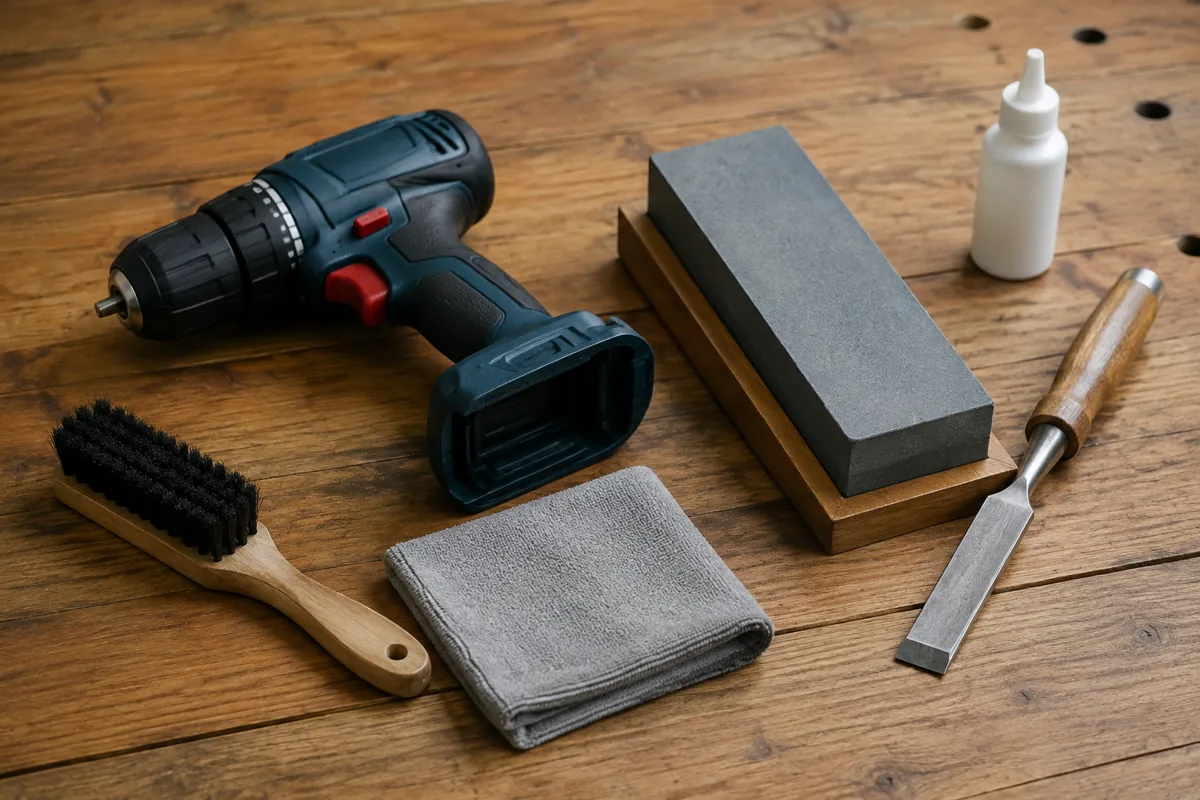
Where Rust Actually Comes From In A Home Shop
Most shop rust is condensation, not spills. Steel has a lot of thermal mass. When a cold night is followed by a warm humid morning, your drill press table and your chuck jaws are still at last night’s temperature while the air around them is not, and moisture condenses right onto the metal. That is why tools rust worst in spring and fall in most of the country, and why an unheated garage in the Southeast is a harder environment than a heated basement in Minnesota.
The second big source is your own hands. Skin oil is mildly acidic and skin salt is worse. If you grip a bare cast iron surface or a bit shank with sweaty hands and walk away, you will often see a fingerprint in rust two weeks later. It looks like witchcraft. It is just chloride.
Third is trapped water from use. Wet lumber, treated lumber especially, cutting fluid, water from a wet-cut in masonry, and the small amount of moisture that condenses inside an airline and blows out through a pneumatic tool. Any of those left sitting overnight will start something.
A Rust Prevention Kit That Fits On One Shelf
You do not need much. Here is how the main product categories compare, in plain terms, so you can pick what suits your climate and how often you are in the shop.
| Approach | Best for | Typical cost tier | What it actually does |
|---|---|---|---|
| Dehumidifier | Garages and basements over 55 percent RH | Higher up-front, ongoing power | Removes the water so nothing else matters much |
| VCI paper and capsules | Closed drawers, cases, bit rolls | Low | Releases vapor that plates bare steel inside a sealed space |
| Wax or dry film protectant | Table saw tops, drill press tables, planer beds | Low | Leaves a hard non-oily barrier you can still slide wood across |
| Light oil or rust preventive spray | Bits, chucks, hand tools, unpainted castings | Low | Displaces moisture and seals the surface, needs reapplying |
| Desiccant packs | Small sealed boxes and cases | Very low | Absorbs moisture in a small volume, must be recharged |
| Sealed cases and gasketed boxes | Field tools that travel | Medium | Keeps humid outside air from cycling through |
Two notes on that table. A dehumidifier is the only item on the list that fixes the cause rather than treating the symptom, so if you have a persistently damp space it is the first thing to buy and the rest becomes almost optional. And desiccant only works in a genuinely sealed volume. Tossing a silica pack into an open toolbox drawer accomplishes nothing except making you feel proactive.
Garage and basement dehumidifiers
If your shop reads above 55 percent relative humidity for weeks at a time, this is the purchase that ends the problem instead of managing it. Look for a continuous gravity drain port so you are not emptying a bucket, and a unit rated for the square footage you actually have rather than the one on sale. In an unheated garage, check the low-temperature operating range before you buy, because standard compressor units lose effectiveness as the space gets cold.
My Actual Routine For Preventing Rust On Tools
Here is what I do, and it takes about ninety seconds at the end of a session.
Blow the dust off, then wipe. Sawdust holds moisture against steel like a sponge, and dust from wet-treated lumber is worse. Compressed air first, then a rag. If I was drilling green or treated stock, the shanks and flutes get wiped before they go anywhere near a case.
Wipe with something, not nothing. A rag with a little light machine oil on it, kept in a closed jar or a coffee can so it stays lightly charged, is the single best tool in this whole article. One pass over bit shanks, chuck jaws, unpainted castings, and any plane or chisel that came out. It also removes the fingerprints, which is half the point.
Never case a warm tool in a cold shop. A drill body that has been working is warm and slightly humid inside. Snap the case shut and you have made a little terrarium. I leave cases open for twenty minutes or set the tool on the bench and close up on my way out next time.
Loosen the chuck. Keyless chucks that get clamped tight on a wet day can seize. I back mine off and give the jaws a shot of light oil every month or so, wiping the excess so it does not collect dust.
Waxed tops, oiled edges. Flat reference surfaces that wood slides on get paste wax or a dry film, because oil transfers into your workpiece and ruins finish adhesion. Bits and cutters and hand tools get oil, because they do not touch anything that gets stained.
Rust preventive spray and VCI storage products
The pairing that does the most work for the least money: a can of moisture-displacing rust preventive for wipe-downs, plus vapor corrosion inhibitor paper or capsules for anything that lives in a closed drawer, blow-molded case, or bit roll. VCI needs an enclosed space to work, so it is ideal for drill index cases and tool chest drawers and useless on open shelving. Check the stated coverage volume on capsules rather than assuming one covers a whole chest.
Bits, Chucks And Drivers: The Drilling Specific Stuff
Drilling gear has its own failure modes. High speed steel twist bits and black oxide bits rust from the inside of the flutes outward, and the flute is exactly where you least want roughness, because a pitted flute drags chips instead of evacuating them. Once a bit stops clearing chips it heats, and once it heats it loses its edge. So rust on a bit is not cosmetic, it eventually becomes a cutting performance problem.
Titanium coated bits are not rust proof. The coating is thin and it is on the ground surfaces, not necessarily everywhere, and every resharpening opens bare steel. Cobalt bits are steel too. Carbide masonry tips do not rust but their steel bodies do, and a wet-cut in concrete or tile leaves alkaline slurry on the shank that will bloom overnight if you do not rinse and dry it.
Auger bits and long ship augers with a lead screw are the ones I babysit most, because a rusty lead screw stops pulling itself in and you end up leaning on the drill, which is how you snap a bit or wreck a wrist. Same for self-feed bits. Wipe the screw, oil the screw.
Impact driver bits are usually fine because they get used up before they rust, but the hex shanks in a magnetic holder are worth a look. A rusty shank in a magnetic bit holder gets sticky and starts wobbling.
On storage: a hard index case in a dry space, with a VCI capsule inside, beats a canvas roll every time. Canvas breathes, which sounds good and is actually the problem, because it also holds humidity against steel. If you like rolls, and I do for augers, keep them somewhere dry and re-oil more often.
Rescuing Tools That Already Rusted
Surface rust is not a death sentence. The rule I use is simple: if you can still see the machining marks or the grind lines under the orange, it will clean up fine. If the surface is pitted deep enough to catch a fingernail, the metal underneath is already gone and you are just making it look better.
For light rust, oil and a nylon abrasive pad or fine bronze wool will take it off without scratching. Work along the grain of the original finish. For heavier rust on non-precision parts, a soak in a chelating rust remover overnight is far kinder than a wire wheel, which will round over cutting edges and eat the corners off bit flutes. Whatever you use, the critical step is the one people skip: rust removal leaves the steel completely bare and unusually eager to rust again, so it must be oiled or waxed immediately, not tomorrow.
Do not put a wire cup on a drill press table or a saw top. It will leave a texture you cannot undo. Oil plus an abrasive pad plus patience.
- ✔ A dehumidifier plus an oily rag stops nearly all shop rust for very little effort
- ✔ Oil, wax and VCI products are cheap and last a long time
- ✔ Ninety seconds of wipe-down at the end of a session beats an afternoon of restoration
- ✔ Light surface rust cleans up completely if you catch it early
- ✘ Oil attracts sawdust and has to be reapplied on a schedule
- ✘ Desiccants and VCI only work inside genuinely sealed containers
- ✘ Oil must stay off surfaces that touch wood you plan to finish
- ✘ Unheated garages in humid regions may need real climate control, which is not cheap
FAQ
What humidity level do I need to stay under to stop rust? Under about 50 percent relative humidity, ordinary rust essentially stops progressing. Between 50 and 60 you get slow trouble on bare steel. Above 60, especially with temperature swings, you get visible rust in weeks. A cheap hygrometer on the wall is the most useful diagnostic you can own, because it tells you whether you have a storage problem or a climate problem.
Can I just use WD-40 to keep my bits from rusting? It works as a short-term moisture displacer and it is far better than nothing, but the standard formula is light and evaporates, so the film does not last long in storage. For tools going into a drawer for months, a dedicated rust preventive, a light machine oil, or paste wax will hold up considerably longer. Use the spray to clean and displace water, then follow with something that stays put.
Should I oil the inside of my drill’s chuck? A light film on the jaws and jaw tracks, yes, wiped so nothing drips. Do not pack it with grease, because grease collects dust and abrasive grit and turns into lapping compound. If the chuck is stiff or gritty, a spray of moisture-displacing oil, several full open and close cycles, and a wipe usually restores it.
Rust is a maintenance problem masquerading as a materials problem. Get a hygrometer, fix the humidity if the number is bad, keep a charged oily rag within arm’s reach of the bench, and stop closing cases on warm tools. Do those four things and you will spend your shop time drilling instead of scrubbing.
Check prices on Amazon →