What's inside
As an Amazon Associate I earn from qualifying purchases. This post may contain affiliate links at no extra cost to you.
What we cover
What matters when drilling overhead
Drilling up into joists is tiring work: the drill is above your shoulders, chips fall toward you, and a long bit magnifies any wobble. For ordinary holes for cable or small fasteners, a compact 18V or 20V cordless drill is usually a better choice than a heavier hammer drill. Prioritize low weight, a manageable grip, a two-speed gearbox, and a clutch you can set for driving screws. A side handle can help control larger bits, but it adds bulk for small overhead holes.
Check the tool’s bare weight and, more importantly, its weight with the battery installed. A compact drill with a small 2.0Ah battery is often easier to hold overhead than a high-torque model fitted with a large 5.0Ah pack. The smaller pack is fine for a few holes; a larger battery makes sense for a long run of drilling or frequent use away from a charger.
As an Amazon Associate we earn from qualifying purchases at no extra cost to you.
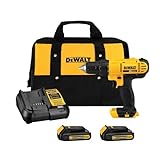


Compare the main drill types
| Type | Best for overhead joist work | Trade-off |
|---|---|---|
| Compact cordless drill/driver | Pilot holes, small twist bits, and general drilling | Less comfortable with large bits or repeated deep holes |
| Full-size cordless drill/driver | Longer sessions and larger bits in wood | More weight and bulk above shoulder height |
| Cordless hammer drill | One tool for wood and occasional masonry | Heavier; hammer mode is unnecessary for wood |
| Right-angle drill | Tight spaces between framing or near obstructions | Specialty tool that may be poor value for occasional work |
For most homeowners drilling a handful of holes, a compact drill/driver is the sensible buy. A hammer drill does not drill wood better: leave hammer mode off, and expect to carry extra weight for a feature you only need in masonry. If you also drill concrete or brick, a cordless hammer drill kit can cover both jobs, though a separate lightweight drill may be more comfortable for overhead work.
Match the drill to the hole
Small bits—roughly 1/8 to 1/4 inch—are easy work for nearly any decent cordless drill. As bit diameter and drilling depth increase, the drill needs more torque and the operator has to resist more twisting force. A 3/8-inch hole through a typical joist is a modest task; a large self-feed bit or hole saw can bog down a compact drill, especially if the bit is dull or catches in knots.
Use low gear for large bits and higher gear for small bits. Low gear gives better control and reduces the chance of a sudden stall. If the drill repeatedly slows, gets hot, or twists in your hands, stop rather than forcing it. Clear chips from a deep hole by backing the bit out periodically. A sharp auger or boring bit cuts faster and with less strain than a worn one; choose a bit intended for wood, such as a wood auger bit set, when making deeper or wider holes.
Features worth paying for
A keyless chuck is standard and convenient, but check that it grips the shank securely. A bit that slips overhead can damage the hole or fall when you lower the drill. A belt hook is useful when moving along a ladder or joists, but it is not a substitute for a stable work position. An LED helps in dim bays; it does not replace checking that the bit is lined up before you squeeze the trigger.
Brushless motors can run more efficiently and often give better performance per battery charge, but they are not essential for occasional holes. If the brushless model costs substantially more, a brushed drill with a good battery and suitable bits will do the job. A compact cordless drill/driver kit is often a better overhead setup than buying a bare tool and pairing it with a large battery.
Drill safely and avoid damaged joists
Before drilling, locate wiring, plumbing, and other services. Do not assume the joist bay is clear because it looks clear from below; inspect from above where possible, and use an appropriate detector when services may be hidden. Wear eye protection, because sawdust and chips fall directly toward your face. Keep your stance secure and do not lean sideways from a ladder to reach a hole.
Joists are structural members, so follow the framing rules and guidance that apply to your building. Do not notch, bore near an end, or make a large hole just because the drill can cut it. Hole limits depend on joist type, dimensions, location, and local code; engineered I-joists have manufacturer-specific rules, and cutting a flange can seriously weaken one. If you cannot confirm that a proposed hole is permitted, stop and ask a qualified builder or structural professional.
Start slowly with the bit square to the face, then increase speed once it has a stable bite. Avoid pushing hard enough to make the drill stall. If a bit catches, release the trigger and keep a firm grip—do not try to muscle through a jam while the motor is powered. For large holes, use a drill with enough torque, a sharp bit, and a side handle if the tool supports one. A compact drill is easier to hold; a larger drill is less likely to struggle. Buy for the bit size and frequency you actually expect, not the biggest hole you might make once.