What's inside
As an Amazon Associate I earn from qualifying purchases. This post may contain affiliate links at no extra cost to you.
Composite decking is less forgiving than it looks. A screw driven too hard can dimple the surface, strip its head or leave a mushroomed ring around the hole. An impact driver can make the work faster, but its rapid hammering is easy to overdo on composite boards. The best choice is a compact, controllable cordless impact driver used with the decking maker’s recommended screws and a test board.
As an Amazon Associate we earn from qualifying purchases at no extra cost to you.



What we cover
What matters in an impact driver
Look for variable-speed control, a comfortable low-speed trigger and a compact head that fits between boards and joists. Three speed settings are useful, but they do not replace a light trigger finger: even a low setting can drive a screw too far if you hold the trigger down after the head seats. A brushless motor can improve runtime and reduce wear, but it is not essential for occasional deck repairs.
Battery size is a trade-off. A 2.0Ah pack keeps the tool lighter and is usually enough for a small project; a 4.0Ah pack means fewer swaps during a large installation but adds weight. If you already own a cordless tool system, staying with its battery platform is often better value than buying a second charger and batteries.
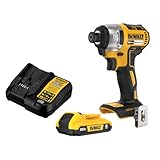
For anyone buying a tool specifically for a deck, compare compact cordless impact driver kits by trigger feel, weight and included battery—not just maximum torque. High torque figures matter more for long structural fasteners than for ordinary decking screws.
Tool options for composite decking
| Option | Best use | Trade-off |
|---|---|---|
| Compact impact driver | Many screws, tight access, repeated fastening | Can overdrive screws quickly; requires a test setting and careful control |
| Drill/driver with clutch | Small decks, repairs, or users prioritizing control | Slower on long runs; clutch settings still need testing |
| Collated decking fastening system | Large installations where consistent spacing and speed matter | Higher upfront cost and may require compatible screws or tool attachments |
A drill/driver is a sensible, cheaper choice for a dozen replacement boards or a small landing. Its clutch can stop the motor at a selected resistance, which helps limit overdriving. It is not foolproof: different screw lengths, board temperatures and framing materials can change how the screw seats. For a large deck, a compact impact driver is generally faster, while a collated system may be worth considering if its fasteners are approved for the specific decking.
Match the fastener to the board
Use screws specified by the composite manufacturer. Many systems call for corrosion-resistant composite decking screws with a trim head and a design intended to reduce surface mushrooming. Ordinary drywall or interior wood screws are not substitutes; they can corrode, break or leave a poor-looking finish. Screw length depends on board thickness and framing, so follow the product instructions rather than choosing by appearance.
Keep a clean, correctly sized driver bit on hand. A worn bit can cam out, chewing up the screw recess and leaving a head that is difficult to remove. If the manufacturer calls for predrilling or countersinking—especially near board ends or in cold weather—do it. Otherwise, predrilling every hole may add time without improving a system designed for direct fastening. For replacement or odd-sized bits, check bits matched to the decking screws.
Set up before driving a full row
Read the board and fastener instructions for required gaps, fastening locations and minimum end distances. Composite boards expand and contract with temperature; spacing is part of the installation, not a cosmetic choice. Check that joists are sound and properly aligned, and use the specified number of fasteners at each support. A powerful driver cannot make a loose, twisted or damaged joist suitable for fastening.
Make several test drives in an offcut or a concealed area using the same board and framing. Start in the driver’s low speed setting and press the screw straight down with steady pressure. Stop as soon as the head is seated flush or reaches the manufacturer’s specified position. If it sinks below the surface, reduce speed or switch to a drill/driver with a clutch. If the screw stalls or the head strips, check the bit fit, screw type and pilot-hole requirements instead of simply applying more force.
Avoid common fastening failures
Overdriving is the most visible problem: it can crush the board surface, leave a crater or prevent a plug from sitting correctly. Backing a screw out and retrying in the same damaged hole may not restore its holding power. Follow the manufacturer’s repair guidance, which may call for moving the fastener, replacing the board or using an approved plug.
Another failure is a screw that spins without tightening. That can indicate stripped framing, a hole that is too large or a fastener that missed the joist. Remove it and locate solid framing before fastening again; a spinning screw is not secured just because its head appears flush. If a screw breaks, stop and address the obstruction or fastening angle before driving another into the same spot.
Which should you buy?
Choose a compact impact driver with a comfortable low-speed trigger if you are fastening hundreds of screws, working in confined spaces or already own compatible batteries. A midrange kit is usually enough; paying extra for extreme torque is unlikely to improve ordinary deck-screw work. If you only have a small repair to do, use a decent drill/driver with a clutch or borrow an impact driver rather than buying a premium kit.
For a large new deck, first check whether the decking brand approves a particular screw system or installation tool. A compatible hidden-fastener system can give a cleaner surface, but it limits your fastener choices and may cost more. Where face screws are required, a collated cordless decking screw gun can speed repetitive work, though it is hard to justify for occasional repairs. Whichever tool you use, a test drive and the right screw matter more than a high torque number.