What's inside
As an Amazon Associate I earn from qualifying purchases. This post may contain affiliate links at no extra cost to you.
What we cover
What you need to drill a concrete patio
For a few holes in an ordinary concrete patio slab, a cordless hammer drill is usually enough. It combines rotation with a rapid hammering action, helping a masonry bit cut without requiring you to lean hard on the tool. It is not the same as a rotary hammer: the latter delivers stronger blows and is a better choice for many large or deep holes, repeated work, or very hard concrete.
Before buying, check what you’re fastening and the hole size it calls for. Light-duty anchors commonly need holes around 1/4 inch; larger wedge or sleeve anchors may need 3/8 inch or more. Follow the anchor maker’s specified bit diameter and minimum embedment depth. If you’re drilling many holes or need holes larger than about 1/2 inch, consider a rotary hammer instead of forcing a cordless hammer drill through the job.
As an Amazon Associate we earn from qualifying purchases at no extra cost to you.
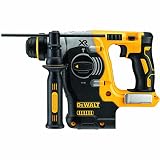


Cordless options at a glance
| Tool type | Best for | Trade-off |
|---|---|---|
| Compact 12V hammer drill | Occasional small holes in relatively soft concrete | Less power and battery capacity; slow for larger holes |
| 18V/20V hammer drill | Most patio anchor jobs, especially holes up to about 1/2 inch | Heavier than a compact drill; still slower than a rotary hammer in hard concrete |
| Cordless rotary hammer | Many holes, larger holes, or tough concrete | Higher cost and weight; unnecessary for a handful of small holes |
For most homeowners, an 18V or 20V cordless hammer drill kit is the practical middle ground. A kit includes a battery and charger, which matters if you don’t already own tools in that battery system. If you do, buying a bare tool can be cheaper.
Features worth paying for
Look for a hammer setting, a keyed or keyless chuck that accepts the bit size you need, and a side handle. Concrete drilling can make the drill twist abruptly when a bit catches, so the handle gives you better control. Two batteries are useful for a long session, but not essential for six or eight small holes.
Voltage alone does not tell you how well a drill will perform. Battery capacity, the drill’s design, bit quality, and concrete hardness all matter. A compact 12V model can work for occasional 1/4-inch holes, particularly in older or softer concrete, but it may bog down as hole size or depth increases. If buying from scratch and expecting more than occasional anchor work, compare cordless hammer drills with a side handle in the 18V/20V class.
Don’t pay extra for a drill simply because it advertises a high torque figure. Torque is useful in fastening, but concrete drilling depends heavily on impact action, speed, and the bit. A good masonry bit often improves progress more than a small step up in drill price.
Choose the bit and mark the hole
Use a carbide-tipped masonry bit rated for rotary hammer-drill use. A worn bit can make a capable drill seem weak, heat up, and leave a ragged hole. Match the bit diameter to the anchor instructions; a hole that is too wide may not hold, while one that is too narrow can prevent the anchor from seating.
Check the slab for embedded services before drilling, and avoid drilling near edges unless the anchor instructions allow it. Keep holes far enough from slab edges and joints to reduce the risk of cracking or breakout. Mark the depth on the bit with tape, or use the drill’s depth stop. For example, if an anchor needs a 2-inch-deep hole, don’t assume a 2-inch anchor length means the hole should be exactly 2 inches; use the manufacturer’s stated hole depth.
Drill without overheating or damaging the slab
Set the drill to hammer mode and use a steady, controlled grip. Start at low speed to keep the bit from skating, then increase speed while maintaining light, even pressure. Let the hammer action do the work. Pressing hard can overheat the bit, slow the drill, and make the tool harder to control.
Pull the bit out every few seconds to clear dust, especially in deeper holes. Concrete dust can pack into the hole and make drilling stall. Stop if the bit becomes very hot; let it cool rather than dipping a hot bit in water, which can damage it. Wear eye protection and a suitable dust mask, and keep other people away from the dust plume.
If the bit stops advancing, don’t keep leaning into the drill. You may have hit a stone, a particularly hard aggregate, or a reinforcing bar. Try withdrawing the bit and clearing dust. If you hit metal, stop and reconsider the hole location; drilling through rebar can damage the bit and may compromise the slab.
When a rotary hammer is the better buy
A cordless hammer drill is the cheaper, more versatile option for mixed household drilling and a small number of patio anchors. Its drawback is speed: hard concrete, deep holes, and larger diameters can turn a short job into a frustrating one. If you’re installing dozens of anchors or drilling frequent 3/8- to 1/2-inch holes, a cordless SDS-Plus rotary hammer will generally work faster and with less effort.
For just a few small holes, renting a rotary hammer may cost less than buying one. For occasional 1/4-inch anchor holes, the hammer drill you already own may be adequate—use a sharp, correctly sized bit and accept that progress may be slower. The right choice is the least tool that can do the job safely, without forcing it past its limits.