What's inside
As an Amazon Associate I earn from qualifying purchases. This post may contain affiliate links at no extra cost to you.
Thin galvanized steel is usually easy to drill, but it punishes the wrong bit. The steel layer may be only 18 to 24 gauge—about 0.048 to 0.030 inches thick—yet a dull bit can skate across the zinc coating, tear the hole, or grab suddenly as it breaks through. The best choice depends on whether you need one clean hole, a range of hole sizes, or many holes in sheet metal.
As an Amazon Associate we earn from qualifying purchases at no extra cost to you.
What we cover
The Best Bit Types for Thin Galvanized Steel
For most household work, start with a sharp high-speed steel (HSS) twist bit. HSS bits are inexpensive, easy to replace, and work well in galvanized ductwork, metal studs, flashing, electrical boxes, brackets, and light-gauge framing. A standard 135-degree split point is preferable because it starts more easily and reduces walking on smooth metal.
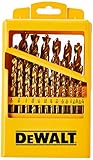
A HSS split-point drill bit set is the best general-purpose purchase if you do not already own metal bits. Look for sizes from 1/16 inch through 1/2 inch, preferably in 1/32-inch increments for the smaller sizes. For a single hole, a basic HSS bit is usually all you need.
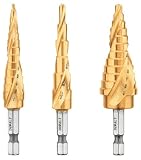
Step bits are often faster for thin sheet metal, especially when you need a hole larger than 1/4 inch. One bit can make several diameters, and its short cutting edges are less likely to snag the sheet. The trade-off is cost and durability: step bits are not ideal for thick steel, and the individual steps can wear quickly if you force the drill or run at high speed.
A step drill bit set for thin metal makes sense for electrical and plumbing work where hole sizes vary. Choose one with clearly marked steps and a 1/4-inch hex shank if you plan to use it in an impact driver occasionally. A regular drill is still the better tool for controlled work.
Comparing Bits for Galvanized Sheet Metal
| Bit type | Best use | Advantages | Limitations |
|---|---|---|---|
| HSS twist bit | Small holes and occasional work | Low cost, accurate, widely available | Can walk or grab if used carelessly |
| Titanium-coated HSS | Repeated holes in thin sheet | Lower friction and longer life than plain HSS | Coating does not make a poor bit sharp |
| Cobalt alloy bit | Frequent drilling or tougher steel | Handles heat better and stays useful longer | More brittle and usually unnecessary for one-off jobs |
| Step bit | Large holes and multiple diameters | Fast, clean starts and fewer tools | Expensive; each step has limited cutting life |
| Hole saw | Large holes over about 1 inch | Efficient for large openings | More grabbing, heat, and setup effort |
Titanium nitride-coated bits can be a sensible middle ground. The coating reduces friction while the cutting edges remain sharp, but it is not a substitute for HSS underneath. Once the coating is worn through, sharpening or overheating can reduce its advantage. Cobalt bits are worthwhile for repeated work or when the galvanized material is heavier than expected; for a few holes in thin sheet, they are usually overkill.
How to Choose the Right Bit
Match the bit to the finished hole, not just the fastener. For a self-drilling screw, the screw may create its own pilot hole. For a wood screw passing through metal, drill a clearance hole slightly larger than the screw shaft. For a wall anchor or bolt, measure the anchor body and follow its specified hole diameter. Do not size the hole by the outside diameter of the screw threads unless the fastener instructions say to do so.
For holes up to 1/4 inch, an HSS twist bit gives the most control. For a 3/8- to 1-inch opening, a step bit is usually cleaner and quicker than enlarging a small pilot hole with several twist bits. For very large openings, use a bi-metal hole saw, but clamp or support the sheet because the saw can catch as it exits.
Do not use masonry bits or wood brad-point bits. A masonry bit may scratch the zinc but will not cut steel efficiently. A wood bit can overheat, chatter, and damage its cutting edges almost immediately.
The Right Drilling Technique
Mark the hole with a fine-tip marker, then make a small center-punch mark. A spring-loaded automatic center punch works well on thin sheet and avoids swinging a hammer near a finished surface. The indentation keeps the bit from skating across the galvanized coating.
Set the drill to forward rotation with hammer mode off. Use the low-speed range for larger bits and the high-speed range for small bits, but control the trigger rather than running continuously at full speed. As a starting point, run a 1/8-inch bit around 1,500 to 2,500 rpm, a 1/4-inch bit around 800 to 1,500 rpm, and a step bit around 300 to 800 rpm. Exact speeds vary by bit and steel thickness; smoke, blue discoloration, or a sharp burnt smell means you are running too hot.
Apply firm, steady pressure until the bit cuts, then reduce pressure as it breaks through. Thin sheet often grabs at breakthrough, which can twist your wrist, enlarge the hole, or pull the sheet into the bit. Keep the drill square to the surface. If the material flexes, place a scrap block of wood behind it or clamp the sheet between two pieces of plywood.
For holes larger than about 1/4 inch, drilling a 1/8-inch pilot hole can help a twist bit start, but it is not always necessary with a step bit. Use cutting oil sparingly if you are drilling many holes. A drop is enough; too much oil makes the work slippery and attracts metal chips. Wipe the bit clean between holes.
Using a Cordless Drill or Impact Driver
A cordless drill is the better tool because its clutch, variable speed, and side handle provide control. A compact 12-volt drill has plenty of power for thin galvanized sheet. An 18- or 20-volt drill is useful when running larger step bits or hole saws, but power does not compensate for a dull bit or excessive speed.
An impact driver can drill thin metal with a hex-shank bit, but its hammering action can make small holes rough and can damage inexpensive bits. Use it for quick pilot holes or when access is limited, not as the first choice for precision openings. Keep both hands on the tool when possible, and avoid holding the sheet by hand near the bit.
Protecting the Zinc Coating and Yourself
Drilling removes the galvanized coating around the hole, leaving bare steel exposed to moisture. Brush away loose chips, then apply a zinc-rich cold galvanizing compound or suitable metal primer to the cut edge. This matters outdoors, in damp garages, and anywhere the hole will contact water.
Wear safety glasses; thin chips are sharp and often eject when the bit breaks through. Gloves can protect against sheet-metal edges, but keep them away from a rotating bit. Deburr the finished hole with a countersink, deburring tool, or a larger bit turned slowly by hand. A clean edge seats washers and cable fittings better and is less likely to cut insulation or skin.