What's inside
As an Amazon Associate I earn from qualifying purchases. This post may contain affiliate links at no extra cost to you.
Thin carbon steel tubing is easy to drill through, but it is also easy to snag, deform or leave a rough, oversized hole. For most jobs, a sharp cobalt or high-speed-steel twist bit, used at low speed with the tube supported and clamped, is the right choice. The best bit depends on how many holes you need, the tubing wall thickness and whether hole size or finish matters.
As an Amazon Associate we earn from qualifying purchases at no extra cost to you.



What we cover
Choose a bit for the job
For occasional holes in mild steel tubing, a quality HSS bit is usually enough. A cobalt HSS bit costs more but tolerates heat better and is a sensible upgrade for repeated drilling, harder steel or a drill setup that runs warm. Look for a standard 118-degree point for general-purpose work or a 135-degree split point if you want easier starting and less walking. The point angle matters less than sharpness, steady pressure and keeping the bit cool.
A step bit is useful when you need a clean round hole in thin stock, especially for holes larger than about 1/4 inch. Its stepped cutting edges are less likely to grab and pull into thin material than a large twist bit. It does not replace a twist bit for small holes or deep drilling, and the finished hole size depends on stopping at the correct step.
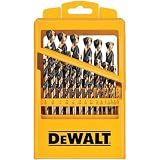
A cheaper HSS set is fine for a few holes in ordinary, low-carbon tubing. Avoid forcing a dull bit to compensate: excess heat softens the cutting edge, and a bit that rubs rather than cuts can leave a blue, ragged hole. If you are drilling many holes or working with tougher steel, a cobalt drill bit set for metal is a more durable buy.
Bit options at a glance
| Bit type | Best use | Trade-off |
|---|---|---|
| HSS twist bit | Occasional small holes in mild steel | Inexpensive, but wears faster if overheated |
| Cobalt HSS twist bit | Repeated holes or tougher steel | Costs more; still needs correct speed and pressure |
| Step bit | Clean, larger holes in thin walls | Limited by its step sizes and drilling depth |
| Hole saw | Large openings beyond typical step-bit sizes | More prone to grabbing; needs rigid support |
Set up the tube and drill
Secure the tubing in a vise or with clamps before drilling. Put a close-fitting wood dowel or scrap wood inside the tube behind the drilling point if practical; it supports the wall and reduces the chance of denting or tearing through. Do not hold the tube in your hand. Thin-wall tubing can spin suddenly when a bit catches, even with a cordless drill.
Mark the hole with a center punch, using a light tap so you do not crush the wall. For larger holes, make a pilot hole around 1/8 inch first, then enlarge it with the intended bit. A pilot hole helps guide a twist bit, but it is not always needed for a step bit, which often starts cleanly with a small pilot. Use cutting oil or a few drops of general-purpose cutting fluid; keep it off surfaces where it could make the workpiece slippery.
For twist bits around 1/8 to 1/4 inch in mild steel, start around 600–1,000 rpm and adjust to the bit size and how the cut behaves. Use slower speeds for larger bits: a 1/2-inch bit may work best around 250–400 rpm. These are starting ranges, not a substitute for the bit maker’s chart. With a cordless drill, use low gear and squeeze the trigger steadily rather than running flat out. A hammer drill’s hammer mode must be off; impacts do not help cut metal and can damage the bit or workpiece.
Drill without grabbing or overheating
Keep the drill square to the tube and apply firm, even pressure. You should see chips forming. If the bit squeals, smokes, polishes the surface or turns the chips blue, stop and let it cool; reduce speed and add cutting fluid before continuing. If it stops cutting, inspect the edge for dullness instead of leaning harder. Excessive pressure is a common cause of a sudden breakthrough and a bit that catches on the far side.
When the bit breaks through, ease off the pressure. Thin tubing has little material to support the cutting edge, so the bit can grab and pull itself through. For holes larger than about 3/8 inch, a step bit is often easier to control than enlarging a pilot hole with a large twist bit. A step drill bit for thin metal is especially handy for electrical knockouts, brackets and other holes where a smooth edge matters.
Finish the hole safely
Remove burrs with a deburring tool, a countersink turned gently by hand, or a small file. Do not run a high-speed countersink aggressively through thin tubing; it can enlarge the hole quickly. Brush away chips rather than wiping them with bare fingers, and wear eye protection. Hot, sharp chips can travel a surprising distance, and the tube edge can be sharp after drilling.
If you need a hole much larger than a step bit can make, a hole saw can work, but it needs a firm grip on the tubing and careful control at breakthrough. For one or two small holes, there is little reason to buy a specialty bit: a sharp HSS twist bit, low drill speed and good support are enough. For repeated holes, larger diameters or cleaner results, cobalt bits or a step bit can save time and reduce damaged workpieces.