What's inside
As an Amazon Associate I earn from qualifying purchases. This post may contain affiliate links at no extra cost to you.
Mounting a handrail bracket to concrete is not the place for a light-duty plastic wall plug. A handrail is pulled sideways and downward every time someone uses it, and the load is concentrated at a few small brackets. The best anchor depends on the concrete, the bracket hole size, the distance to an edge, and whether the rail is used for balance or fall protection.
As an Amazon Associate we earn from qualifying purchases at no extra cost to you.



What we cover
Choose the anchor for the wall and the load
For sound, solid concrete, a properly installed concrete screw is usually the simplest choice for a residential handrail. It installs with a hammer drill, is removable, and works well when the bracket has several mounting holes. A sleeve anchor provides more expansion and is a better choice for heavier rails or brackets with larger holes. Wedge anchors are stronger still, but they need deeper holes and more room from concrete edges.
If the wall is concrete block, the answer changes. The face shell may be thin, and an expansion anchor can crack it or pull through. A concrete screw may be acceptable in the solid portion of a block, but the hole location matters. For hollow block, use an anchor system specifically rated for hollow masonry, or through-bolt the bracket where the opposite side is accessible. Do not assume that “masonry” on the package means the anchor is suitable for every block wall.
| Anchor type | Best use | Main advantage | Important limitation |
|---|---|---|---|
| Concrete screw | Most residential handrail brackets | Fast installation and easy removal | Requires sound concrete and the correct bit |
| Sleeve anchor | Heavier brackets and larger holes | Good holding power with straightforward installation | Expansion can damage weak or thin concrete |
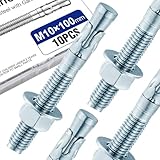
| Wedge anchor | High-load rails in solid concrete | Strong, permanent connection | Needs adequate embedment and edge distance |
| Epoxy anchor with threaded rod | Cracked concrete, close edges, or engineered work | No expansion pressure in the hole | More expensive, slower, and sensitive to hole cleaning |
Best default: concrete screws
For many handrail brackets, start with a concrete screw anchor kit. Choose screws long enough to pass through the bracket and enter the concrete by at least about 1-1/2 inches, while staying within the manufacturer’s minimum and maximum embedment. A common 1/4-inch or 5/16-inch screw may be suitable for a light residential bracket, but the bracket and anchor manufacturer’s load tables matter more than diameter alone.
Concrete screws are a good value when the bracket has three or four mounting holes and the wall is solid. They are also forgiving if you need to remove the rail later. Their failure modes are straightforward: the screw can strip the hole, spin without tightening, or pull out if the concrete is weak or the embedment is too shallow. A stripped hole is not fixed by simply driving the same screw harder. Move to a new hole or use a larger, approved anchor if the bracket allows it.
Use a hammer drill and a sharp carbide masonry bit in the diameter specified for the screw. Drill 1/4 to 1/2 inch deeper than the required hole depth so dust has somewhere to go. Clear the dust with a vacuum or compressed air, then drive the screw steadily. An impact driver can be useful for driving the fastener, but high torque can snap a screw or damage the bracket. Stop when the washer is snug; crushing the bracket does not increase holding power.
When to use sleeve or wedge anchors
Choose concrete sleeve anchors when the bracket has larger clearance holes, the rail is long, or the installation needs more predictable expansion than a small concrete screw provides. Stainless steel is useful in damp indoor spaces, exterior locations, and near treated lumber. Zinc-plated anchors cost less and are often fine in a dry interior.
Wedge anchors are appropriate when the handrail is expected to take substantial load and the concrete is thick and sound. They are permanent: once installed, removal usually means cutting the anchor flush and abandoning the hole. Follow the specified hole depth, cleaning procedure, tightening torque, and minimum spacing. Expansion anchors placed too close to a corner can split the concrete or break out a chunk around the bracket.
As a practical rule, keep anchors well away from slab edges, corners, and existing holes. The exact minimum is product-specific, but an anchor near an edge deserves more caution than one in the middle of a broad wall. If the bracket must sit close to an edge, a non-expanding adhesive anchor may be the better design.
Epoxy anchors and difficult concrete
Use concrete epoxy anchoring adhesive with threaded rod when expansion pressure is undesirable, the concrete is cracked, or the bracket holes are close to an edge. This is not automatically a stronger DIY option. The hole must be drilled to the specified diameter and depth, brushed and blown clean in the correct sequence, and allowed to cure for the stated time. Dust left in the hole can reduce bond strength dramatically.
Epoxy also has a temperature-dependent cure time. Do not load the handrail immediately just because the adhesive feels firm at the surface. For a stair rail, a building inspector, engineer, or anchor manufacturer may be the right source for the required embedment and load rating.
Installation checklist
First, locate reinforcement, conduit, and plumbing before drilling. A basic detector is not reliable through every concrete wall, so avoid unnecessary holes and stop if drilling suddenly hits steel. Never drill into suspected post-tensioned concrete without confirming the slab layout.
Hold the bracket in position and mark every hole. Keep the bracket level, but do not force a hole location so close to an edge that the anchor cannot develop its rated strength. Drill perpendicular to the wall. A cordless cordless hammer drill is sufficient for a few holes; use rotary-hammer equipment for repeated drilling or hard concrete. Wear eye protection and hearing protection, and control silica dust with a vacuum and suitable respiratory protection.
Install all anchors loosely first, then tighten the bracket evenly. Test the rail with gradually increasing hand pressure in several directions. If the bracket moves, the hole is oversized, the anchor is wrong for the wall, or the concrete is failing. Do not compensate by adding random longer screws. A handrail that could catch a falling person deserves an anchor system selected from published load data, not guesswork.
What to buy
For a normal indoor rail on solid concrete, buy quality concrete screws, the matching carbide bit, and a bracket with multiple mounting holes. Use sleeve anchors when you need more expansion capacity or the bracket is designed for them. Choose wedge anchors for a permanent, high-load installation in thick concrete. Use epoxy or a through-bolt when edge distance, cracked concrete, or hollow masonry makes expansion anchors questionable. The cheaper concrete screw is fine when the wall is sound and the installation matches its rating; it is not a shortcut around poor concrete or inadequate embedment.