What's inside
As an Amazon Associate I earn from qualifying purchases. This post may contain affiliate links at no extra cost to you.
Mounting a bracket to a concrete slab is mostly an anchor-selection problem. The right fastener depends on the bracket load, whether the slab is cracked, how close the holes are to an edge, and whether the bracket will be pulled straight out or loaded sideways. A small shelf bracket and a heavy equipment mount may both use 3/8-inch hardware, but they do not create the same demands.
As an Amazon Associate we earn from qualifying purchases at no extra cost to you.


What we cover
Choose the anchor by load and installation
For most wall-mounted brackets attached to sound, poured concrete, the practical choices are concrete screws, sleeve anchors, and wedge anchors. Concrete screws are fastest and easiest to remove. Sleeve anchors tolerate minor variations in hole depth and are useful for medium-duty brackets. Wedge anchors provide the strongest, most consistent hold when you have enough concrete thickness and edge distance.
| Anchor type | Best use | Main advantage | Main limitation |
|---|---|---|---|
| Concrete screw | Light to medium brackets, repairs, removable mounts | Quick installation; no separate nut and washer | Lower capacity and more sensitive to an oversized or poorly cleaned hole |
| Sleeve anchor | Medium-duty brackets and general-purpose mounting | Simple installation and good tolerance for variable materials | Can slip or spin if the hole is oversized |
| Wedge anchor | Heavy brackets and high pullout or shear loads | Strong, reliable expansion in sound concrete | Needs accurate drilling, proper torque, and adequate edge distance |
| Drop-in anchor | Flush or removable threaded mounting points | Clean finished appearance with machine screws | Requires a setting tool and is less forgiving of installation mistakes |
The best concrete anchors for a bracket
Concrete screws are the sensible cheap option for a light-duty bracket, such as a small cable tray, tool holder, or wall-mounted storage rail. A 1/4-inch or 5/16-inch screw can work well when the bracket has several mounting holes and the load is modest. Use the exact drill-bit diameter specified by the anchor maker. The common mistake is using a worn bit that makes a hole too large; the screw may feel tight while providing poor pullout resistance.
For a useful starting point, compare concrete screw anchor kits with masonry bits. The included bit is convenient, but it may be blunt after several holes. For more demanding work, buy a fresh SDS-plus concrete drill bit instead.
Sleeve anchors are a good middle ground. They are available in common diameters such as 1/4, 5/16, and 3/8 inch, and they work well for brackets experiencing both shear and moderate pullout. Tightening the nut draws the sleeve over an expansion cone. They are less expensive than many heavy-duty wedge systems and are often the best value for a medium-size mount.
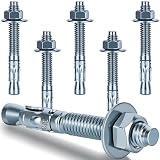
Wedge anchors are the better choice for a heavy bracket, a handrail base, or a mount that could be pulled away from the wall. A 3/8-inch or 1/2-inch wedge anchor may be appropriate, but diameter alone does not determine capacity. The concrete strength, embedment depth, spacing, edge distance, and bracket geometry all matter. Follow the anchor manufacturer’s published minimum embedment and torque rather than guessing.
For a clean, reusable threaded hole, consider a concrete drop-in anchor and setting-tool kit. These are useful when the bracket will be removed periodically, but they are not automatically stronger than a properly installed wedge anchor.
Drilling, hole depth, and embedment
Use a hammer drill for small concrete screws and an SDS-plus rotary hammer for repeated holes or larger anchors. A regular cordless drill with a masonry bit can eventually drill soft concrete, but it is slow and encourages overheating or wandering. For a 3/8-inch hole, an SDS rotary hammer usually produces a cleaner hole with less effort.
Mark the hole locations through the bracket, then check for reinforcement, conduit, and plumbing before drilling. Do not simply move a hole if the bracket requires a specific pattern; verify that the revised position still leaves enough concrete around the anchor.
Drill at least the specified embedment depth, plus roughly 1/2 inch for dust and the tip of the bit unless the manufacturer states otherwise. A typical concrete screw may need about 1-3/4 inches of total hole depth for 1-1/4 inches of effective embedment. A wedge anchor may require 2-1/2 to 4 inches or more. The anchor’s data sheet overrides these examples.
Keep the hole perpendicular to the slab. A tilted anchor can prevent the bracket from sitting flat and can reduce edge distance on one side. After drilling, remove dust with repeated brushing and vacuuming or with compressed air where appropriate. Dust left in the hole is one of the most common causes of weak expansion anchors.
Edge distance and load direction
Expansion anchors push outward against the concrete. Too close to an edge, they can split or break out the slab. As a practical minimum, keep an anchor at least 4 to 6 anchor diameters from an unsupported edge unless the manufacturer permits less. A 3/8-inch anchor therefore often needs roughly 1-1/2 to 2-1/4 inches of edge distance, with more being safer.
Spacing matters too. Closely packed anchors can interact and reduce capacity. Do not assume four anchors provide four times the strength. A bracket loaded downward mainly creates shear, while a bracket projecting from the wall creates a prying moment that pulls the upper anchors outward. That pullout force can be several times the carried weight, especially with a long bracket arm.
Installation checklist and failure modes
Use washers under nuts and bolt heads so the bracket does not deform. Tighten expansion anchors with a torque wrench when the specification gives a torque value. Over-tightening can damage the concrete or strip a concrete screw; under-tightening can leave a sleeve or wedge anchor below its intended capacity.
Never reuse a wedge anchor that has been removed. Replace any anchor that spins during tightening, cracks the surrounding concrete, or reaches full depth without clamping the bracket. If the slab is cracked, thin, lightweight, or badly spalled, standard expansion anchors may be a poor choice. Use a fastening system rated for cracked concrete, move the bracket, or consult an engineer for a safety-critical installation.
For most ordinary brackets, the buying decision is straightforward: use concrete screws when the load is light and removal matters, sleeve anchors for a forgiving medium-duty installation, and wedge anchors when pullout and shear loads are substantial. The cheapest anchor is fine only when the concrete, load, and installation details are all within its rating.