What's inside
As an Amazon Associate I earn from qualifying purchases. This post may contain affiliate links at no extra cost to you.
What we cover
Why brad-point bits work well in walnut
Walnut is a hardwood, but a sharp bit cuts it cleanly without much force. Its dark color makes ragged edges and torn fibers especially visible, so bit geometry and setup matter more than simply choosing the hardest steel. A brad-point bit has a small center spur that locates the hole and outer spurs that score the rim before the cutting edges remove wood. That scoring helps leave a cleaner entrance than a general-purpose twist bit.
For most furniture, cabinet, and shop work, a quality set of brad-point bits is the practical choice. If you drill only occasional holes, an inexpensive set can do the job; replace or sharpen bits when they start burning, wandering, or leaving fuzzy edges. For frequent work or larger holes, buying individual sizes in a better-ground set avoids paying for sizes you rarely use. Compare brad-point drill-bit sets for wood by size range, shank fit, and whether the cutters can be resharpened.
As an Amazon Associate we earn from qualifying purchases at no extra cost to you.
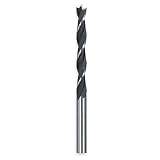

Bit types compared
| Bit type | Best use in walnut | Main trade-off |
|---|---|---|
| Brad-point bit | Clean, accurately located holes, especially small and medium diameters | Can pack with chips in deep holes; needs periodic clearing |
| Twist bit | Occasional holes where a rougher exit is acceptable | More likely to wander and tear the rim without careful backing |
| Forstner bit | Flat-bottomed counterbores and larger, precise recesses | Needs a steady drill press or controlled feed; can overheat |
| Auger bit | Deeper, larger holes where fast chip removal matters | Can pull aggressively and is less suited to delicate, small holes |
A brad-point set covering roughly 1/8 to 1/2 inch handles many joinery and hardware jobs. Forstner bits make more sense when you need a flat-bottomed recess, such as a concealed hinge cup; they are not a universal upgrade for ordinary through-holes. See Forstner bit sets for woodworking if that specific task is on your list.
What to look for when buying
Check that the set includes the diameters you actually use and has clear markings that remain readable after handling. A straight, consistent shank matters: a bent bit or a bit that does not seat securely will wobble, making a clean hole unlikely. Standard round shanks work in most cordless drills. Hex-shank bits are convenient for quick changes, but confirm the shank is rated for your chuck or quick-change holder and remains secure under load.
High-speed steel (HSS) is enough for walnut. Titanium-colored coatings do not make a bit automatically better for wood, and carbide is generally unnecessary for ordinary walnut drilling. A sharper, accurately ground cutting edge is more useful than a flashy coating. A basic set is fine for a few projects, provided you avoid forcing dull bits and store them so their points do not knock against each other.
How to drill cleaner holes
Clamp the board securely and mark the center with a sharp pencil or an awl. Set the drill to its low-speed range for larger bits and keep it square to the surface. A cordless drill with a sound chuck is sufficient; a hammer setting is not appropriate for wood. Start at a moderate speed with light, steady pressure. If the bit squeals, smokes, or leaves a dark ring, stop: it may be dull, moving too slowly under heavy pressure, or clogged with chips.
For a through-hole, clamp a scrap backer tightly against the exit face. The backer supports the fibers as the point breaks through and substantially reduces splintering. If you cannot use a backer, drill from one face until the center spur just appears on the other side, then finish from that side using the small mark as your guide. For holes deeper than about one bit diameter, withdraw the bit periodically to clear chips. Packed walnut dust creates heat, burns the hole wall, and can make the bit bind.
Match speed to diameter and feel rather than chasing a single setting. Small bits can run faster; large bits need slower speed to keep the rim cutters from overheating. If the drill slows sharply, ease off instead of leaning harder. A clutch is useful for driving fasteners, but switch out of clutch mode for drilling so it does not interrupt the cut.
Common problems and fixes
If a hole starts off-center, the bit may be dull, the board may not be clamped, or the surface may be sloped or uneven. A brad point helps locate the center, but it cannot compensate for a poor mark or a moving workpiece. If the entrance is fuzzy, check the outer spurs for damage and use a backer. If the hole burns, clear chips more often, reduce pressure, and inspect the cutting edges. Walnut dust is fine and irritating, so use extraction or a dust mask and clear the work surface after drilling.
For an occasional small hole, a budget brad-point set is usually adequate. Spend more when you drill often, need consistent diameters, or rely on clean results across a run of parts. Buy only the sizes you need if a large mixed set would mostly sit unused; replace a damaged bit rather than trying to force it through valuable stock.