What's inside
As an Amazon Associate I earn from qualifying purchases. This post may contain affiliate links at no extra cost to you.
Boring a clean hole through a wooden bed rail is a control job, not a power contest. The drill needs enough torque for the bit, a clutch that helps limit damage, and a chuck that holds the bit securely. For most home repairs and bed-frame modifications, a good 18V or 20V cordless drill is more useful than a bulky hammer drill or an impact driver.
As an Amazon Associate we earn from qualifying purchases at no extra cost to you.


What we cover
What the job actually needs
Bed rails are often hardwood or engineered wood, and the hole may need to be large enough for a bolt, dowel, or furniture connector. A pilot hole for a 1/4-inch screw is easy work for nearly any current cordless drill. A 1/2-inch hole through dense hardwood takes more torque and a sharp bit. Larger holes, especially with a hole saw, put much more strain on the drill and the person holding it.
Check the rail before drilling. Avoid existing fasteners, joints, and narrow edges; a hole too close to an edge can split the rail or weaken it. Measure both sides if the hole must line up with hardware. Clamp the rail to a stable surface, support the exit side with scrap wood, and mark the center with an awl or a small pilot hole. Those steps prevent more mistakes than buying a drill with a higher voltage label.
Which drill type to buy
A standard drill/driver is the right choice for most bed-rail holes. Its variable-speed trigger gives useful control, and the clutch can reduce the chance of driving a screw too far when the same tool is used for assembly. Choose a model with a two-speed gearbox: use low gear for larger bits and high gear for small pilot holes and screws.
A hammer drill can also bore wood, but its hammer action is for masonry. Turn that function off for wood. Paying extra for hammer mode makes sense if you also drill into brick or concrete; it does not make a bed-rail hole cleaner. An impact driver is poor as the only tool for this job. Its rotational impacts are designed for driving fasteners, not steady drilling, and many models require hex-shank bits or an adapter. It can work with suitable bits, but offers less control for a precise, round hole.
For a straightforward purchase, compare 18V cordless drill/drivers. If drilling masonry is also on the list, look at cordless hammer drills and make sure they have a drill-only setting.
Quick comparison
| Tool | Best fit for bed rails | Main drawback |
|---|---|---|
| Basic cordless drill/driver | Pilot holes, screws, and holes up to about 1/2 inch | May bog down with large bits in hardwood |
| Higher-torque drill/driver | Frequent use or larger bits and hole saws | Heavier and often more expensive |
| Hammer drill/driver | Wood drilling plus occasional masonry work | Hammer mode adds no benefit in wood |
| Impact driver | Driving bed-frame screws | Less suited to controlled, accurate boring |
Features worth paying for
For a one-off bed repair, a 12V drill may be enough, especially for pilot holes and ordinary screws. It is usually lighter and easier to control in a tight space. A 18V or 20V drill is a better general-purpose choice if you expect to bore larger holes or use the tool on other projects. The voltage labels are not a direct measure of drilling ability, so compare the tool’s stated torque, weight, chuck capacity, and battery system rather than choosing by voltage alone.
A 3/8-inch chuck accepts many common drill bits but limits some larger accessories. A 1/2-inch chuck is more versatile for furniture work and larger bits. Check the bit’s shank size before buying: a bit with a 1/2-inch cutting diameter may still have a smaller shank, but larger accessories can exceed a 3/8-inch chuck’s capacity.
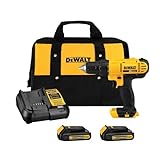
Two batteries are convenient if you already do longer projects, but they are not essential for a few holes in one rail. A compact battery keeps the drill lighter; a larger-capacity pack can be useful for repeated large-hole drilling. If you own tools from a battery platform already, buying a bare tool is often the sensible cheaper option. For occasional household work, an inexpensive drill kit is fine if it has variable speed, a secure chuck, and a battery that is still available from the manufacturer.
Bits and technique matter
Use a sharp brad-point bit for a clean, accurately placed hole in wood. Its center spur helps keep the bit from wandering. For a through-hole, drill until the tip just emerges from the far side, then finish from that side using the small exit hole as a guide. Alternatively, clamp scrap wood behind the rail to reduce tear-out. A standard twist bit can do the job, but it is more likely to wander on a smooth surface.
For a larger flat-bottomed hole, use a Forstner bit; for a rougher, faster large hole, a spade bit is cheaper. Spade bits can grab suddenly, particularly in hardwood, so use low gear, a firm two-handed grip, and a drill with enough torque. Do not force the tool when the bit stops cutting: pull it back to clear chips. A hole saw is for larger openings, but it needs steady pressure and can bind as the cut deepens. A clutch does not reliably protect you from that kickback.
Start slowly, keep the drill square to the rail, and increase speed only once the bit is centered. For a bolt hole, make the diameter just large enough for the hardware to pass without forcing it; check the hardware’s stated size instead of assuming the nominal bolt diameter is the required hole diameter. If the rail begins to split, the bit binds repeatedly, or the material is cracked near the hole, stop. Relocating the hole or replacing a damaged rail is safer than trying to fix a weakened structural member with a bigger drill.
A practical buying decision
Buy a basic drill/driver if you mainly need pilot holes, screws, and occasional holes up to roughly 1/2 inch. Step up to a higher-torque 18V or 20V drill if you regularly use larger bits, work in dense hardwood, or want one drill for demanding household jobs. Choose a hammer drill only when masonry drilling is part of the plan. Spend the remaining budget on a sharp wood bit, clamps, and a spare battery only if your work sessions justify it.