What's inside
As an Amazon Associate I earn from qualifying purchases. This post may contain affiliate links at no extra cost to you.
A small medicine cabinet is not especially heavy, but it can become a demanding drywall load once filled with bottles, glass containers, and metal hardware. The best wall anchor depends on the cabinet’s loaded weight, the number of mounting holes, and whether the cabinet can be fastened to a stud. For most surface-mounted cabinets, a toggle-style anchor is the safest drywall-only choice. For a very light cabinet, a self-drilling anchor may be adequate. If a stud is available, use a screw into the stud instead of relying on an anchor.
As an Amazon Associate we earn from qualifying purchases at no extra cost to you.


What we cover
Check the Wall and Cabinet Before Buying Anchors
Start by weighing the cabinet empty, then estimate the contents. A small metal or plastic cabinet may weigh 8 to 15 pounds empty and 20 to 35 pounds when loaded. Use the loaded figure, not the catalog weight. Also account for the cabinet pulling away from the wall when the door opens. That outward force is harder on drywall than simple downward weight.
Use a stud finder, then confirm the result with a small drill bit or by driving a test screw. Most wall studs are spaced 16 inches on center, though some walls use 24-inch spacing. If one or more mounting holes line up with a stud, drive a suitable screw at least 1 1/2 inches into the wood after passing through the cabinet rail. Do not count drywall thickness as part of the screw’s grip.
Inspect the cabinet’s mounting rail as well. A thin, slotted rail can tear or bend before a properly installed anchor fails. Use large washers under screw heads where the mounting holes are oversized. If the cabinet has only two small mounting holes, consider adding a backing strip or mounting cleat so the load is shared across more fasteners.
Best Wall Anchor Types for a Small Cabinet
| Anchor type | Typical drywall use | Strength and advantages | Main drawbacks |
|---|---|---|---|
| Plastic expansion plug | Very light loads | Cheap and easy for pictures or small accessories | Can pull out or spin under a cabinet’s outward load |
| Self-drilling threaded anchor | Light cabinets and accessories | Fast installation with no large hole | Limited holding power; coarse threads can damage weak drywall |
| Threaded hollow-wall anchor | Light to medium loads | Clamps the back of the drywall; removable and fairly strong | Requires a setting tool for many versions; can crush drywall if overtightened |
| Toggle bolt or strap toggle | Medium loads and cabinets with outward pull | Broad load distribution and strong resistance to pullout | Needs a larger hole; toggle can fall behind the wall if removed |
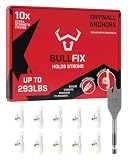
For a cabinet weighing up to about 25 pounds loaded, with four mounting holes and no usable studs, a properly installed strap toggle drywall anchor is usually the most dependable option. The broad toggle spreads the force over a larger area of gypsum board. Use two or four anchors according to the cabinet’s mounting design, but do not assume four anchors automatically provide four times the capacity. The cabinet rail and the drywall between holes still limit the result.
A threaded hollow-wall anchor is a good middle ground for a lighter cabinet, especially one weighing 15 to 20 pounds loaded. These anchors expand behind the drywall and remain in place while you drive the screw. They are cleaner than toggle bolts and often easier to remove. A metal hollow-wall anchor kit is generally preferable to thin plastic versions when the cabinet will be opened frequently.
Self-drilling anchors are convenient, but they are often overused. They work well for a small mirror, towel hook, or lightweight cabinet that will not be heavily loaded. They are not my first choice for a medicine cabinet with a glass door because repeated opening and closing creates movement. If you use them, choose a substantial metal anchor rather than a small plastic spiral and install one at every available mounting hole.
When the Cheaper Option Is Fine
Basic plastic expansion anchors are acceptable when the cabinet weighs less than about 10 pounds loaded, has a broad back or lower support point, and will hold only light items. They are also fine when the cabinet is primarily decorative and the mounting screws are not exposed to repeated pulling.
They are a poor choice for a narrow cabinet that stands away from the wall, has a heavy mirrored door, or will be packed with shampoo bottles and glass containers. In those cases, the door acts like a lever. A 20-pound cabinet can place considerably more than 20 pounds of force on the upper anchors when the door is pulled open.
How to Install the Anchors
Hold the cabinet in its final position and mark every mounting hole. Check that the cabinet is level before drilling. If the mounting rail is adjustable, mark through the rail rather than guessing from the cabinet body.
For a self-drilling anchor, drive it straight into the drywall with a screwdriver or drill on low speed. Stop when the shoulder is flush with the wall; do not bury it. For a hollow-wall anchor, drill the specified hole size, insert the anchor, and set it with the manufacturer’s tool. For a toggle, drill the required opening carefully with a drywall drill bit set. A hole that is too large reduces the toggle’s contact area.
Use a cordless drill’s clutch at a low setting for the final tightening. A drill or impact driver set to full power can strip the anchor, crush the drywall, or bend the cabinet rail. Tighten until the cabinet is firmly seated, then stop. Do not use an impact driver for the final tightening; its repeated hammering makes it easy to overdo a hollow-wall fastener.
Avoid These Common Failures
Do not hang the cabinet from two anchors when four mounting holes are provided. Do not place an anchor within roughly 1 inch of a drywall edge, corner, or previous hole unless the manufacturer specifically allows it. Closely spaced holes weaken the gypsum and can cause a section to break away.
Do not rely on a drywall anchor’s advertised maximum rating without checking how it was tested. Ratings vary with drywall thickness, installation quality, and load direction. A cabinet should have a safety margin of at least two to one between its loaded weight and the combined practical anchor capacity.
Finally, inspect the cabinet after a week of use. Look for a widening hole, a loose screw, a tilted cabinet, or a rail pulling away from the wall. Any movement means the anchors are being overloaded or the cabinet is acting as a lever. Remove it and remount it into a stud, a solid wood cleat, or larger toggle anchors rather than simply tightening the existing screws.