What's inside
As an Amazon Associate I earn from qualifying purchases. This post may contain affiliate links at no extra cost to you.
Cherry is a hardwood, but a sharp bit and a steady drill make clean holes in it routine. The drill matters most when you need controlled low-speed starts, consistent depth, and enough torque for larger bits—not when you’re chasing the biggest voltage number on the box. For most furniture, cabinet, and shop work, a quality 18V-class drill with a clutch and a variable-speed trigger is the practical choice.
As an Amazon Associate we earn from qualifying purchases at no extra cost to you.



What we cover
What to look for in a drill
Choose a drill with a two-speed gearbox, a 1/2-inch chuck, and a clutch you can set low enough for small fasteners. The low gear gives more control and torque for larger holes; the high gear is useful for small bits. A responsive trigger helps you start a hole slowly without the bit skating across the cherry’s surface.
A drill with a brushless motor can run longer per battery charge and may hold speed better under load, but it is not required for clean holes. A less expensive brushed drill will do the job if its chuck grips securely and its trigger is easy to control. For occasional woodworking, put money toward good bits and a spare battery before paying a large premium for extra drill features.
Drill types compared
| Drill type | Best fit for cherry | Trade-off |
|---|---|---|
| Compact 12V drill | Pilot holes, small bits, hardware, and light assembly | Less reserve for large Forstner bits or repeated deep holes |
| 18V-class drill | General woodworking, holes up to about 1 inch, and occasional larger bits | Heavier than a compact drill; quality and control vary by model |
| Hammer drill | Wood drilling plus occasional masonry work | Hammer mode is unnecessary for wood and must be switched off |
| Impact driver | Driving screws with a hex-shank bit holder | Poor choice for ordinary twist-bit drilling; impacts can bruise or split work |
A dedicated drill is usually more comfortable for drilling than an impact driver. An impact driver can make pilot holes with compatible hex-shank bits, but its rapid impacts reduce finesse. If one tool must cover both wood and masonry, a hammer drill is reasonable; turn off hammer mode before drilling cherry.
Pick the bit for the hole
For clean holes through cherry, use a sharp brad-point bit for small and medium diameters. Its center point locates the hole, and its outer spurs score the fibers before the cutters remove material. A dull bit tends to burn, wander, or tear fibers at the exit. Replace or sharpen it when cutting slows, the hole darkens, or you need to push unusually hard.
For larger flat-bottomed holes, a sharp Forstner bit gives a clean rim and controlled depth, but it creates more resistance and heat than a small twist bit. Use low gear, moderate pressure, and clear chips often. Spade bits are cheaper and fast, but they are more likely to leave a rougher exit and are less suited to visible, precision work. Forstner bits are a good upgrade for repeated clean counterbores; a basic brad-point set is enough for many furniture holes.
How to drill without tear-out or burning
Mark the center accurately and clamp the work to a sacrificial backer board. The backer supports the fibers as the bit exits, reducing breakout. If you cannot use a backer, drill from one face until the point just emerges, then finish from the other face using that small opening as your guide. This takes more care but is useful on finished panels.
Start at low speed until the point is seated, then increase speed while keeping the drill square to the surface. Do not force the tool: excessive pressure can stall a small drill, flex a long bit, or produce heat that scorches cherry. For a deep hole, withdraw the bit periodically to clear chips. A 1/4-inch hole in a thin board needs little interruption; a deep 3/4-inch hole may need several withdrawals. If the bit squeals, smokes, or leaves a dark ring, stop, clear the flutes, and check sharpness.
For a hole that must be perpendicular, use a drill guide or drill press when available. A freehand drill can work, but even a slight lean becomes obvious in a deep hole or when installing a close-fitting dowel. A simple square held beside the drill can help with alignment, though it does not replace a guide for demanding work.
What to buy for your workload
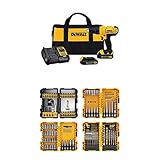
For occasional pilot holes, shelf hardware, and small fasteners, a compact drill is often enough. Look for a kit with a 1/2-inch chuck if you expect to use common woodworking bits. A 12V cordless drill kit is a sensible lower-cost choice when you are not routinely boring large holes.
For a regular mix of furniture work, larger bits, and general household drilling, buy an 18V-class drill with two speeds, a controllable trigger, and a second battery if the kit price is reasonable. A brushless 18V drill kit is worth considering for frequent use, but a brushed kit is fine for occasional projects. If your work includes concrete or brick, choose a hammer-drill model with a separate hammer setting rather than relying on an impact driver.
Common mistakes to avoid
Do not use hammer mode in cherry: the pulsing action can damage the hole and workpiece. Avoid running a large bit at high speed, which can overheat the cutting edge and leave burn marks. Do not assume a more powerful drill will compensate for a dull bit or poor support. And do not clamp so close to the hole that the chuck or handle hits the clamp as you work.
For most clean holes in cherry, the best purchase is a controllable drill that suits your workload, paired with sharp brad-point bits and a backer board. Spend extra on power only if you regularly use large bits or drill many holes in a session; otherwise, careful setup makes the bigger difference.