What's inside
As an Amazon Associate I earn from qualifying purchases. This post may contain affiliate links at no extra cost to you.
What we cover
The short answer
For most flat-pack cabinets, a cordless drill is the better tool to buy first. It gives you more control over screw depth, is quieter, and can drill pilot holes. An impact driver can run screws faster, but its hammering action makes it easier to strip a small screw head, split a panel, or drive a fastener too far.
If you already own an impact driver, you can use it for some cabinet fasteners—but use a suitable bit, keep the speed low, and stop as soon as the screw seats. For the small cam screws and connectors common in flat-pack furniture, a hand screwdriver may give you better control than either power tool.
As an Amazon Associate we earn from qualifying purchases at no extra cost to you.


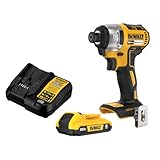

How the tools differ
A drill rotates smoothly and usually has an adjustable clutch. Set the clutch low and it slips when resistance reaches the selected level, helping prevent overtightening. Its chuck accepts round-shank drill bits as well as many screw-driving bits.
An impact driver also rotates, but adds rapid rotational blows when a screw meets resistance. That extra torque is useful for long screws and other demanding fastening, but the blows can make a small cabinet screw hard to control. Most impact drivers use a 1/4-inch hex collet, so ordinary round-shank drill bits need a compatible adapter.
Comparison for flat-pack assembly
| Factor | Cordless drill | Impact driver |
|---|---|---|
| Control on small screws | Better, especially with a clutch | Less forgiving; can overdrive fast |
| Typical cabinet fasteners | Well suited | Often more power than needed |
| Drilling pilot holes | Convenient with standard bits | Usually needs a hex-shank bit or adapter |
| Noise and vibration | Lower | Higher during impact |
| Best use in this job | Most assembly and careful fastening | Longer screws into solid wood or wall framing |
Which one should you buy?
Choose a drill if this is your first tool, if you expect to assemble furniture regularly, or if you need to drill holes as well as drive screws. A basic cordless drill with a clutch and two speed settings is enough for typical flat-pack assembly. A 12-volt drill is often lighter and easier to handle in a cramped cabinet; an 18- or 20-volt drill is useful if you also plan to drill larger holes or tackle heavier household jobs.
Choose an impact driver if you already have a drill, or you regularly drive long structural screws, deck screws, or fasteners into dense material. It can make those jobs quicker and less tiring. For cabinet assembly alone, its speed advantage is limited: most of the time goes into sorting parts, aligning panels, and installing connectors, not driving long screws. Compare cordless drills with an adjustable clutch if you want one tool for assembly and general drilling, or cordless impact driver kits if you have harder fastening jobs too.
A cheaper corded drill or a manual screwdriver can be perfectly adequate for one cabinet. The trade-off is convenience: a cord can get in the way, and hand-driving many screws takes longer. If you assemble only a few pieces of furniture, there is little reason to buy both tools.
How to avoid damaging the cabinet
Follow the maker’s instructions first. Flat-pack panels are often particleboard or MDF, which hold screws less securely than solid wood. A screw driven too hard can strip its hole or crush the material. Keep the tool straight, use the correct bit, and let the fastener—not extra force—do the work.
With a drill, start at the lowest clutch setting that reliably seats the screw. Increase it one step at a time if the clutch slips before the head is seated. Use the low-speed setting for more control. If the instructions call for a screw to be hand-tightened, finish by hand rather than trying to force the drill clutch to match that feel.
With an impact driver, use a low-speed mode if the tool has one. Keep the bit firmly seated in the screw head, apply steady pressure, and use short trigger taps. Stop immediately when the head reaches the surface. Impacts can cam a bit out of a screw head, especially if the bit is worn or slightly mismatched; this damages the screw and can leave the joint loose. Do not use an impact driver on cam-lock connectors unless the manufacturer explicitly allows it.
Pilot holes and wall fixing
Do not drill new holes in a cabinet panel unless the instructions call for them. When driving a screw into solid wood, a pilot hole can reduce splitting; choose a bit slightly narrower than the screw’s solid core, and test on scrap if you are unsure. In particleboard, a pilot hole that is too large can leave the screw with little material to grip.
Securing a cabinet to a wall is a separate task from assembling it. Use the supplied restraint hardware if appropriate, but select the wall fixing for the actual wall: drywall alone, masonry, and a timber stud all need different fixings. A hollow-wall anchor is not a substitute for fastening into a stud when the cabinet’s instructions require a stud connection. If drilling masonry, you may need a hammer drill and masonry bit; ordinary drills are slower there, while an impact driver is not a hammer drill. Check for hidden pipes and cables before drilling, and use a level to position the cabinet before fixing it.
For screw bits, a correctly fitting Pozidriv or Phillips bit matters more than a high torque rating. Keep a few fresh bits in the size specified by the instructions, and stop if the bit slips repeatedly. The practical choice is usually simple: buy or borrow a drill for controlled assembly, and reach for an impact driver only when the fastener and material actually call for its extra force.