What's inside
As an Amazon Associate I earn from qualifying purchases. This post may contain affiliate links at no extra cost to you.
Small brackets are easy to underestimate. A curtain tieback, cable guide, shelf support, motion sensor, or small tool holder may weigh only a few pounds, but the fastener sees more than the bracket’s static weight. Pulling, vibration, and repeated loading can loosen an anchor or crush brittle plaster around the hole.
The best anchor depends first on what is behind the plaster. Traditional plaster may be applied over wood lath, metal lath, or masonry. Modern walls may be plaster skim over drywall. These are not interchangeable surfaces. Before buying hardware, tap the wall, inspect an outlet or switch box if possible, and drill a small pilot hole in an inconspicuous spot. A stud finder can help, but many models struggle with thick plaster and metal lath.
As an Amazon Associate we earn from qualifying purchases at no extra cost to you.



What we cover
Best anchor types for a small bracket
| Wall condition | Best choice | Typical useful load | Main drawback |
|---|---|---|---|
| Plaster over drywall, light bracket | Self-drilling drywall anchor or plastic expansion anchor | About 10–25 lb per anchor, depending on the product | Can pull out under leverage |
| Hollow wall, moderate load | Toggle bolt or metal hollow-wall anchor | About 25–50 lb per anchor in sound material | Needs a larger hole and clearance behind the wall |
| Plaster over wood lath | Long screw into lath or, preferably, a stud | Highly variable | Lath can split; plaster can chip |
| Solid masonry behind plaster | Masonry screw with correct bit | Often more than needed for a small bracket | Hard drilling and possible plaster cracking |
When a plastic anchor is enough
For a small bracket holding less than roughly 10 pounds, a quality ribbed plastic expansion anchor is often the sensible low-cost option—provided the wall is sound and the bracket sits flat. It spreads pressure over a larger area than a bare screw and is inexpensive to replace. This is adequate for a light cable bracket, small sensor, or decorative hardware that will not be pulled downward.
Use an anchor rated for the screw diameter, not simply whatever fits the hole. Drill the specified hole, usually with a sharp bit slightly smaller than the anchor body, and stop drilling as soon as you pass through the plaster surface. A regular plastic wall anchor kit is fine for this job if its instructions provide a load rating and matching screws.
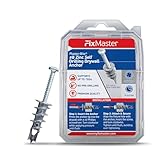
Self-drilling drywall anchors are convenient in plaster-over-drywall, but their points may skid on hard plaster. Do not force one through the finish with an impact driver. Make a small pilot hole first, then install the anchor with a hand screwdriver or a cordless drill on low torque. If the anchor spins while tightening, remove it and use a larger or different anchor rather than continuing to tighten.
When to choose a toggle or metal anchor
A toggle is the safer choice when the bracket creates leverage or the load approaches 15 to 25 pounds. A shelf support, small monitor accessory, or wall-mounted tool holder can pull outward as well as downward. Toggle wings distribute that force over the back of the wall instead of relying on the plaster’s weak surface layer.
Traditional snap toggles are usually easier to install than old-style spring toggles because the retaining channel stays in place while you fit the bolt. They require a larger hole—often around 1/2 inch—and enough open space behind the wall for the wings. Avoid them near electrical boxes, plumbing, and blocking. A snap toggle anchor set is a practical choice when you need more holding power in a hollow wall.
Metal hollow-wall anchors, sometimes called molly bolts, work well for medium-light brackets and leave a more compact installation than a toggle. Their sleeves must expand fully behind the wall. Plaster that is loose, cracked, or powdery can fail before the metal anchor does, so published ratings should not be treated as guarantees.
The strongest option is often not an anchor
If you can place one bracket hole over a stud, use a screw into the stud. A 2 1/2- to 3-inch screw is commonly suitable for a bracket over roughly 1/2 inch of plaster and lath, but check the actual wall thickness. The screw should enter the stud by at least 1 1/4 inches without being so long that it risks hidden wiring or plumbing.
With wood lath, a screw may catch a thin strip and feel tight while holding poorly. Drill a pilot hole through the plaster and lath to reduce chipping, then drive the screw slowly. If the bracket has two holes, one screw in a stud plus one properly selected hollow-wall anchor is usually better than two anchors in weak plaster.
For masonry behind plaster, use a masonry drill bit and a masonry screw. A hammer drill can speed work in brick or concrete, but use hammer mode only after clearing the plaster surface. Hammering on the finish can create a crater larger than the bracket. A standard cordless drill is often safer for the first inch.
How to prevent plaster damage and pullout
Mark the holes with the bracket held level. Apply painter’s tape over each mark to reduce surface chipping, and use a sharp bit at low speed. Keep the drill perpendicular; an angled hole makes the bracket rock and places extra stress on the anchor.
Do not overtighten. Tighten until the bracket is firmly seated, then stop. Excess torque can crush plaster, strip plastic threads, or deform a metal anchor. An impact driver is generally the wrong tool here unless its torque is set very low and you already know the anchor’s limits. A hand screwdriver or cordless drill with a low clutch setting gives better control.
Leave a safety margin of at least two to one. If the bracket and its contents weigh 8 pounds, select anchors whose combined realistic rating is at least 16 pounds, and reduce that rating further if the load projects far from the wall. For anything valuable, heavy, or regularly pulled, fasten to a stud or use a larger bracket with more mounting points. A cordless drill with an adjustable clutch makes controlled installation much easier than a high-torque driver.
Signs the installation is failing
Stop if the anchor rotates, the screw never becomes snug, the plaster cracks outward, or the bracket remains loose after tightening. These indicate a damaged hole, hidden cavity problem, or unsuitable anchor. Remove the hardware and move the bracket at least an inch if possible. Do not simply fill the hole with spackle and reinstall the same anchor; spackle is not structural.