What's inside
As an Amazon Associate I earn from qualifying purchases. This post may contain affiliate links at no extra cost to you.
Red brick is usually straightforward to drill, but the wrong drill or bit can turn a simple anchor hole into a chipped, oversized mess. For most home jobs, a cordless drill with a hammer function and a sharp masonry bit is enough. The key buying decision is whether you need a compact hammer drill for occasional holes or a rotary hammer for repeated drilling, large anchors, or hard brick.
As an Amazon Associate we earn from qualifying purchases at no extra cost to you.


What we cover
Choose the right drill for the job
A cordless hammer drill spins the bit while tapping it forward. It is lighter and more versatile than a rotary hammer, and a good choice for shelves, brackets, and other small-to-medium fixings. Look for a hammer setting, a two-speed gearbox, and a clutch for ordinary screwdriving. A 1/2-inch chuck accepts common masonry bits; roughly 18–20 volts is a useful range, though battery capacity and tool design matter more than voltage alone.
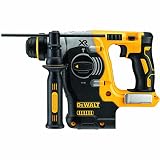
A rotary hammer uses a different striking mechanism and typically an SDS-Plus bit connection. It drills faster with less pressure, particularly in hard masonry, and is the better choice for many holes or larger diameters. It costs more, weighs more, and is less convenient for general screwdriving. If you are drilling only a handful of holes in soft red brick, that extra power may not be worth buying.
For an occasional project, a cordless 1/2-inch hammer drill is the sensible starting point. For frequent masonry work, compare it with a cordless SDS-Plus rotary hammer. Don’t choose by the largest claimed impact rate alone: grip, balance, battery availability, and the bit system are more useful in everyday work.
Hammer drill or rotary hammer?
| Tool | Best fit | Main trade-off |
|---|---|---|
| Cordless hammer drill | A few holes for common wall anchors; general household drilling and driving | Slower in hard brick; requires more pressure and can tire your hands |
| Corded hammer drill | Longer sessions when an outlet is close and a lower purchase cost matters | More awkward around a ladder or exterior wall; cord management is a nuisance |
| SDS-Plus rotary hammer | Many holes, larger holes, or hard masonry | Higher cost and weight; SDS bits do not fit a standard three-jaw chuck |
Match the bit to the anchor
Use a carbide-tipped masonry bit, not a wood or general-purpose twist bit. The hole diameter should match the anchor maker’s instructions: a 1/4-inch anchor, for example, commonly calls for a 1/4-inch hole, but check the package rather than assuming. A bit that is even slightly oversized can leave a plastic plug spinning instead of gripping. For repeat work, keep a spare bit; a dull tip drills slowly and encourages excess force.
Choose a bit long enough to reach the specified embedment depth, but don’t use a very long bit when a short one will do. A longer bit flexes more and is easier to start at an angle. For a standard plastic expansion plug, drill the full required depth and clear the dust from the hole before fitting it. Dust left inside can stop the anchor seating fully.
Drilling clean holes in red brick
First decide whether to drill into the brick or the mortar joint. Brick is usually the stronger fixing point, but old, cracked, or fragile brick may split. Mortar is easier to drill and repair, but it can be weaker and may crumble. Follow the anchor or fixture instructions, and avoid drilling close to a brick edge; as a practical starting point, leave at least an inch where the layout allows.
Mark the hole, check for hidden wires or pipes, and hold the drill square to the wall. Start slowly to keep the bit from wandering. Once it is centered, use the hammer setting and steady pressure—let the bit do the cutting rather than leaning your full weight on the tool. A strip of tape on the bit makes a simple depth marker. For a small hole, withdraw the bit once or twice to clear dust; for deeper holes, stop and clean it more often.
Red brick varies. Soft brick may drill quickly, while dense or fired brick can be surprisingly tough. If the bit barely advances, check that hammer mode is engaged and the bit is sharp before increasing pressure. Excess force can overheat the bit, enlarge the hole, or crack the brick. If the drill repeatedly stalls or the job involves many holes around 3/8 inch and larger, a rotary hammer is likely the better tool.
What is worth paying for?
For a few holes a year, a basic hammer drill from a tool line you already own is often enough. Buying into a battery platform makes sense if you also need a saw, impact driver, or extra batteries; otherwise, the battery kit can cost more than the masonry work warrants. A corded hammer drill can be a lower-cost option for a stationary job near an outlet, but it is less convenient on a ladder.
Look for a comfortable side handle, especially if you expect to drill larger holes. It helps control the tool if the bit binds. A depth stop is useful for repeat holes but not essential; tape works for occasional jobs. Avoid using an impact driver for ordinary masonry drilling: its hex chuck is designed for driving and impact-rated accessories, not for controlled hammer drilling into brick. If you already own a hammer drill and need bits, a carbide-tipped masonry bit set is usually the more useful purchase than a more powerful drill.
Know when to stop
Stop if the brick starts cracking, the hole wanders toward an edge, or the bit heats up and stops cutting. Let a hot bit cool naturally; quenching it can damage the carbide tip. If the anchor turns in the hole, don’t keep tightening the screw. Remove it and use the correct bit size, a suitable larger anchor if the fixture permits, or a different fixing method. A clean, accurately sized hole is more important than buying the strongest drill on the shelf.