What's inside
As an Amazon Associate I earn from qualifying purchases. This post may contain affiliate links at no extra cost to you.
Tamper-resistant Torx screws look like ordinary six-point Torx screws, but they have a small pin in the center of the recess. A standard Torx bit cannot seat fully, so it either will not turn the screw or will damage the recess while you try. The correct tool is a security Torx, tamper-proof Torx, or pin-in Torx bit with a hole drilled through its tip.
For use with a cordless impact driver, the bit needs more than the right Torx size. It must also be impact-rated, made for a 1/4-inch hex chuck, and strong enough to handle repeated shock loads. A hand-tool security Torx key may fit the screw, but it is a poor choice in an impact driver.
As an Amazon Associate we earn from qualifying purchases at no extra cost to you.



What we cover
What to look for in impact driver bits
Start with a set of security Torx impact driver bits rather than a general Torx set. The listing should specifically say “security Torx,” “tamper-proof Torx,” or “pin Torx,” and it should show a hole through each working end.
The bits should be marked as impact-rated. Look for terms such as S2 steel, modified S2 steel, or torsion-zone construction, although the word “impact” matters more than the steel description alone. Impact-rated bits are designed to flex slightly under the repeated hammering of an impact driver. Hard, brittle bits can snap at the shank or at the drilled tip.
A 1/4-inch hex shank is the normal format for impact drivers. Short bits are usually the strongest choice because they have less leverage and less opportunity to twist. Longer bits are useful when the screw is recessed or surrounded by an enclosure, but a 2-inch or 3-inch bit will generally tolerate less abuse than a stubby bit of the same quality.
Torx sizes and fit
Security Torx screws are commonly found in sizes from T10 through T40. Electronics, appliances, vehicle trim, locks, and small machinery often use T10, T15, T20, or T25. Larger fixtures and outdoor equipment may use T27, T30, or T40.
Do not guess based on appearance. A T25 bit forced into a T27 recess may feel close enough to turn the screw, but the small contact area concentrates the impact force on the corners. The result is a rounded recess, especially if the screw is rusty or over-tightened.
The center hole must also be deep and wide enough for the screw’s pin. Some security screws have unusually long pins. If the hole in the bit bottoms out on the pin, the six driving points will not reach the sides of the recess. Clean dirt and paint out of the screw before judging the fit.
| Bit feature | Best use | Main trade-off |
|---|---|---|
| Short, impact-rated security Torx bit | Routine fastening and removal with good access | Least reach around deep housings |
| Long security Torx bit | Recessed screws and appliance panels | More flex and greater breakage risk |
| Security Torx socket | High-torque work with a 3/8-inch or 1/4-inch ratchet or adapter | Bulkier and less convenient in tight spaces |
| Hand-driver security Torx key | Light-duty electronics and final tightening | Not suitable for impact-driver hammering |
The best set for most jobs
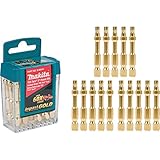
For general repair work, buy a set covering at least T10, T15, T20, T25, T27, T30, and T40. A set with duplicate T20 and T25 bits is useful because those sizes see the most use and are the ones most likely to be worn or lost.
Choose a set with clear size markings. Laser-etched markings can become difficult to read, while molded or stamped markings usually last longer. A compact case is preferable to a loose assortment; security bits are easy to confuse with standard Torx bits when they are mixed together.
A cheaper set is fine for occasional indoor work, such as removing an appliance panel or replacing a lock component. Use low speed, moderate trigger pressure, and stop as soon as the screw begins to slip. For daily installation, automotive work, structural fastening, or seized screws, better-made bits are worth the cost because one broken bit or rounded screw can consume more time than the price difference.
If you already own quality impact bits, add a separate security Torx bit set covering T10 to T40. Buying only the sizes you need is cheaper, but complete coverage avoids substituting the wrong size later.
How to use them without stripping the screw
Set the impact driver to its lowest speed or torque setting first. Push the bit firmly into the recess and keep the driver aligned with the screw. Start the screw at low trigger speed rather than immediately using full power. A security Torx bit depends on all six points making solid contact; even a small angle can load only two or three points.
For removal, clear rust and debris from the recess with a pick or stiff brush. If the screw is stuck, apply penetrating oil where appropriate and use short impact pulses. Do not hold the trigger continuously against a screw that is not moving. Ten seconds of hammering can overheat the bit, deform the recess, and break the center-pin section.
When driving into wood or sheet metal, stop when the head is seated. An impact driver can easily bury a screw head or shear a small T15 or T20 screw. For final tightening on delicate equipment, switch to a hand driver or use a low torque setting rather than relying on the impact mechanism.
When another tool is better
A security Torx socket is preferable when the fastener requires substantial torque and there is room for a socket. Sockets have more material around the drive end and can be used with a ratchet for controlled force. They are less practical in narrow recesses.
For damaged screws, a new security bit may not be enough. Try a fresh, correctly sized bit with firm inward pressure. If the recess is already rounded, locking pliers, a screw extractor, or drilling the head off may be necessary. Do not keep increasing impact-driver power; that usually destroys the screw and can snap the bit.
For a small repair kit, a compact 1/4-inch hex impact security Torx set is the practical choice. Confirm the sizes, the center holes, and the impact rating before buying. Those details matter more than a large bit count or an attractive case.