What's inside
As an Amazon Associate I earn from qualifying purchases. This post may contain affiliate links at no extra cost to you.
What we cover
Choosing the right bit
Hex-head sheet-metal screws are driven by the size of the hex washer head, not by a Phillips or Torx recess. The usual tool is a magnetic nut setter: a short socket with a hexagonal opening that fits over the screw head. For an impact driver, buy one rated for impact use. A standard nut setter may fit and work briefly, but its harder, less forgiving construction can crack or shed pieces under repeated impact loading.
Common screw-head sizes include 1/4, 5/16 and 3/8 inch. Measure the head across its flats, or check the screw packaging; do not guess from the screw’s diameter. The socket should slide over the head with little play. Too tight, and paint, burrs or slight misalignment can stop it seating. Too loose, and the socket can round the hex corners, especially at high speed.
As an Amazon Associate we earn from qualifying purchases at no extra cost to you.

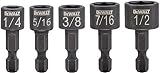

For occasional repairs, a basic impact-rated magnetic nut setter in the correct size is usually enough. If you work with several screw sizes or drive fasteners overhead, a set is more convenient. Compare impact-rated magnetic nut-setter sets by included sizes, usable socket depth and retention method—not by the number of pieces alone.
Match the bit to the screw
Check the screw’s hex head before buying. A 1/4-inch socket is common on smaller sheet-metal screws; larger screws may use 5/16- or 3/8-inch heads. These are examples, not a guarantee: head sizes vary by screw type and manufacturer. If the fastener is already on hand, test the bit on it before starting a long run.
| Bit type | Best use | Trade-off |
|---|---|---|
| Short magnetic nut setter | Routine screws with clear access | Compact and inexpensive, but may not reach recessed heads |
| Long-reach nut setter | Fasteners set below an edge or behind a flange | Reaches farther, but the extra length can flex or wobble |
| Deep socket-style nut setter | Long screws or heads with a tall washer | More clearance around the screw, but can be awkward in tight spaces |
| Nonmagnetic nut setter | Work where magnetism attracts metal debris | Avoids magnetic swarf, but does not hold a screw for one-handed placement |
A longer bit is not automatically better. Use the shortest length that clears the workpiece. A long extension puts more leverage on the socket if the driver tilts, which increases the chance of damaging the screw head or snapping the bit. For frequent work in a particular size, a single impact-rated nut setter in the measured size can be a better buy than a large set of sizes you will never use.
Magnetism and screw retention
Most magnetic nut setters hold a screw head well enough for positioning, but magnet strength and socket depth differ. A strong magnet is useful when starting screws overhead or in a corner. It can also collect metal filings and steel chips, which may scratch a painted panel or keep the screw from seating fully. Brush or wipe debris from the socket when it builds up.
Some setters use a retaining ring or sleeve instead of relying only on a magnet. These can keep a fastener from falling, but the added sleeve may limit access around a raised seam or washer. For ordinary bench-height installation, a basic magnetic setter is often the cheaper, simpler choice. Pay extra for retention features when the job makes dropped screws costly or access difficult.
Drive without damaging the fastener
Start the screw square to the surface and keep steady pressure behind the driver. Use a slower trigger pull to start the threads; pulling the trigger fully from the outset can spin the screw, tilt the bit or dimple thin sheet metal before you can react. Once the screw is seated, stop. An impact driver can keep tightening after the washer has made contact, crushing the material, stripping the threads or snapping the screw.
For thin sheet metal, test the setting and technique on scrap of the same thickness. A low speed or power mode, if your driver has one, gives better control. Do not treat a torque number as a universal setting: screw diameter, sheet thickness, framing material and the driver all affect the result. If the screw repeatedly spins without tightening, the hole may be oversized or the threads may be stripped. A longer or stronger impact-rated bit will not fix that; use an appropriate larger fastener, a repaired hole or another approved fastening method.
Driving too slowly can also cause problems if the bit wobbles or the screw is badly aligned. Keep the socket fully engaged on the hex, and avoid side-loading it. If the corners are becoming shiny or rounded, stop and check the fit rather than forcing the screw. Replace a bit with a cracked socket, badly rounded opening or loose shank; continuing can ruin fasteners and leave metal fragments in the work area.
What to check before buying
Confirm the head size, then choose an impact-rated setter with the reach the job requires. A 1/4-inch hex shank fits most impact-driver chucks, but inspect the product details rather than assuming. If you need to work close to a wall or inside a narrow channel, check the outside diameter and overall length too. A deep socket may fit over the screw but still be too wide to clear nearby material.
For a small repair, one correctly sized, short magnetic setter is usually sufficient. For maintenance work involving mixed fasteners, a set covering the sizes you actually encounter saves trips to the tool case. Avoid buying on magnet strength alone: socket fit, access and the ability to control the driver have a bigger effect on a clean installation. If you are unsure of the size, take the screw to a hardware store or buy a set with clearly marked, useful sizes rather than forcing a near-fit bit.