What's inside
As an Amazon Associate I earn from qualifying purchases. This post may contain affiliate links at no extra cost to you.
The right anchor depends less on the railing bracket than on what the wall is made of, how much sound material sits behind the finish, and whether the railing will see a hard sideways load. A loose bracket can let a person fall, so don’t choose an anchor by its package rating alone. For a sound concrete or solid masonry wall, a properly sized masonry screw is often the simplest option. For hollow block, damaged masonry, or a heavily loaded railing, the fixing needs a different approach—or a professional assessment.
As an Amazon Associate we earn from qualifying purchases at no extra cost to you.



What we cover
Identify the wall before buying anchors
Concrete, solid brick, hollow concrete block, and brick veneer are not interchangeable anchor materials. Check an exposed edge, an existing hole, or building plans if you can. A hammer drill can make quick work of concrete, but drilling a deep hole does not turn a thin brick veneer or hollow block face into a reliable railing support.
Also check for render, tile, or plaster. Those layers are not structural. The anchor must engage sound masonry behind them, and the bracket should not crush a thick, soft finish when tightened. If the wall is cracked, crumbling, unusually thin, or built from hollow units, stop and establish a suitable fixing method before drilling.
Compare the main anchor types
| Anchor type | Best suited to | Advantages | Limits |
|---|---|---|---|
| Concrete screw | Sound concrete and suitable solid masonry | Quick to install and remove; no expansion sleeve | Needs an accurately sized, clean hole; capacity varies by substrate |
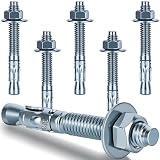
| Expansion anchor | Sound concrete, where the anchor design and edge distances fit | Strong mechanical grip in appropriate concrete | Expansion can damage weak masonry or split material near an edge |
| Adhesive anchor with threaded rod | Specified installations in solid masonry or concrete | No expansion force; useful where a designed system calls for it | Requires careful hole cleaning, correct resin, and cure time |
| Hollow-masonry system | Hollow block, only when the system is rated for that unit | Designed to work with cavities or webs | Generic concrete anchors may pull out; installation is system-specific |
For an ordinary bracket on sound concrete, start by comparing concrete screws for masonry. They are often the most straightforward choice when the manufacturer’s instructions cover the wall material and bracket load. Expansion anchors can be appropriate in solid concrete, but their outward pressure makes them a poor default for weak brick, narrow edges, or cracked masonry.
Choose diameter and embedment from the fixing instructions
Do not guess based on the bracket holes. Anchor diameter, effective embedment, spacing, edge distance, and the masonry’s condition all affect performance. Follow the anchor maker’s installation data and the railing or bracket manufacturer’s requirements; use the more demanding requirement where they differ. A long anchor is not automatically stronger if it bottoms out, hits a void, or has too little sound material around it.
For a railing, consider the direction of load. People pull sideways and downward, which can pry the bracket away from the wall. Two fasteners close together may not share that load evenly. Bracket spacing, the number of brackets, railing height, and leverage all matter. If the railing is required for fall protection, stairs, a balcony, or a public area, use a design that meets local code rather than treating it as a light-duty handrail.
Drill the hole cleanly and accurately
For concrete, use a hammer drill with a sharp masonry bit of the specified diameter. A regular drill may work in softer brick, but it can be slow in concrete; an impact driver is not a substitute for a hammer drill. Keep the bit square to the wall, drill to the required depth, and mark the depth on the bit with tape if it has no depth stop. Avoid drilling close to an edge unless the anchor instructions allow it.
Clean the hole as directed. Dust left inside can prevent a concrete screw from cutting properly and can seriously reduce the bond of an adhesive anchor. Use the specified brush and blow-out method for resin systems; follow the product’s cleaning and curing instructions exactly. Wear eye protection, and check for hidden wiring or plumbing before drilling.
Install the fastener with the correct driver or wrench and stop at the maker’s stated tightening requirement. Overdriving a concrete screw can strip its hole; overtightening an expansion anchor can damage the substrate or fastener. If the anchor spins, the hole is oversized, or masonry breaks away, don’t “fix” it by adding extra torque. Move to an approved new location or use a properly specified alternative.
When the wall is hollow or damaged
In hollow block, a standard sleeve or concrete screw may grip only a thin face shell and pull out under a sudden load. Use a fixing system explicitly approved for that block type and load, often with a mesh sleeve and resin where specified. Adhesive anchors are not a universal cure: the resin, sleeve, rod, hole size, and installation method have to be a tested combination. For a handrail that could prevent a fall, have the substrate and fixing assessed if you cannot verify that combination.
In soft or cracked brick, placing a powerful expansion anchor near a brick edge can split the unit. A fixing in a mortar joint is not automatically safer; mortar strength varies and may be poor. If the bracket layout leaves little room for proper edge distance, consult the anchor maker’s technical data or choose a mounting arrangement designed for that wall.
What to buy for the job
For sound concrete, buy a listed concrete screw in the diameter and length required by the bracket and anchor instructions, plus the matching masonry bit. A hammer-drill masonry bit set is useful if you do not already own the correct size, but check that the individual bit matches the anchor’s specified hole diameter. For occasional work in soft brick, a corded or cordless drill with a good masonry bit may be enough; there is no need to buy a large hammer drill for one small hole if the tool can drill the substrate cleanly.
Buy adhesive-anchor components only as a matched system, and account for cure time before loading the railing. If the substrate is hollow, cracked, or uncertain, do not substitute a generic anchor because it is cheaper or already on hand. The cost of the right fixing is small compared with the consequences of a bracket pulling loose.