What's inside
As an Amazon Associate I earn from qualifying purchases. This post may contain affiliate links at no extra cost to you.
Every chainsaw owner eventually hits the same wall: the chain stops pulling through cuts cleanly, smoke starts appearing at the bar tip, and you realize you have been running on a dull edge for too long. Manual filing works if you have the patience and a steady wrist, but most weekend sawyers do not. That is where the best motorized chainsaw chain sharpeners change the game—removing human inconsistency from the equation and producing uniform tooth geometry in minutes rather than hours.
The category has matured considerably, and 2026 brings options ranging from pocket-sized cordless kits to bench-mounted rotary tools that rival what professional arborists use. But not all of them deliver. The real differentiators come down to speed control accuracy, guide geometry consistency, and whether the unit actually produces a flat top plate or just rounds off the tooth. A poor sharpener can shorten chain life faster than filing by hand.
As an Amazon Associate we earn from qualifying purchases at no extra cost to you. Product prices and availability are accurate as of the date shown and are subject to change.




Quick Picks
| Product | Best for | Price |
|---|---|---|
| Sharp Pebble Electric Kit | Even tooth sharpening without removing the chain | $39.99 |
| Sharp Pebble Cordless Kit | Sharpening anywhere, no outlet needed | $64.99 |
| Oregon Universal Field Kit | Field repairs and backup manual sharpening | $18.88 |
| VEVOR 140W Bench Sharpener | Heavy-use bench-top precision | $53.90 |
| EzzDoo with Diamond Bits | Quick touch-ups across all chain types | $37.99 |
| 180W Multi-Purpose Rotary Tool | Value and versatility beyond chainsaws | $37.99 |
| Honoson 3-Piece File Set | Minimal budget manual sharpening | $9.99 |
| 2-in-1 Stihl-Compatible Sharpener | Stihl owners wanting a direct replacement | $19.32 |
How We Picked
We evaluated every tool against four criteria that matter most in this category: consistency of sharpening angle across all teeth, ease of use on-chain versus requiring removal, build quality under repeated vibration, and value relative to how many chain resharpenings the unit will actually handle before the wheel or bit wears through. We also weighted user-reported results heavily—star ratings told us what manufacturers do not.
The 8 Best Motorized Chainsaw Chain Sharpeners in 2026
Sharp Pebble Electric Chainsaw Sharpener Kit
This is the entry point most buyers should consider first. The kit includes four grinding wheel bits covering common file sizes, an angle guide that locks the tooth geometry, and a wrench for wheel changes. The real strength is that it sharpens directly on the bar—no chain removal, no alignment guessing. You clamp the guide, pull the trigger, and each tooth gets the same cut. The bundled eBook walks through technique. The downside is that the motor is modest, so heavily worn or damaged teeth demand patience. If your chain has deep grooves or a broken racker, skip this and go straight to a bench tool.
- Sharpen all teeth evenly without removing the chain
- Angle guide eliminates the most common user error
- Motor struggles with severely damaged or overgrown teeth
Sharp Pebble Electric Cordless Chainsaw Sharpener Kit
The cordless version solves the one limitation that kept some buyers away from the original: outlet dependency. If you maintain saws at remote job sites, in a barn without power, or simply prefer not to run an extension cord, this kit delivers the same angle-guide accuracy with battery freedom. Four wheel sizes and the same wrench-and-eBook package are included. The tradeoff is runtime—extended sessions across many chains will require a swap or recharge, and the higher price reflects the battery hardware. Skip this if you always work near a power source; the corded version does the same job for less.
- Full cordless freedom for field or remote use
- Same proven angle-guide system as the corded model
- Runtime limits make long multi-chain sessions awkward
Oregon Universal Chainsaw Field 7 Piece Sharpening Kit
Oregon makes chains, so you know their field kit is designed by people who understand tooth geometry. Five round files in the most common sizes, a flat file for top plates, a handle, a filing guide, and a pouch—all organized for one-handed use in the woods. This is not motorized, but it belongs in a roundup because smart chainsaw owners keep a manual kit as backup when the battery dies or the wheel wears out. The files cut cleanly and the guide maintains consistent angles even with cold hands. Skip if you want to avoid manual labor entirely.
- Three round file sizes cover virtually all consumer chains
- Travel pouch makes it genuinely usable in the field
- Requires manual effort and steady hands for best results
VEVOR Electric Chainsaw Sharpener 140W Bench Tool
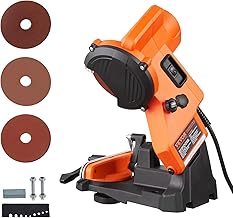
At 140 watts and 5700 RPM, this is the most powerful unit on the list and it behaves like one. The bench-mounted design locks the chain in place while the grinding wheel does precise, repeatable work on each tooth. Three wheels included, sized for chains from 0.25 inch to 0.404 inch pitch—covering the full range from homeowner bar-and-chains to pro-grade equipment. The solid steel base eliminates vibration creep, so the angle you set on tooth one matches tooth fifty. This is the pick if you sharpen multiple chains per session. Skip if you have limited bench space or only need occasional touch-ups.
- High wattage and locked-chain design produce consistent professional results
- Fits the widest range of chain pitches among motorized options here
- Bench footprint and chain removal requirement add friction for quick jobs
EzzDoo Electric Chainsaw Sharpener Kit with Diamond Bits
Instead of abrasive grinding wheels, EzzDoo uses six titanium-coated diamond bits—essentially a powered version of the round file. No chain removal is needed, and the handheld form factor means you can rotate the saw and hit every tooth without clamps or guides. Diamond coating lasts far longer than standard wheel material, so the bits stay effective through more resharpenings. The main complaint from users is that without an angle guide, consistency depends on your hand discipline. It is fast for touch-ups between major sharpenings, but a full chain restoration takes patience. Skip if you need guaranteed angle accuracy across dozens of teeth.
- Diamond bits far outlast conventional grinding wheels
- Handheld and on-chain—maximum speed for quick maintenance
- No angle guide means results depend on user technique
Electric Chainsaw Sharpener Kit 180W Multi-Purpose Rotary Tool
This is the most versatile unit here: 180 watts, variable speed from 8000 to 35000 RPM, six diamond bits, and an angle attachment. The speed range means you can run low for delicate tooth work and high for aggressive material removal on top plates. Beyond chainsaw use, it functions as a general rotary tool for grinding and DIY projects—effectively two tools for under forty dollars. The included angle attachment bridges the consistency gap that plagues the EzzDoo above. The body is lighter-duty than the VEVOR bench unit, so sustained heavy grinding may stress the motor. Skip if you need a dedicated bench solution for professional volume.
- Variable speed and six bits handle every sharpening scenario plus general DIY
- Angle attachment delivers consistency comparable to fixed-guide kits
- Lighter build shows limits under sustained heavy material removal
Honoson 3 Pieces Chainsaw File Set
Nine dollars and ninety-nine cents for three steel round files with plastic handles in 5/32, 7/32, and 3/16 inch. This is the cheapest way to keep a functional sharpening solution in every truck, shed, or barn. The steel cuts reasonably well for the price, and the handles are adequate for occasional use. It is strictly manual, so it does not compete with the motorized tools above—think of it as insurance against running out of battery or breaking a wheel mid-project. Skip if you sharpen more than one or two chains per year; your wrists and your edge quality will thank you for upgrading.
- Three common file sizes cover most residential chainsaw chains
- Truly disposable budget—replace the whole set for less than one replacement wheel
- Manual-only with no guide or angle control included
2-in-1 Chainsaw Sharpener Compatible with Stihl
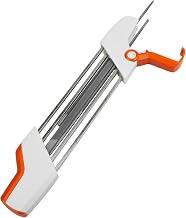
Designed specifically as a replacement for the Stihl 5605-7504-303 file holder, this 2-in-1 tool accepts 5/32 inch diameter files and maintains the correct angle for 3/8 inch pitch chain. The dual-head design lets you switch between top-plate filing and round filing without putting one tool down. Build quality is utilitarian—plastic body, functional steel guide—but the geometry is correct and that is what matters most. It is the smartest purchase if you own a Stihl and want OEM-compatible results at half the dealer price. Skip if your chain uses a different pitch or file size; compatibility is narrow.
- Exact replacement geometry for popular Stihl 3/8 inch pitch chains
- Dual-head design reduces tool swaps during filing sessions
- Narrow compatibility—only useful for the specific pitch and file diameter it targets
Buying Guide
Guide Angle Consistency
The single biggest factor separating a sharp that lasts from one that does not is top-plate flatness. Every chain tooth has a flat top plate at a specific angle—usually between 25 and 35 degrees. Motorized sharpeners with built-in angle guides or locking fixtures maintain this geometry across all teeth. Tools without guides rely on your hand, and by tooth twenty you will drift. If even-tooth results matter to your cut quality, prioritize units with a fixed angle mechanism.
Chain Removal Versus On-Chain Operation
Bench-top tools require removing the chain and clamping it into a fixture. On-chain tools sharpen directly while the chain stays on the bar. Removal gives more precision and easier access to the top plate, but on-chain wins for speed and convenience. Your workflow determines the right answer: if you sharpen at a fixed bench, go bench-top; if you touch up between cuts at a job site, choose on-chain.
Wear Surface: Wheels Versus Diamond Bits
Traditional abrasive wheels cut aggressively but wear down relatively quickly—each resharpening removes material from the wheel itself. Diamond or titanium-coated bits remove far less per pass and can handle hundreds more teeth before replacement. The tradeoff is cost per bit and initial aggressiveness: a fresh wheel clears a damaged tooth faster than a diamond point. For regular maintenance, diamond wins on longevity. For restoring badly abused chains, wheels are faster.
Our Verdict
The top pick is the 180W Multi-Purpose Rotary Tool—it combines the highest user rating on this list, variable speed control, an angle attachment for consistency, diamond bit longevity, and genuine versatility beyond chainsaw use, all for under forty dollars. For a budget manual backup that should be in every truck, the Honoson three-piece set at under ten dollars is unbeatable value. And if you run a shop with volume, the VEVOR 140W bench tool wins because nothing else here matches its locked-chain precision across dozens of resharpenings in a single session.
FAQ
How often should I sharpen my chainsaw chain?
Sharpen when the chain stops producing coarse sawdust and starts making fine powder, or when it pulls to one side during cutting. Most homeowners will resharpen after roughly five to ten hours of runtime, depending on wood hardness and soil contact.
Can a motorized sharpener damage my chain if used incorrectly?
Yes. Excessive pressure or running too long on a single tooth can overheat the steel and ruin the temper, or gouge the top plate flat when it should retain a slight angle. Always follow the included guide and use light passes rather than one heavy grinding pass.
Do I need different wheel sizes for different chains?
Yes. Chain pitch and tooth geometry vary, so file diameter must match. Common consumer sizes range from 5/32 inch to 7/32 inch. The kits that include multiple wheel or bit sizes are far more practical than single-size tools unless you only maintain one saw.
Is a cordless sharpener worth the extra cost over corded?
Only if you regularly sharpen away from an outlet—job sites, remote cabins, or a detached barn. For home users with a garage or shop, the corded version delivers identical results and removes the runtime anxiety of battery management.