What's inside
As an Amazon Associate I earn from qualifying purchases. This post may contain affiliate links at no extra cost to you.
For most ordinary wood-screw jobs, a cordless drill is easier to control and can do the work well. An impact driver is more useful when screws are long, the wood is dense, or you have many fasteners to install. It delivers more rotational force in short pulses, which helps drive stubborn screws—but those pulses can also strip screw heads or bury them too deep if you are not careful.
If you are choosing one tool, think about the screws and materials you use most, not just the tool’s maximum torque. For a small shelf, a few cabinet screws, or occasional home repairs, a drill is often the better-value choice. For framing, decking, or repeated driving of 3-inch screws, an impact driver can save effort and time.
As an Amazon Associate we earn from qualifying purchases at no extra cost to you.



What we cover
How the tools differ
A cordless drill turns its chuck continuously. You set the clutch to limit torque for driving, and the chuck holds round-shank drill bits and many screw-driving accessories. The smooth rotation makes it easier to start a screw slowly and stop at a precise depth.
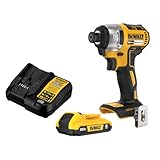
An impact driver also rotates, but when resistance rises, its internal hammer mechanism adds rapid rotational blows. These impacts help keep a screw moving when a standard drill slows or stalls. Most impact drivers use a 1/4-inch hex collet, so check that your bits have a compatible hex shank. Impact-rated bits are designed to withstand the repeated loading; ordinary brittle bits can break.
Quick comparison
| Factor | Cordless drill | Impact driver |
|---|---|---|
| Best at | Controlled driving, drilling holes, mixed tasks | Repeated or demanding screw driving |
| Control | Smooth rotation; clutch helps limit torque | More forceful; requires a light touch |
| Typical chuck or holder | Adjustable three-jaw chuck | 1/4-inch hex collet |
| Common risk | Stalling or twisting your wrist under heavy load | Stripped heads, snapped screws, overdriving |
| Also drills holes? | Yes, with suitable bits | Possible with hex-shank bits, but less versatile |
Which tool for which screws
For small screws in softwood—such as 1- to 2-inch screws in pine—a drill is usually enough. Set a low clutch setting, start slowly, and increase the setting only if the clutch slips before the screw is seated. The clutch is helpful for avoiding damage, though it is not a precise depth stop: different wood and screw sizes change how much force the job needs.
For 2- to 3-inch construction screws, an impact driver becomes more useful, especially in hardwood, dense framing lumber, or a long run of fasteners. It can keep driving where a drill would stall, but it can also twist a screw head off if the screw is binding. Use the correct driver bit, keep it fully seated, and ease off as the head approaches the surface.
For delicate work—cabinet hinges, thin trim, or screws near an edge—a drill often gives better control. A high-powered impact driver can split the wood or pull a screw below the surface before you react. Drill a pilot hole when the wood is prone to splitting, the screw is large, or the fastener is close to an edge. A countersink bit can make room for a flat-head screw to sit flush.
Choose a tool for your workload
If you own no cordless tool and expect to drill holes as well as drive screws, start with a cordless drill driver. It covers basic woodworking, furniture assembly, and household repairs without requiring a separate tool for drilling pilot holes. A drill with a 1/2-inch chuck offers broad bit compatibility; a 3/8-inch chuck is generally adequate for lighter home use.
If you already have a drill and often drive long screws, add an impact driver. It is particularly useful for decking, fence repairs, and framing, where there may be dozens or hundreds of fasteners. You can keep a drill bit in one tool and a driver bit in the other, avoiding repeated bit changes.
Compare tools within the same battery platform if you already own batteries. Batteries and chargers can add substantially to the cost of a bare tool. For occasional repairs, paying for an impact driver may not be worthwhile; a drill and a good set of bits are usually enough. For frequent work, a drill and impact driver combo kit can be a practical way to get both tools, provided the kit includes batteries and a charger you need.
Drive screws without damage
Use a bit that matches the screw head exactly. A loose Phillips bit can cam out and chew up the recess; a mismatched Torx or square-drive bit can slip or fail to seat fully. Replace worn bits before they start jumping out of the head. For an impact driver, choose an impact-rated bit of the correct type and length.
Start the screw straight and hold the tool in line with it. On a drill, begin with a low clutch setting and low speed. On an impact driver, use the lowest speed or assist mode if available, particularly for small screws or softwood. If the screw stops moving, do not keep triggering the tool. Back it out, check for a misaligned bit, a knot, or a pilot hole that is too small. For a long screw in hardwood, a properly sized pilot hole can reduce splitting and driving force.
Stop when the head is seated where it needs to be. Driving too far can crush the wood fibers, weaken the joint, or leave the head below the surface. If a screw snaps, remove the remaining piece if practical and replace it with a fresh fastener; repeating the same drive into the damaged hole may not hold securely. With either tool, use a manual screwdriver for the final adjustment when the fit or depth needs fine control.