What's inside
As an Amazon Associate I earn from qualifying purchases. This post may contain affiliate links at no extra cost to you.
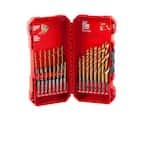
The Milwaukee Shockwave drill bit set earns its place in a woodworking kit because it solves a specific problem — standard round-shank twist bits snap under the torque spikes of an impact driver, and these don’t. The combination of a reinforced web, fast-clearing flute geometry, and a 1/4″ hex shank means you can drill pilot holes, clear waste, and run hardware with one index of bits across both a drill/driver and an impact driver. Whether it’s the right set for you depends mostly on how much metal you drill and how organized your kit already is.
As an Amazon Associate we earn from qualifying purchases at no extra cost to you.



What we cover
Why Shockwave bits survive impact-driver torque
An impact driver doesn’t spin smoothly — it hammers rotationally, delivering torque in spikes that can exceed 1,500 in-lbs on modern models. Bits usually snap for one of two reasons: the flutes bind in the hole and the spike twists the thin web apart, or the bit walks at the start and side-loads a small diameter until it shears. The Shockwave geometry addresses both:
- Thickened, tapered web behind the tip. The core of the bit is beefier where standard bits are weakest, so it flexes slightly under peak torque instead of fracturing.
- Variable-helix flute (Red Helix design). An aggressive ~35° helix near the tip tapers back toward ~15°, which pulls chips out of the hole fast. Less chip packing means less binding — and binding is what actually kills bits in an impact driver.
- 135° split point. The self-centering tip starts on contact instead of skating across the surface, which matters twice over on thin material and on the tiny sizes that snap easiest.
- 1/4″ hex shank. No chuck slippage, instant swaps between tools, and a flat-on-flat drive that can’t spin in the holder the way a round shank does.
The Milwaukee Shockwave titanium drill bits add a titanium nitride (TiN) coating over the HSS body. TiN is dramatically harder than the underlying steel and lowers cutting friction, so the edge runs cooler and stays sharp longer — especially in abrasive materials like MDF, plywood glue lines, and mild steel. It’s a coating, not a solid titanium bit, which matters for longevity (covered below).
Set configurations at a glance
Shockwave drill bits come in several counts and two main materials. Prices vary by retailer and promotions, but the market ranges look like this:
| Set | Pieces | Size coverage | Material / coating | Case | Typical price range |
|---|---|---|---|---|---|
| Compact titanium | ~10–15 | Popular sizes, roughly 1/16″–3/8″ | HSS + TiN | Slim plastic index | $15–30 |
| Mid-size titanium | 23 | 1/16″–1/2″, with doubles of the smallest sizes | HSS + TiN | Slim plastic index | $30–45 |
| Full titanium | 29 | 1/16″–1/2″ in every 1/64″ step | HSS + TiN | Slim plastic index | $50–70 |
| Cobalt Red Helix | 15–29 | Similar fractional coverage | Cobalt-alloy HSS | Slim plastic index | $60–90 |
| Packout-bundled sets | Varies | Varies | TiN or cobalt | Packout-compatible organizer | Premium of roughly $10–20 over the equivalent loose set |
The 29-piece set is the interesting one mathematically: from 1/16″ to 1/2″ in 1/64″ steps is exactly 29 sizes, meaning zero gaps. That matters for metalwork, where tap-drill and clearance-hole sizes are prescribed — a 7/64″ or 25/64″ hole has a job, and skipping it isn’t an option. For pure woodworking, three or four sizes do 80% of the work, so a mid-size set is usually the smarter spend.
If your kit rides in a Milwaukee Packout stack, look for the Milwaukee Packout drill bit set versions that ship inside a low-profile Packout organizer — the bit index locks into the same footprint as your other boxes instead of rattling loose in a drawer. The standard slim cases also drop inside Packout organizer bins if you already own the empty box.
Which sizes you’ll actually use
For woodworking
Most shop use is pilot holes, clearance holes for screws, and hardware installation. Match the bit to the screw gauge, not guesswork:
| Screw gauge | Pilot hole, softwood | Pilot hole, hardwood |
|---|---|---|
| #6 | 1/16″–5/64″ | 3/32″ |
| #8 | 5/64″–3/32″ | 7/64″ |
| #10 | 3/32″–7/64″ | 1/8″ |
| #12 | 7/64″–1/8″ | 9/64″ |
One honest caveat: the Milwaukee hex drill bit set format is built for speed and durability, not finesse. Twist bits tear fibers on entry and exit, so for visible holes in furniture work — shelf pins, through-holes in show faces — a brad-point or Forstner bit still leaves a cleaner rim. Use the Shockwave bits for pilots, jigs, shop fixtures, and construction carpentry; reach for wood-specific bits when the hole is the finished product.
For metal
The titanium set handles mild steel, aluminum, and sheet goods well. If stainless or hardened fasteners are a regular part of your work (restoration, exterior hardware, metal framing), step up to the cobalt Red Helix variants — cobalt is hard through the entire bit, not just at the surface, so it survives re-sharpening and sustained heat better than a TiN coating can.
Impact driver or drill/driver: where each bit belongs
The 1/4″ hex shank is universal — these bits fit every major brand’s impact driver and quick-change chuck, and they also run fine in a standard three-jaw drill chuck. But “fits” and “best tool for the job” aren’t the same thing:
- Impact driver: ideal for quick pilot holes in framing, deck work, and rough carpentry where speed matters and hole cosmetics don’t.
- Drill/driver: the better choice for metal (steady RPM lets you control heat and use cutting oil properly), for sizes under 3/32″ (the hammering action gives you less feel, and small bits still snap if you lean on them), and for anything where hole placement or cleanliness matters.
Rough speed guidance: a 1/4″ bit in mild steel wants around 1,000–1,500 RPM with cutting oil; the same bit in hardwood can run at full drill speed. Stainless wants roughly half the steel RPM with firm pressure — running fast and dry is the fastest way to cook the edge off any of these bits.
Durability and ownership realities
What wears first: predictably, the sizes you use most. Expect 1/16″ and 5/64″ to snap before they dull (that’s why the 23-piece set doubles them), and expect 1/8″, 5/32″, and 3/16″ to dull first from sheer volume. The TiN coating disappears first at the cutting lips — once the gold is gone at the edge, you effectively have an HSS bit, which still works but loses the heat advantage. Re-sharpening removes the coating at the tip regardless.
The math on a set: a 23-piece set in the $35–45 range works out to roughly $1.50–2.00 per bit, while equivalent hex-shank replacement singles run about $3–6 each. If the five sizes you’d buy anyway cost $20–30 as singles, the set pays for itself the first time you reach for a size you didn’t plan on — which happens constantly once you drill metal.
Care that actually extends life:
- Use cutting oil (or even a paste wax in a pinch) on steel and stainless; heat, not torque, is what dulls edges.
- Back the bit out to clear chips on holes deeper than about twice the diameter — packed flutes bind, and binding snaps bits.
- Keep bits in the index rather than loose in a drawer; edge nicks from rattling against other bits dull them before you’ve drilled anything.
- If a bit starts squealing or producing powder instead of chips, it’s dull — pushing harder only work-hardens the material you’re drilling.
Which set for which buyer
| Your situation | Pick | Why |
|---|---|---|
| Weekend DIY — shelves, deck repairs, occasional angle iron | Compact or 23-pc titanium | Covers every common size; low cost per bit |
| Woodworker installing hardware, building jigs, drilling pilots | 23-pc titanium | Doubled small sizes match pilot-hole work; pairs with brad-points for show faces |
| Remodeler drilling wood and metal daily | 29-pc titanium | No size gaps; 1/64″ steps cover tap and clearance drills |
| Regular stainless or hardened steel | Cobalt Red Helix set | Through-material hardness survives heat and resharpening |
| Truck kit built on Packout | Packout-bundled version | Index locks into your stack instead of migrating to the bottom of a bag |
FAQ
Do Shockwave bits fit non-Milwaukee impact drivers?
Yes. The 1/4″ hex shank is an industry standard — they seat in DeWalt, Makita, Bosch, Ryobi, and every other brand’s quick-change collet, as well as standard drill chucks.
Titanium or cobalt — which should I buy?
Titanium (TiN-coated HSS) for mixed wood-and-metal use — it’s the better value and the coating genuinely reduces friction. Cobalt only earns its premium if stainless, hardened hardware, or daily metalwork is in the picture.
Are these overkill for woodworking only?
Partly. If you never touch metal and never use an impact driver, a cheaper round-shank brad-point set will leave cleaner holes. The Shockwave set makes sense when one index has to serve both tools and both materials.