What's inside
As an Amazon Associate I earn from qualifying purchases. This post may contain affiliate links at no extra cost to you.
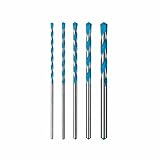
Bosch Multi Construction drill bits (also searched as Bosch multi-purpose bits) are carbide-tipped bits with a sharply ground cutting edge. They drill wood, masonry, ceramic tile, plaster, plastic and thin metal with one bit, usually in plain rotary mode. They save the most time when one hole passes through several materials, such as tile over cement board over a stud, or render over brick. They are slower than a dedicated bit in any single material, and they wear quickly in steel. Getting good results is mostly a matter of drill mode, speed and pressure, and those change with each material.
As an Amazon Associate we earn from qualifying purchases at no extra cost to you.



What we cover
What makes a multi construction bit different
A standard masonry bit has a blunt, chisel-like carbide tip built to pulverize stone under hammer action. It barely cuts wood or tile in rotary mode. A Bosch Multi Construction bit uses a carbide plate ground to a sharp cutting angle, closer to a metal-drilling point. That lets it shear wood fibers and scratch through glazed tile without hammering. The carbide also survives contact with brick and concrete.
Bosch sells these bits under several names depending on the region:
- Expert Multi Construction (CYL-9): round-shank bits in Bosch’s premium Expert range, sold widely in Europe and elsewhere.
- Hex-shank versions: 1/4-inch hex shanks for quick-change chucks. Do not use them in an impact driver’s hammering action on masonry: the impacts are not designed for this bit and chip the carbide.
- North American multi-purpose bits: Bosch’s carbide multi-purpose bits sold in inch sizes, in small sets and singly.
Drill settings by material
These settings are general starting points for an 18V/20V cordless drill or a corded hammer drill with a 1/4-inch (6 mm) bit. Halve the speed roughly for 3/8 inch and larger.
| Material | Drill mode | Speed (6 mm / 1/4″ bit) | Pressure | Notes |
|---|---|---|---|---|
| Softwood, plywood | Rotary | 1,200–1,800 rpm | Light | Exit tear-out is worse than with a brad-point bit, so back the workpiece with scrap |
| Hardwood | Rotary | 800–1,200 rpm | Moderate | Clear chips every 1/2″–3/4″ of depth |
| Glazed ceramic wall tile | Rotary only | 400–700 rpm | Light | Start on masking tape. Never use hammer mode |
| Porcelain tile | Rotary only | 300–500 rpm | Light, steady | Possible but slow. Diamond core bits are faster for porcelain |
| Plaster, drywall | Rotary | 600–1,000 rpm | Light | Rotary keeps the hole edge clean for wall plugs |
| Soft brick, block | Rotary or light hammer | 800–1,200 rpm | Moderate | Rotary gives cleaner holes. Hammer is faster |
| Concrete | Hammer | 1,000–1,500 rpm | Firm | Works for small anchor holes. Use a masonry or SDS-plus bit for many holes |
| Thin mild steel (up to about 1/8″) | Rotary | 400–600 rpm | Firm | Expect faster wear. HSS or cobalt is better for metal |
| Plastic, PVC, acrylic | Rotary | 500–900 rpm | Light | Ease off at breakthrough to avoid chipping |
How to drill through tile and into the wall behind it
This is the job multi construction bits handle best, so the steps are worth getting right:
- Mark on masking tape. Tape keeps the point from skating on glaze and gives you a surface to mark.
- Start at low speed in rotary mode. Tilt the bit slightly at first to scratch a small starting notch, then bring it square to the wall.
- Keep the bit cool in tile. On hard or thick tile, pause every 10–15 seconds or mist the spot with water. Do not dip a hot carbide tip in water, because thermal shock can crack it.
- Stay in rotary through the tile. Hammer mode cracks tiles, especially near edges and corners.
- Behind the tile, switch to light hammer only if you hit brick or concrete and progress stalls. Stay in rotary for cement board, drywall or wood studs.
- Clear the dust before inserting a wall plug, so the plug seats to full depth.
When a multi construction bit is the wrong tool
| Job | Better choice | Why |
|---|---|---|
| Many holes in poured concrete | SDS-plus bit in a rotary hammer | Far faster, and saves the sharp multi construction edge |
| Holes in porcelain over 8 mm | Diamond core bit with water | Porcelain dulls carbide fast at larger diameters |
| Steel thicker than about 1/8″ | Cobalt HSS twist bit | Carbide edges chip under steel’s interrupted cut |
| Clean visible holes in fine wood | Brad-point bit | Much cleaner entry and exit |
| Large holes in wood | Spade, auger or Forstner bit | Multi construction sizes stop well short of these diameters |
Wear, resharpening and what fails first
- The sharp edge dulls before the carbide chips. Once a bit squeals in tile or burns wood instead of cutting, the edge is dull. A diamond hone can touch up the cutting edge on larger sizes. Small sizes are usually cheaper to replace.
- Hammer mode on hard concrete rounds the sharp edge quickly and makes the bit worse for tile afterwards. Keep one bit for tile and another for masonry if you do both often.
- Overheating shows up as a discolored, bluish tip. It weakens the bond between the carbide and the steel body.
- Bending happens with long bits pushed sideways. Keep the drill in line with the hole, especially in mixed layers.
Buying sizes that match common fixings
Most multi construction sets cover roughly 4–10 mm (about 5/32″–3/8″). The sizes used most often match common wall plugs: 5 mm and 6 mm for light plugs, 8 mm for heavier plugs and frame fixings in masonry, and 3/16″ or 1/4″ in inch sets for concrete screws and plastic anchors. A small set plus a spare of your most-used size covers most bathroom, kitchen and shelving installs. A set of four or five Bosch multi construction bits typically costs in the $20–$60 range, and single bits run around $6–$15 depending on size.
Quick takeaway
Use Bosch Multi Construction bits in rotary mode, at low speed for tile and moderate speed for wood and brick, with light pressure. Switch to hammer only for small holes in hard masonry. They are the right bit when the hole crosses several materials or you want one bit in the bag. For high-volume concrete, large porcelain holes or real metalwork, a dedicated bit is still faster and cheaper per hole.