What's inside
As an Amazon Associate I earn from qualifying purchases. This post may contain affiliate links at no extra cost to you.
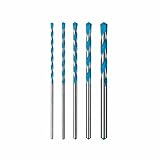
A multi-purpose drill bit set is a set of carbide-tipped bits with a sharpened, positive-rake cutting edge that can drill wood, plastic, drywall, brick, block, light concrete, tile and thin mild steel with the same bit, usually in 4 to 10 mm (5/32 to 3/8 in) sizes. It is the right buy if you hang shelves, mount TVs and fit anchors in mixed walls and do not want to swap between masonry, wood and metal sets. It is the wrong buy if you mostly drill clean holes in finished wood or a lot of steel, because a dedicated bit will cut faster and cleaner in each of those materials.
As an Amazon Associate we earn from qualifying purchases at no extra cost to you.


What we cover
How a multi-purpose bit differs from a masonry bit
A standard masonry bit has a blunt carbide tip that pulverizes stone under hammer action. A multi-purpose (also sold as multi-material or multi-construction) bit uses a carbide plate ground with a sharp cutting edge and a centering point, so it can also slice wood fibers and shave metal. That sharper grind is what lets it work in rotary-only mode on tile and steel, but it also means the edge is more fragile under heavy hammering.
| Bit type | Tip | Wood | Brick/block | Concrete | Ceramic tile | Mild steel | Hammer mode |
|---|---|---|---|---|---|---|---|
| Multi-purpose carbide | Sharpened carbide plate | Good | Good | Fair (small holes) | Good (rotary only) | Fair (thin stock) | Yes, light |
| Standard masonry | Blunt carbide wedge | Poor, ragged | Good | Good | Poor, chips glaze | No | Yes |
| HSS twist (black oxide) | Ground steel, 118 degree | Good | No | No | No | Good | No |
| Brad point | Spur and center point | Excellent | No | No | No | No | No |
| SDS-Plus | 2- or 4-cutter carbide | No | Excellent | Excellent | No | No | Yes, heavy |
What comes in a typical set
Most multi-purpose sets are small and focused on anchor and fixing sizes. The table shows common compositions and what they are good for.
| Set size | Typical diameters | Shank | Typical price | Who it suits |
|---|---|---|---|---|
| 4-5 pieces | 5, 6, 8, 10 mm (or 3/16, 1/4, 5/16, 3/8 in) | Round or tri-flat | $15-$35 | Occasional DIY: shelves, curtain rails |
| 7-8 pieces | 4, 5, 5.5, 6, 6.5, 8, 10 mm | Round or hex | $25-$50 | Homeowners fitting many wall plugs |
| 10-14 pieces | 3-12 mm or 1/8-1/2 in | Hex or round | $40-$80 | Renovators, installers working across materials |
| Long-series singles | 6-10 mm, 150-400 mm long | Round | $10-$25 each | Drilling through thick walls |
Brands that make multi-purpose or multi-material bits for the US market include Bosch (MultiConstruction), DeWalt and Irwin. Bosch’s MultiConstruction bits are the most widely known; they are designed to be used in both rotary and light hammer mode depending on the material.
Match the bit to your anchor sizes
For most people a multi-purpose set is bought to fit wall plugs. The table below gives common pairings; always follow the anchor packaging if it lists a different size.
| Anchor / plug | Hole size | Typical load |
|---|---|---|
| Small plastic plug (#6-#8 screw) | 5-6 mm (3/16-1/4 in) | Pictures, light shelves |
| Medium plastic plug (#10 screw) | 6-8 mm (1/4-5/16 in) | Curtain rails, cabinets |
| 1/4 in masonry screw (Tapcon-style) | 3/16 in (about 4.8 mm) | Ledger strips, brackets |
| Frame fixing / large plug | 8-10 mm (5/16-3/8 in) | TV brackets, heavy shelves |
Settings by material
Multi-purpose bits only last if you run them at the right speed and mode. Too fast on steel or tile and the carbide overheats; hammer mode on tile cracks the glaze.
- Wood, plywood, MDF: rotary only, medium-high speed. Back out often to clear chips.
- Drywall and plaster: rotary only, medium speed to avoid blowing out the back.
- Brick, block, mortar: hammer mode on, medium speed, steady pressure.
- Concrete: hammer mode, low-medium speed; keep holes under about 8 mm or switch to SDS-Plus bits for repeated work.
- Ceramic wall tile: rotary only, low speed, light pressure; switch to hammer only after you are through the tile into masonry behind. Porcelain is much harder and is better tackled with a diamond bit.
- Mild steel and aluminum: rotary only, low speed, a drop of cutting oil, sheet thickness up to a few millimeters.
Decision matrix: is a multi-purpose set right for you?
| What you drill most | Best choice |
|---|---|
| Mixed walls in an older house (plaster, brick, timber studs) | Multi-purpose set |
| Mostly furniture making and fine woodwork | Brad point set |
| Mostly concrete and foundation walls | SDS-Plus set and rotary hammer |
| Mostly steel brackets and frames | Cobalt (M35) twist set |
| A bit of everything, small toolbox | Multi-purpose set plus a basic HSS twist set |
Round, tri-flat or hex shank?
Multi-purpose bits are sold with three shank styles. Round shanks grip best in a keyed or quality keyless chuck and are the standard for hammer drills. Tri-flat shanks add three flats so the bit cannot spin in the chuck under load, which helps in brick. Quarter-inch hex shanks snap into impact drivers and quick-change chucks, which is convenient for anchor work in timber and drywall, but impact drivers lack a true hammer action, so they are slow in masonry. If you own a hammer drill, choose round or tri-flat; if you mostly use an impact driver, hex is the practical choice for smaller sizes.
Wear, sharpening and common mistakes
- What wears first: the carbide corners. Once they round over, holes in masonry go undersize and plugs spin.
- Sharpening: carbide needs a diamond or green silicon carbide wheel. A light touch-up on the cutting faces is possible, but most users replace the most-used sizes instead.
- Overheating: a blue tint on the steel body or a smell of burning means too much speed. Let the bit cool in air rather than quenching it in water, which can crack the brazed carbide.
- Hammering tile: the most common cause of cracked tiles. Drill through the glaze first in rotary mode.
- Hitting rebar: stop. Multi-purpose bits can chip on embedded steel; use a rebar cutter bit or move the hole.
Wear safety glasses and a dust mask when drilling masonry and tile, and use a detector to check for cables and pipes before drilling into walls.