What's inside
As an Amazon Associate I earn from qualifying purchases. This post may contain affiliate links at no extra cost to you.
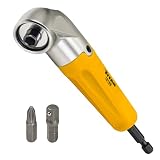
If you want a Ryobi right angle impact driver, the real choice is between a dedicated angle-head impact tool and the cheaper ways to drive fasteners at 90 degrees on the Ryobi 18V ONE+ platform: an impact-rated right-angle attachment on a standard Ryobi impact driver, the ONE+ right-angle drill, or a ONE+ ratchet. For occasional cabinet, joist and engine-bay work, the attachment or right-angle drill usually wins on price; a dedicated angle impact only pays off when you drive many tight-space fasteners every week.
As an Amazon Associate we earn from qualifying purchases at no extra cost to you.

What we cover
Why People Want an Angle-Head Impact Driver
A standard 1/4-inch hex impact driver is roughly 5 to 6.5 inches from bit tip to back of the housing once a bit is installed. Between joists on 16-inch centers, inside a sink base cabinet, behind an appliance or under a vehicle dash, that length simply does not fit. A right-angle head turns the drive 90 degrees so the tool body lies along the gap, and the impact mechanism keeps reaction torque off your wrist when a lag or long screw seats.
Your Four Options on the Ryobi ONE+ Platform
| Option | Approx. head height with bit | Usable torque range | Best for | Typical 2026 cost |
|---|---|---|---|---|
| Standard Ryobi impact driver + impact-rated right-angle attachment | ~2-2.5 in | Moderate; attachment limits peak torque | Occasional cabinet and appliance work | $25-$60 for the attachment |
| Ryobi ONE+ right-angle drill (3/8 in chuck) | ~3.5-4 in with short bit | Low-moderate, no impact | Drilling pilot holes and small screws in tight spots | $60-$120 tool only |
| Ryobi ONE+ 3/8 in ratchet | ~2-2.5 in | Low powered torque; hand-finish higher | Nuts and bolts in engine bays, appliances | $60-$130 tool only |
| Dedicated cordless angle impact driver | ~2-3 in | Moderate to high for its size | Daily tight-space fastening: HVAC, cabinet installs, decking under rails | $120-$300 tool only |
Dimensions vary by model and bit length. A 1-inch insert bit in a quick-change chuck gives the lowest profile; 2-inch power bits add height.
Torque Reality Check
Straight Ryobi ONE+ HP brushless impact drivers are commonly rated in the roughly 1,800-2,300 in-lb range, with lower settings for small screws. Angle tools give some of that up because the bevel gears in the head are smaller and must survive impact loading. Here is how that translates to real fasteners:
| Fastener job | Torque demand | Right-angle attachment | Right-angle drill | Dedicated angle impact |
|---|---|---|---|---|
| #8 x 1-1/4 in cabinet screw | Low | Easy | Easy | Easy |
| #10 x 3 in construction screw in pine | Moderate | Yes, with pilot in hardwood | Struggles | Yes |
| 1/4 x 3 in lag into joist | Moderate-high | Borderline; may slip or overheat | No | Yes in most cases |
| 3/8 x 4 in lag | High | No | No | Pilot hole required; slow |
| Hex bolts on brackets (with socket adapter) | Varies | Light bolts only | No | Yes for small bolts |
For 3/8-inch lags and larger in tight spaces, a compact impact wrench or a hand ratchet is a better tool than any angle-head driver.
Decision Matrix
| How you work | Recommended setup |
|---|---|
| DIY, a few tight spots per year | Impact-rated right-angle attachment on your existing Ryobi impact |
| Drilling more than driving in cabinets and joists | ONE+ right-angle drill |
| Auto, mower and appliance repair | ONE+ ratchet plus a short socket set |
| Installer driving dozens of tight-space screws a day | Dedicated angle impact driver |
| Already on Makita or Milwaukee batteries | That brand’s angle impact rather than adding Ryobi packs |
Choosing a Right-Angle Attachment for a Ryobi Impact
Because Ryobi impact drivers take standard 1/4-inch hex shanks, any impact-rated right-angle attachment will fit. Look for:
- Impact rating on the packaging. Drill-only angle adapters strip or crack under impact loads.
- A magnetic or locking hex socket so bits do not fall into wall cavities.
- A rotating side handle or grip ring to resist reaction torque.
- Compact head height around 2 inches if you work between studs or inside cabinets.
DeWalt and Milwaukee both sell impact-rated right-angle attachments with standard hex shanks, and they work in any brand of impact driver.
Technique for Tight-Space Driving
- Pre-drill hardwood and any lag over 1/4 inch. Angle heads have less torque headroom than straight drivers.
- Start on the lowest speed or a precision mode until the screw bites, then increase.
- Brace the head with your off hand; the attachment will try to rotate opposite the bit.
- Stop impacting as soon as the fastener seats. Extended hammering heats the gear head and can loosen attachment housings.
- Use short, high-quality impact-rated bits; long bits flex and cam out in awkward angles.
Durability and Maintenance
- What wears first: the bevel gears and the bit retention in right-angle heads, especially when used near their torque limit.
- Heat: if the head is too hot to hold comfortably, let it cool. Heat breaks down the grease and accelerates gear wear.
- Cleaning: blow dust out of the head and wipe the hex socket; drywall and sawdust in the bit socket cause wobble.
- Batteries: a compact 2Ah ONE+ pack keeps weight and length down; save 4Ah+ packs for straight driving.
Bottom Line
Most Ryobi ONE+ owners get the angle-driving ability they need from an impact-rated right-angle attachment on the impact driver they already own, with the ONE+ right-angle drill or ratchet covering drilling and bolts. Spend on a dedicated angle impact driver only if tight-space fastening is part of your daily work, and match it to the battery platform you already run.